#12: Home and home run robberies
Plus: Aaron Nola on his favorite hobby
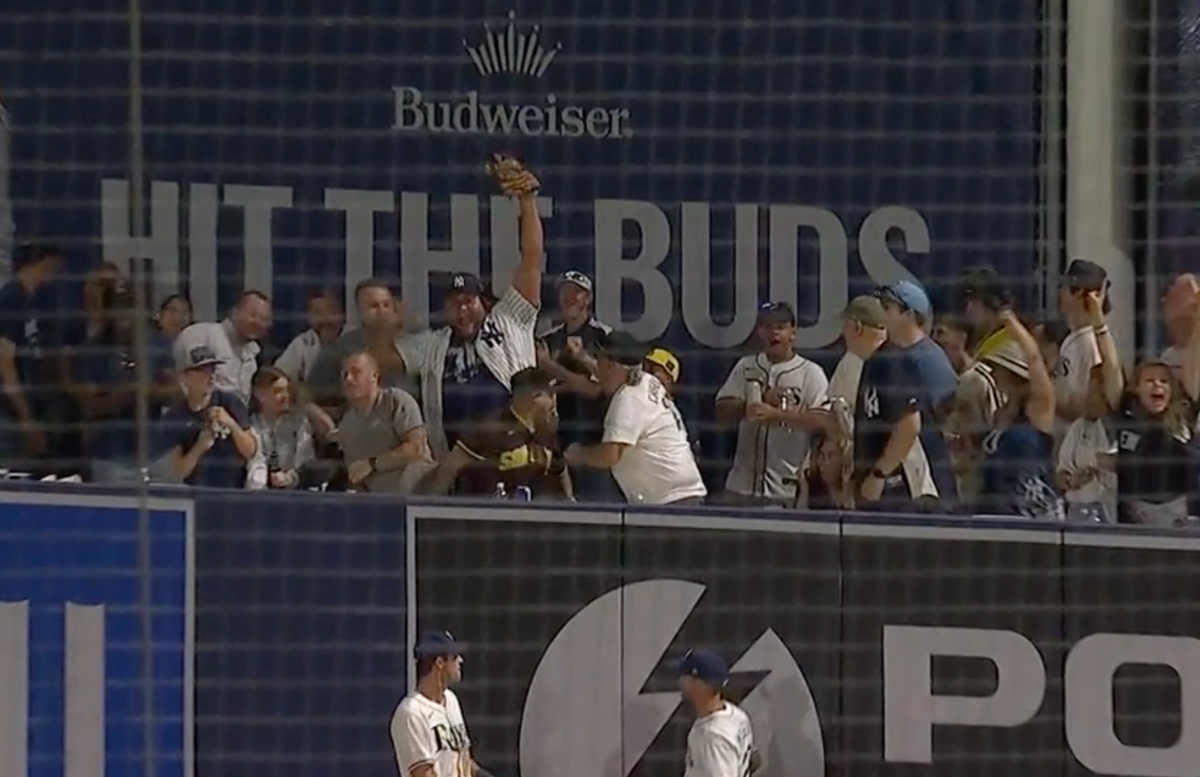
Which team, would you say, was at home? The Yankees — whose utility man hit this homer soundtracked by the crescendo of anticipation and the pop of joy? Or the Rays, whose promising young star hit this dinger that inspired maybe a murmur?
The answer is both of them, obviously.
Hey, it’s Zach, and I couldn’t help but marvel at how utterly unremarkable it felt Thursday when the visiting New York Yankees faced the displaced Tampa Bay Rays, in Tampa, at the Yankees’ park. The whole arrangement, whereby the Rays are playing their 2025 home games at the Yankees’ spring training home, is the makeshift solution to an unfortunate situation. Strong winds from Hurricane Milton severely damaged Tropicana Field, so MLB and the Rays adapted their division rivals’ spring park.
Rays pitcher Drew Rasmuseen told reporters, “We are grateful and thankful to them, which is a funny thing to say, for allowing us to use the facility. But as far as the regular season goes, this is our home, not theirs.”
So Thursday night, the Yankees arrived and went to the visiting clubhouse, the park’s New York paraphernalia papered over in a way the crowd’s allegiances could not be. And Yankees manager Aaron Boone was asked who knows how many times: How does it feel?
From what I can tell, he said it was “definitely a little bit odd” and “quite odd, honestly.”
I’d counter that it might not be odd at all.
“Unfortunately, it is very similar to Tropicana Field sometimes," a Rays supporter told ESPN. "There would be more Rays fans if it were Tropicana Field, but not necessarily more than the Yankees.”
Wait, hold on, that was not about Thursday’s Rays-Yankees game. It was about a Rays-Yankees game in September 2017 that was played at Citi Field in New York — also with the Rays as the home team, also due to a hurricane. When the Rays achieved their on-field breakthrough in 2008, it boosted their average attendance. Yet a September series against the also-ran Yankees at Tropicana Field actually drew fewer fans than a set one year prior, the New York Times reported, “suggesting that the market may prefer that the Yankees contend, not the upstart Rays.”
The Yankees have made spring appearances in Tampa and the surrounding area since the days of Babe Ruth. Their spring park turned divisional destination dates to 1996, two years before the Devil Rays franchise was born. And their reputation dates back to, well, the days of Babe Ruth. Combine the longstanding foothold and cultural cachet with heavy migration from New York and New Jersey to the Tampa-St. Petersburg metropolitan area and the prominent pinstripes aren’t much of a surprise. By the crowd method of measurement, the Yankees are probably at home for three-quarters of their games each season.
The Rays ownership group, meanwhile, has a) installed a highly successful, widely respected baseball operations group that consistently contends on a shoestring budget and b) failed or outright refused to do the obvious thing that might help expand that budget: Build a physical home for their baseball club that anyone in the region wants to go to. They constantly have an eye on the door — you might remember owner Stu Sternberg floating the idea of splitting the team between Montreal and Tampa — and their identity has come to reflect it.
Players come and go, but the thing is, they like the Rays organization. They tend to get better there. The team’s churn is more of a trademark than anyone on the actual roster, but the experience is often a net positive for those brought in and sent out.
There is real emotion and connection involved, but it’s unclear whether it has anything to do with the slightly elevated outcomes that differentiate the Rays from teams with beautiful, centrally located local shrines to the American pastime. Home teams in MLB win 52% to 54% of their games every year, like clockwork, with the only definite advantage coming from pitching first and batting last.
Home might just be the bottom line, in the box score and elsewhere, too.
The art of a meaningless robbery
by Hannah Keyser
The Phillies lost the game that started with the Edmundo Sosa home run robbery. In fact, Sosa himself botched a routine fly ball a few innings later. In his first professional start in the outfield, Sosa, playing in left, was trying to tell center fielder Johan Rojas to catch the ball. But since outfielders usually only yell to call for the ball themselves, Rojas thought Sosa was calling him off. It was the kind of mistake indicative of his inexperience with the position. Which, if you think about it, just underscores how impressive robbery really was.
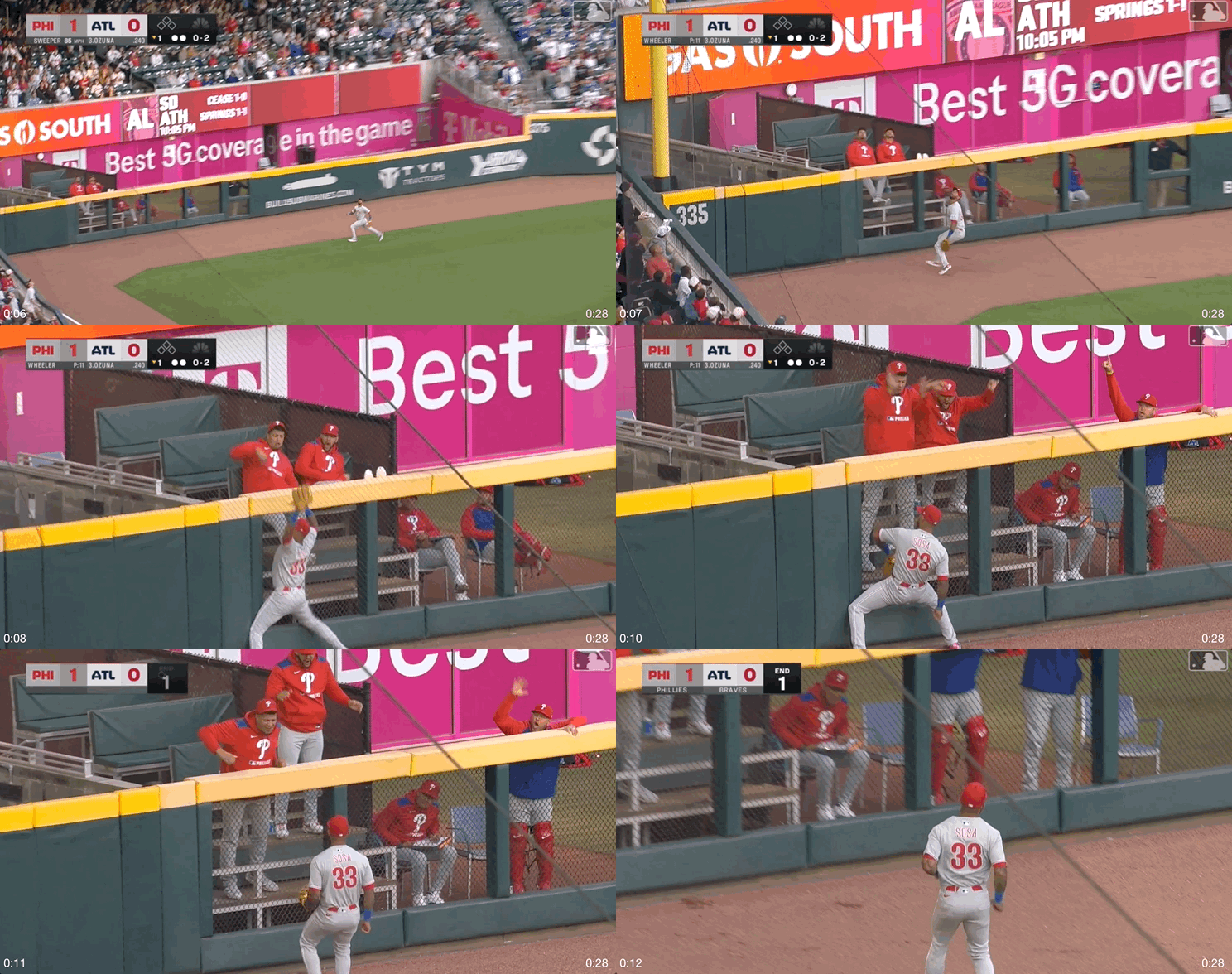
I am sort of obsessed with this play. I’ve watched it at least a dozen times in the 10 days since it happened for the very simple reason that is: I enjoy it! It is athletic and entertaining and single-handedly affects the final score of the game. Put it like that and I’m basically describing the whole point of baseball. To steal a Sam Miller-ism, if the rest of the season is very very boring otherwise, it might even rank among the things I’ll remember from 2025. Certainly, it’s one of the few individual plays I have committed to memory so far.
And yet, ultimately, it didn’t matter. If the Phillies win the World Series this year, I doubt it will feature in any future highlight reel from the season. Or maybe it will, on the assumption that most people won’t remember it was in the first inning of an early April game that they went on to lose.
Of course by that logic, most of baseball isn’t worth watching. Since we do anyway, I was utterly charmed to learn that the robbery had mattered — and to an entire Central American country.
“Panama, specifically, went crazy. They were really happy about it,” Sosa told me this week through Phillies interpreter Diego D'Aniello. “It felt like we had won the World Series. It was really an amazing thing, what happened in Panama. In the moment, I didn't know that the play was going to be so impactful, until I realized that on social media. And especially in Panama, everyone saw it, identified with the play. So a lot of people texting, a lot of people talking about the play. It just felt awesome.”
He even uses the word impactful, and why not? Art can be impactful and no one wins at that either.
Sosa said that during batting practice he noticed the short wall. Still, while shagging flies before the game, “I was even afraid of hitting the wall. But, you know, I think it's the adrenaline that comes from the game itself that helps you with that.”
During the game, Sosa didn’t think much of the catch. He didn’t watch it back or save the baseball. (“I've made good plays before on the infield,” he said, “At the moment, I thought it was just another routine play.”) It wasn’t until he got back to his hotel that he saw how excited his wife and his mom were and started scrolling on social media.
“I see everyone is posting the video, tagging me. Everyone's hyped up. And I'm like, wow, it was really that good.”
It was! A joyous expression of physicality. Sosa manages to manifest both disbelief at himself and the confident swagger of having stolen a run from the division rivals in the milliseconds that follow the catch. He looks like an action figure come to life. Captain Panama, maybe.
“We're 4 million people. We're not that big of a country,” Sosa said. “So it makes it even bigger when you get to represent your country, and all those beautiful people behind it — all the people that follow us and tag us, that are watching our careers, watching our games, following us closely. You feel proud of representing them, and you feel like you're representing them whenever you're on the field. That's what we play for. We played not only for the name in our jersey, but also for the people who are behind us in our country.”
Rooting Around: Aaron Nola
On Fridays we do a segment dedicated to what we’re fans of *other* than baseball. This week I asked Philadelphia Phillies starter Aaron Nola what he’s a fan of and after establishing that he doesn’t watch TV or listen to much music, we found something:
Nola: I like fishing. I watch fishing.
Bandwagon: What is there to watch?
Nola: Like Bassmaster Classic. When I do have a TV on, like in Atlanta in the clubhouse, they had fishing on, so I was watching that a little bit.
Bandwagon: So no music, no TV shows, just fishing.
Nola: Yeah, I don’t want TV anymore.
Editor’s note: I feel like I need to mention that Nola has a young daughter, Scottie, who recently turned one and is probably keeping him fairly occupied away from the field.
Nola: She doesn't really watch TV because we don't really put the TV on. Honestly, it's just the Yule Log. We just put like a fireplace on or jazz music on the Yule Log [on the TV].
Bandwagon: Do you have hobbies? You fish, right?
Nola: I used to fish a lot. I don't fish as much anymore. I used to make fishing rods and fish a lot.
Bandwagon: You made rods? Did you sell them?
Nola: No. When I got hurt in 2016 at the end of the year, I was in Clearwater when I was rehabbing. I just went down to Orlando and bought a bunch of fish and stuff and started making rods. I just had so much time.
I bought a van in 2020 and I built it out, so that’s how [my wife] Hunter and I travel. At the end of the season, we travel from here to Georgia, or wherever. So, that’s been kind of my hobby for the past four years.
What we’re chatting about
- Didn’t mention it in the opening but, the Yankees won that game last night as Ben Rice — a catcher turned DH who has exploded into a power-packed leadoff man — roped four more hits. The Athletic has a fun story about how the Yankees scouted the Dartmouth product, currently producing elite Statcast metrics, pretty much blind of all data because of the pandemic. —ZC
- Over on the Effectively Wild feed (a must-listen pod that, full disclosure, I’ve appeared on a couple times, much to my great honor) Ben Lindbergh is publishing a three-part audio documentary about Ella Black, whom Ben describes as “the first woman to write about baseball for a national publication — if her name was Ella Black, and if she was a woman.” It’s as rigorously reported and scrupulously detailed in scope as you would expect from Ben and EW, but lively and narrative. The MLB season is so dense that it can be easy to forget that there are ways to engage with baseball — as both a content creator and consumer — outside coverage of the games themselves. –HK
- “Something bit [Patrick Corbin], but [he] still [doesn’t] know what.” What?! “It’s just kind of just something that’s really strange.” Indeed! –HK
- This week in Pirates: Tommy Pham got thrown out at first by the left fielder. —ZC
- “I'm Bronny James.” That’s a quote from Brewers general manager Matt Arnold. I encourage you to guess what he’s talking about before clicking through to find out. —HK
Here’s something cool
Hannah here. I went on Tipping Pitches this week and we had so much fun talking about what is and is not (mostly not … but again! In a fun way!) bringing us joy this baseball season that I ended up eating dinner mid-pod because the conversation stretched on so long. I trust they edited out the eating sounds so I fully endorse giving it, and all their other episodes, a listen. To that end! The Tipping Pitches fellas were kind enough to offer Bandwagon readers a chance to experience their Patreon content along with the primary feed. This link will give you access to one free month of the “Alex Rodriguez VIP Club tier”! Sounds fancy. You can listen to the episode I just appeared on, as well as the entire back catalogue of more than 30 bonus episodes. There is literally no reason not to do this!