#4: Zach says the Astros won the Kyle Tucker trade
I should note, he didn't write that headline. Plus: torpedo bats, obviously
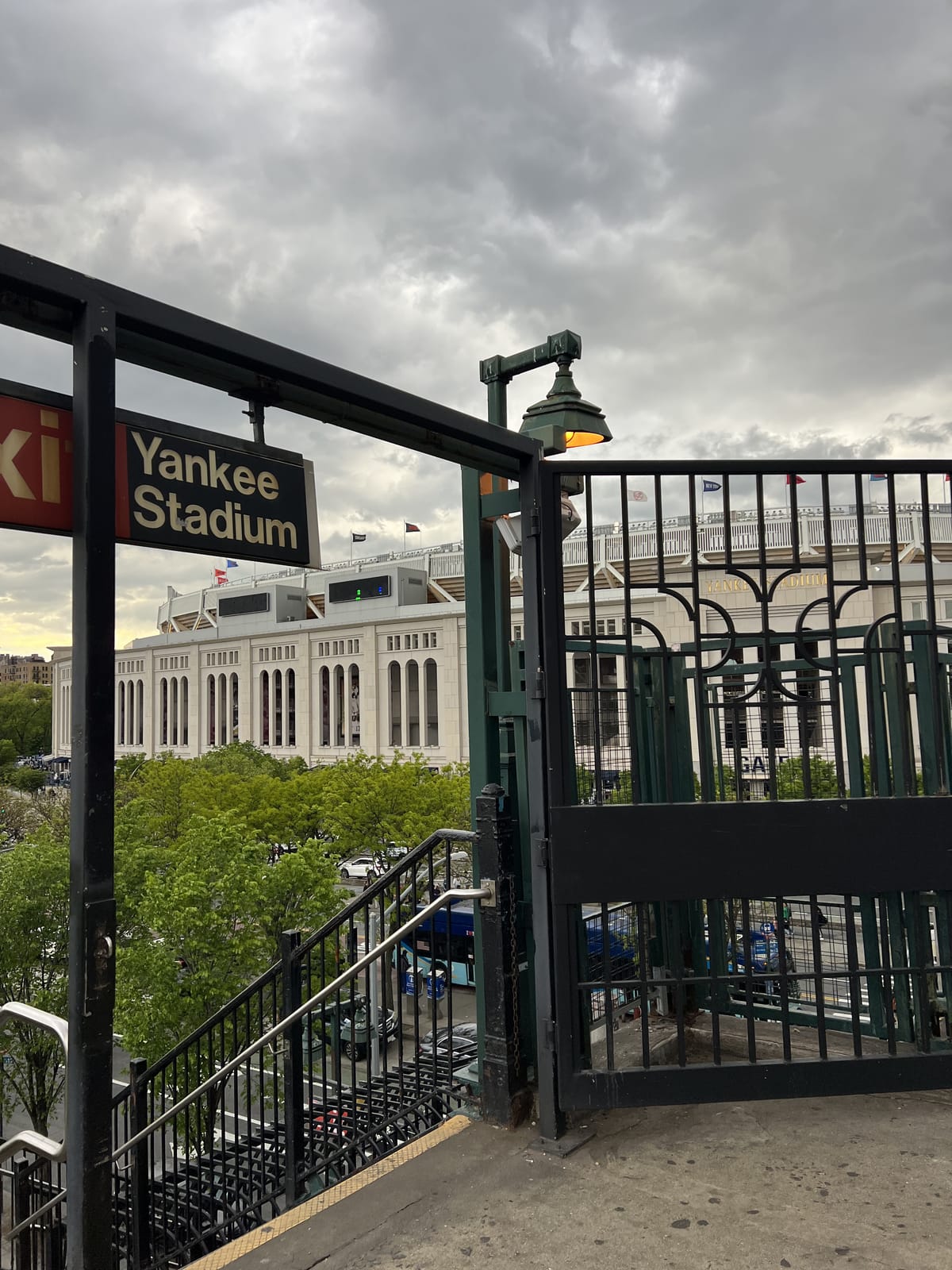
The bats are too good, folks. Hannah here and I know we said we weren’t going to just regurgitate the headlines, but everyone is obsessed with the bats that are not bigger, per se, but are more shapely in all the right places. They’re Rubenesque.
The first weekend of the baseball season gave us our first unexpected storyline to sweep the sport. The Yankees are using bats shaped like a brontosauruses according to Monty Python1 and now they simply can’t stop hitting home runs. I assume no one is more thrilled with this news cycle than Nestor Cortes.
As plenty of people not named Trevor Megill2 have quickly pointed out, the bats are perfectly legal. They were developed, at least in large part, by a former physics professor turned Yankees analyst turned current Marlins field coordinator Aaron Leanhardt.
“The bat speed should stay the same,” he told The Athletic. “Maybe the bat speed can even increase a little bit depending on how you want to redesign the bat. But ultimately you’re getting a fatter barrel, a heavier barrel at the sweet spot. So in some sense, you can have your cake and eat it here too. You can get some gains without actually making sacrifices.”
According to MLB.com, “Jazz Chisholm Jr., Cody Bellinger, Paul Goldschmidt and Austin Wells are among the Yankees swinging ‘Torpedo’ bats.”
But the Yankees aren’t the only ones who want to eat cake and hit dingers.
Junior Caminero of the Rays uses one. Ryan Jeffers of the Twins is using one. Adley Rutschman — and his 267 OPS+ through three games — is using one as well.
“I think it’s pretty good business right there, right? Where you hit the ball, put some more mass in the sweet spot,” Orioles hitting coach Cody Asche told the Baltimore Banner. “I think that’s not something that’s unique to the Yankees. I think a lot of teams are doing that around the league. They may have some more players who have adopted it at a higher rate, but I think if you’re around clubhouses, all 30 teams, you would see a guy or two who’s adopting a bat that is fashioned maybe more specifically for their swing.
(Sig Mejdal, the NASA researcher turned Orioles assistant GM, was apparently involved in the development for Baltimore. The whole thing is especially notable because technological advancements have vastly favored pitching in the recent baseball past.)
Meanwhile a scout tells me, “I bet everyone knew about them on the player/coach side” prior to this weekend.
Yet somehow, Michael Kay broke this story in the middle of the broadcast.
It’s not that hard to figure out why the bulge-y bats are blowing up now3. The Yankees’ 15 home runs through their first three games ties a major league record. But it’s a little surprising that this never came up in the course of people reporting on spring training4. What’ll be interesting now is whether the Yankees’ high-profile success with the torpedo bats is influential within the game. It’s absolutely going to get asked about in every clubhouse this week. Ostensibly we all know it’s just a small sample, but will players who eschewed the innovation before be more motivated to take it for a swing now?
If only because it’s so … exciting to see your … barrel look bigger than you’re used to it looking. Seeing your barrel so big, it just gives you confidence. Hard to not be confident with such a big … barrel.
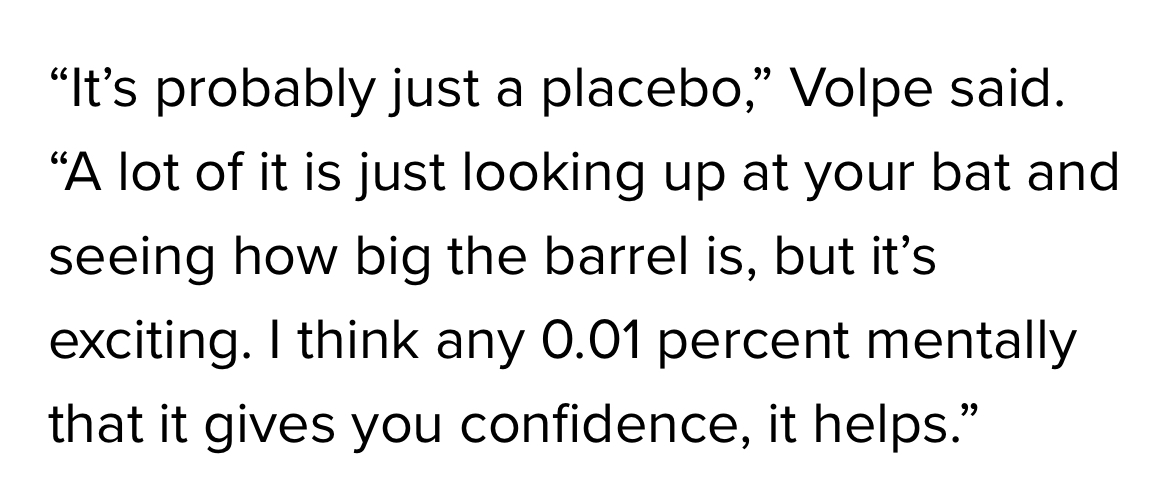
(I’ve heard manscaping does the same thing.)
I think I like the Astros’ end of the Kyle Tucker trade?
by Zach Crizer
Twice this offseason, after trading Kyle Tucker away to the Chicago Cubs, Houston Astros general manager Dana Brown invoked a pet phrase that betrayed an awareness of how these swaps usually turn out.
“Make no mistake,” he said shortly after making the deal, “we’re still going to compete. This is probably one of those moves that, in the future, people will see and understand like, ‘Yeah, wow, I understand it now. I get it.’”
This month, as headlining prospect Cam Smith bashed his way onto the Opening Day roster in Tucker’s right field spot, the hypothetical mistake had shifted in Brown’s favor.
“Make no mistake,” he told a Houston radio station of Smith’s chances despite having been drafted less than a year ago. “I’m not afraid to put this guy in the big leagues. We’re having these discussions right now. This guy is really good.”
An all-around star with power, plate discipline and baserunning chops, Tucker will be a free agent after the 2025 season, and instantly becomes the best player a Cubs team that has struggled to find a gravitational force in the lineup. The Astros — who under owner Jim Crane have declined to commit long-term money to keep George Springer, Carlos Correa and now Alex Bregman — saw the dollar signs on the wall. For the first time in this era of contention, they decided to attempt the dangerous maneuver of selling one year of a superstar-level talent.
In return, they acquired third baseman Isaac Paredes, back-end starting pitcher Hayden Wesneski and Smith.
These sorts of deals are never fan friendly. They acknowledge that ownership doesn’t have any interest in investing in a good player because said player will be expensive. Yet they have become a regular occurrence. The recent history of the gambit begins with the Boston Red Sox sending away Mookie Betts. It was an unmitigated disaster for the team on the field and in the public eye, but the Francisco Lindor and Juan Soto trades nonetheless followed.
The initial calculus is similarly disappointing, but the execution has shifted since Boston’s boondoggle. With the Tucker trade, I’ve found myself feeling downright optimistic about a seller’s side for the first time. Is there a good reason to like the end result of a fundamentally bad idea? I think there might be several.
- Cam Smith is already here
Smith was the 14th overall pick in last year’s MLB draft out of Florida State, but the future-focused headliner of the Astros’ return spent March asserting himself as not just a piece of the Tucker return, but as his direct replacement. That culminated in Astros manager Joe Espada’s tear-jerking (at least for Smith) announcement that Smith did, indeed, make the club.
A massive 22-year-old who played third in the Cubs organization, Smith was arguably the most enticing prospect moved in any of the deals even before he took the field this spring. His preseason prospect evaluations matched Soto-turned-Dylan Cease trade bait Drew Thorpe atop the list at Baseball Prospectus, and tied with Thorpe and Betts return infielder Jeter Downs at FanGraphs.
Then spring happened. Smith was one of the best hitters in spring training action. Maybe the only thing more eye-popping than his .342/.419/.711 line is the pronouncement teammate Mauricio Dubon made to The Athletic’s Chandler Rome.
“You can quote me on this: When he figures it out, when he has an idea of what they’re going to do to him in the big leagues,” Dubon said, “I think he’s going to be the next 60-homer guy.”
Now, a great spring training is far from a guarantee of success — Smith is making the leap from Double-A and had only 20 plate appearances there — but his level of play clearly changed Brown’s thinking. Brown, who previously oversaw the Braves’ farm system, has a track record of pushing surging prospects to the majors quickly. If anyone was going to find out what Smith can do in 2025, it was him.
- Isaac Paredes is a more surefire talent than sellers usually get
Using the Steamer system at FanGraphs, I checked the preseason projections for every player involved in the Betts, Lindor, Soto and Tucker trades — which are distinguished by being the only deals in the span involving contract year hitters charted for 4 or more Wins Above Replacement.
Paredes, the pull-power specialist the Cubs sent back to Houston, has the best projection of any player in a return. Prorating for 500 plate appearances or 160 innings pitched, Paredes is the first player sent back in one of these deals to crack a 3 WAR projection. He’s also the first return player with an All-Star selection already on his resume.
He tops the likes of:
- Alex Verdugo (prorated 2020 projection: 2.7 WAR)
- Andres Gimenez (prorated 2021 projection: 2.3 WAR)
- Amed Rosario (prorated 2021 projection: 2.4 WAR)
- Michael King (prorated 2024 projection: 2.3 WAR)
A big part of this whole equation is nailing the acquisition to capture someone who becomes greater than his projection, like King’s breakout 2024 that earned him Cy Young votes. But Paredes is more established than any of his predecessors, and solved the Astros’ third base hole as they stood idly by and let Alex Bregman go to Boston. With Houston’s advantageous Crawford Boxes in his sights, it’s not out of the realm of possibility that Paredes could match Tucker’s production on his own.
That Houston nabbed him to slide into their lineup along with the potential of Smith, all for for a less stratospheric player than Betts, Soto or Lindor, is a sign that the usually dubious superstar sell-off math might work out better for them.
- The Cubs haven’t managed to secure Tucker long-term
This doesn’t change anything for the Astros, of course, but the Cubs’ inability to sign Tucker beyond 2025 highlights the gambles at hand.
The Cubs are putting a lot of chips on Tucker changing their place on the win curve right away, for one season. It worked out, in a way, for the 2024 New York Yankees. They got over the hump and reached the World Series with Soto before he decamped for Queens. Chicago has the perk of a winnable division, sure, but there’s less evidence the Cubs are near the hump, much less about to surmount it.
The Astros, meanwhile, appear to have two good bets down on players who could extend a competitive window that Crane has claimed “will never close.” Maybe, against all recent history to the contrary, they made no mistake.
What we’ve been chatting about
Friend-of-the-’stack Lindsey Adler has a piece in the New Yorker about elbow injuries that quotes frequent Tommy John surgeon Keith Meister extensively. He says that sweepers create “very recognizable tear patterns” that he can identify on and MRI and that, when he gave a presentation to the Professional Baseball Athletic Trainers Society, “I showed one part of M.L.B.’s report on injuries, and then I showed a picture of a guy with his head in the sand.” But what stood out most to me was the unregulated sphere of youth baseball. Now I’m going beyond the scope of Lindsey’s piece, but I think there’s a general sense that goes: parents who push competitive travel teams and pitching specialization on their kids are bad while parents who encourage kids to just play catch in the backyard with their friends are good. While directionally, I buy that wholeheartedly, I’d love to hear more about what seems like a genuine conundrum from people who are navigating this dynamic from a more personal perspective. —HK
There were a handful of stories written about the transformation of Steinbrenner Field from a Yankees spring training park to the Rays home stadium for this season and my favorite detail I saw was abut the Rays groundskeepers practicing pulling tarp. —HK
“Moeller said his crew helped pull out the tarp twice this spring, good practice for when the games matter. Tropicana Field, unsurprisingly, has never housed a tarp.”
Improvisational defensive play is a very fun way to end a game. —ZC
More impressive feat by a pitcher on Sunday: Nick Martinez no-look, behind-the-back catch on a comebacker or Ryne Nelson RBI pinch hit? —HK
In case you’re not done with prediction szn, here division picks and award picks from Zach at Opta Analyst, and an array of predictions from Hannah at The Guardian.
“thin at one end, much, much thicker in the middle, and then thin again at the far end.” ↩
He claims to have been “misquoted”. But more importantly from that story, Brewers manager Pat Murphy said. “My old ass will tell you this for sure: It ain’t the wand, it’s the magician.” Hope that means he’s an Aubrey Plaza fan. ↩
And they are — this story has broken the baseball confinement so now casual fans are texting me about this and the AP’s Instagram explainer posted to 1.4 million followers is attracting comments like “This explains why they had a terrible draft. They spent all the payroll money on new bats.” ↩
If it did, if someone wrote about this prior to this weekend, please let me know! ↩