An early spring training study guide

Good morning from the middle of a blizzard, it’s going to feel especially notable that baseball is on TV today.
As promised in last week’s essay on the rise of game-calling from the dugout, I’ve got bonus bits and bobs for you today, with a full edition coming in the middle of the week.
This was sent using Ghost, The Bandwagon’s new platform, so if you’re seeing it as usual, great! I’m hoping the transition from Substack went seamlessly, but if you notice anything amiss with delivery or design, please let me know by emailing me or commenting on this post.
The part where I ask for your support
This is a project by and for the passionate. It's totally free to read, but it's far from free to create. It’s undertaken on mornings, nights and weekends, in the spaces between life and my actual full-time job, on trains and planes and scribbled notes in the middle of the day.
If you enjoy the work here, please consider pledging your support. You can:
- Become a Fan for just $4 a month or $40 a year.
- Become a Diehard supporter for $8 a month or $75 a year.
- Offer a contribution in the amount of your choosing. (Perhaps $26 as part of The Bandwagon's pledge drive for '26?)
I recognize the building subscription creep, the proliferation of good writers operating (and charging) independently in this unforgiving industry. I don’t expect The Bandwagon to be your only destination for following baseball; I envision it as a guided tour to make everything else more engaging, to make the emotional investment more enriching. I've tried to make the endeavor of supporting it as simple and open as possible. Anything you can contribute will help sustain the project and raise its ambitions.
The Bullpen
⚾⚾⚾⚾⚾⚾⚾⚾⚾⚾⚾⚾⚾⚾⚾
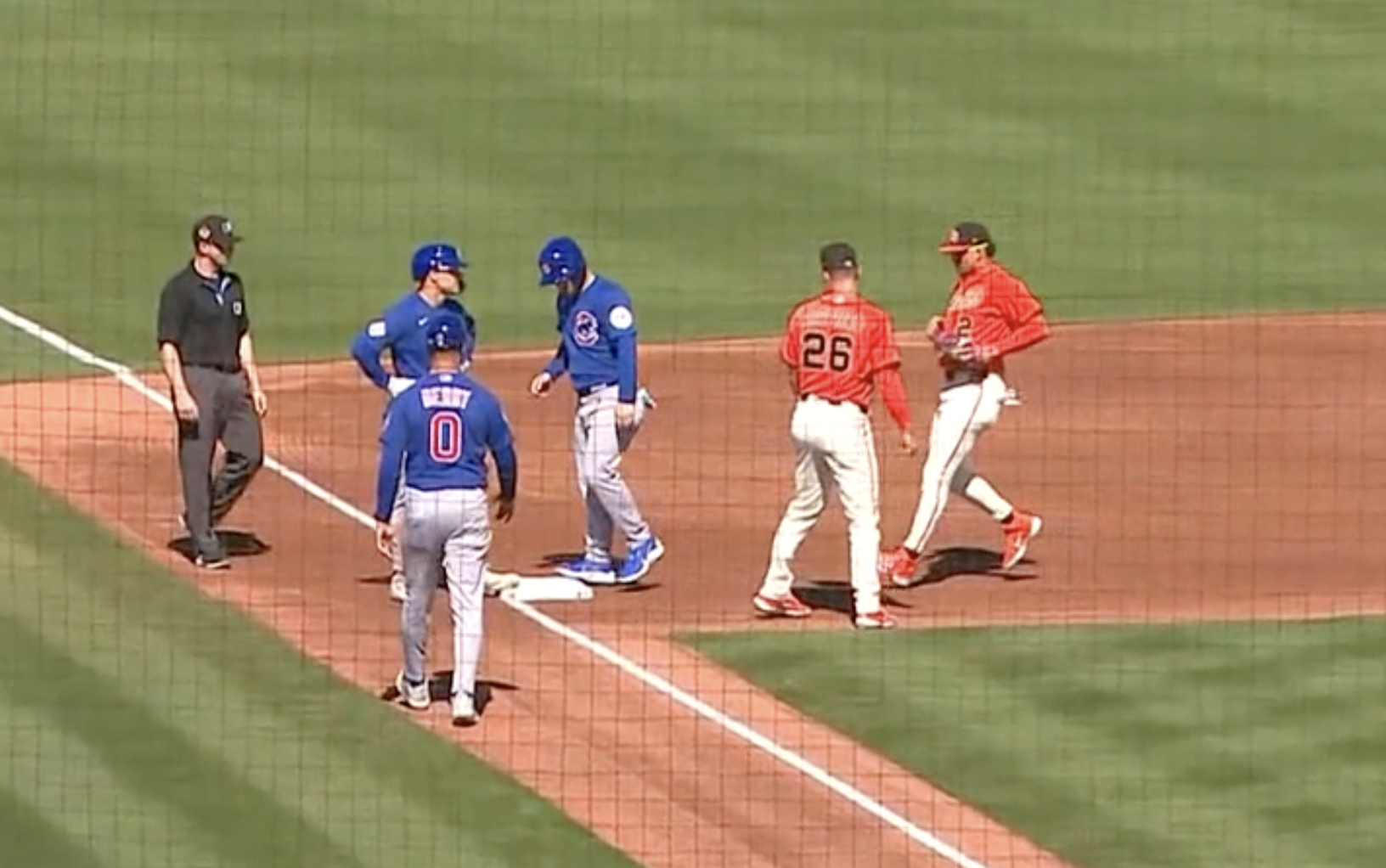
It's time for a little spring training study guide. Perhaps ... the Cubs should first take a good look at the rules of force outs to avoid running into any further triple plays.
⚾⚾⚾⚾⚾⚾⚾⚾⚾⚾⚾⚾⚾⚾⚾
The biggest roster domino still wobbling as spring training games begin isn’t a free agent, but a guy who seems like he should have a clear job near the top of a contender’s batting order. And yet …
Isaac Paredes projects as the second-best bat on the Astros, behind only Yordan Alvarez, by both PECOTA and FanGraphs’ depth charts. A prize of the Kyle Tucker trade who bopped 20 homers with a 128 wRC+ (meaning 28% better than the average MLB hitter) in 102 games last season, Paredes is being squeezed off of his usual third base position by virtue of Houston acquiring Carlos Correa at last summer’s deadline. Pair that with Christian Walker’s subpar trade value, Jose Altuve’s return to second base and Paredes’ own middling defense, and you have a conundrum that could end with Paredes on another team.
It’s true that Jeremy Peña and Correa make for a far better left side of the infield defensively, but the Astros are not in such a strong position that sacrificing Paredes’ offense makes a ton of tense. The Athletic’s Chandler Rome reported the club had a framework to deal Paredes to the Red Sox at one point, before that apparently fell apart and Boston moved on to get Caleb Durbin from the Brewers.
The resolution here will probably be less about Paredes, a consistent and desirable pull power bat with discipline, and more about when and where injury or opportunity strikes to rectify this weird surplus.
⚾⚾⚾⚾⚾⚾⚾⚾⚾⚾⚾⚾⚾⚾⚾
The Twins have a super weird outfield prospect named Emmanuel Rodriguez I’m keeping an eye on. He’s best understand via a pure pros and cons list.
Pros: He makes great swing decisions, he pummels the ball, he can play a great center field.
Cons: He sort of never swings, he doesn’t usually hit the ball when he does, he mostly doesn’t play at all, because he’s got the injury bug like seemingly every other young Twins hitter.
But, he’s playing right now! He ripped a deep homer against the Braves this weekend — in a 2-0 count, of course.
Twins prospect Emmanuel Rodriguez rips a two-run homer off Braves reliever Anderson Pilar.
— Aaron Gleeman (@aarongleeman.bsky.social) 2026-02-22T21:16:45.266Z
As Craig Goldstein pointed out, the PECOTA projection system is head over heels in love with Rodriguez’s combo of walks and hard contact. It has him down for a 116 DRC+, an unheard of number for a rookie. That’s the same mark it projects for Manny Machado.
Take that with the requisite understanding that the system isn’t “saying” anything so much as identifying some very promising tendencies. As the Twins’ season looks more and more rebuild-y, following Pablo Lopez’s season-ending injury, a healthy debut from Rodriguez could make for an interesting silver lining.
⚾⚾⚾⚾⚾⚾⚾⚾⚾⚾⚾⚾⚾⚾⚾
It’s a fun time for young pitchers. MLB has a preponderance of recently debuted, highly intriguing starting pitchers. Some of them were immediately sterling or showed out in the spotlight. The Mets’ Nolan McLean, the Yankees’ Cam Schlittler and the Blue Jays’ Trey Yesavage come to mind. Jacob Misiorowski of the Brewers and sneaky Cubs difference-maker Cade Horton also deserve mention as headliners in an interesting new generation.
One reality of shooting star pitching debuts, however, is that we don’t know them nearly as well as we think. I remember last summer, talking to some smart baseball friends about the fresh arms and arriving at the understanding that we were most confident in the future of Chase Burns, the whippy-armed Reds starter who didn’t have one of those scintillating debuts, by the top line numbers.
Burns, the No. 2 overall pick in the 2024 draft, posted a 4.57 ERA in 13 appearances (eight of them starts), but each step deeper into the numbers makes his performance look more exciting. He allowed a sky-high .360 batting average on balls in play that indicates he allowed hard contact, but also got unlucky. In the obviously small sample (43 1/3 innings), Burns struck out 35.6% of the batters he faced, a mark more in league with the game’s elite relievers than starters. A 27.1 K-BB%, a good back-of-the-napkin measure of dominance, would rank just behind Tarik Skubal and Zack Wheeler and just ahead of Logan Gilbert and Chris Sale.
If you can catch a Burns appearance or two in spring, you’ll enjoy it. He throws a fastball that usually zips in flirting with triple digits. And then he hits you with a diabolical slider that sits 91 mph.
A Chase Burns slider, via MLB.com
On a Reds team with plenty of arms, he’s theoretically fighting for the No. 5 rotation spot, but I’ll go out on a limb and say he’s going to get it and transform it into something like the No. 2 spot in short order.
⚾⚾⚾⚾⚾⚾⚾⚾⚾⚾⚾⚾⚾⚾⚾
One of the top pitching prospects who isn’t on the cusp of the majors is a 20-year-old Mariners right-hander named Ryan Sloan. He torched the lower minors last year and has already made an impression in big-league camp.
As his ascent continues, he may already have a nickname origin story in the making. MLB.com got this quote from Bryan Woo about Sloan’s unnerving blend of youth and physical prowess: “If you gave me his headshot, I’d think he's like 12,” Woo said. “When you send me a picture of his body, I’d think he's like 25, a body builder. He's got legs like a centaur.”
⚾⚾⚾⚾⚾⚾⚾⚾⚾⚾⚾⚾⚾⚾⚾
Public service announcement for those who have or want to get MLB.TV for the 2026 season. There’s some wonkiness associated with ESPN’s purchase of the product.
Neither the price ($149.99 per year or $29.99 per month) nor the platform is necessarily changing in 2026 — you will be able to access it on MLB and ESPN apps, instead of just MLB.
But there’s a sneaky upsell: New and renewing MLB.TV subscribers will be signed up for a free 30-day trial of ESPN Unlimited, which will then renew for $29.99 a month.
You don’t need ESPN Unlimited to use MLB.TV. So it’s a pure stealth effort to sign you up for a second expensive subscription you’re not actively looking for. Be sure to check that and cancel it if you aren’t interested in the ESPN-only benefits.
⚾⚾⚾⚾⚾⚾⚾⚾⚾⚾⚾⚾⚾⚾⚾
NBC’s Sunday Night Baseball plans still aren’t totally confirmed, but per Awful Announcing’s reporting it appears they are aiming to have (the terrific) Tigers and national play-by-play man Jason Benetti on the mic alongside local analysts for each team in the matchup.
The considerably less high-profile Peacock Sunday morning broadcasts tried this practice before. I like the idea a lot, but never found it very enjoyable in practice. The combo of knowledge ultimately did not override the loss of potential chemistry a good broadcast team can form.
We’ll see if Benetti and a high production value can change that equation, but I’d be more interested in allowing a consistent pairing to find their footing.
⚾⚾⚾⚾⚾⚾⚾⚾⚾⚾⚾⚾⚾⚾⚾
Fabian Ardaya sat down with Miguel Rojas to relive his unlikely heroic Game 7 effort for the Dodgers. The whole conversation is fun, but I wanted to highlight how Rojas broke down the approach that led him to whack his stunning homer off a Jeff Hoffman slider.
This is a great distillation of how hitting works right now in a league where fastballs are getting harder to sit on and pulled fly balls are hitting gold.
“If you have fastball timing as a hitter and hit a slider out front that is hanging, that’s the best-case scenario for a hitter,” Rojas said. “You’re going to be ready for a fastball, but you’re kind of realizing that the slider’s coming and you keep going and you ride it out and hit it with the barrel out front. That’s the perfect-case scenario.”
⚾⚾⚾⚾⚾⚾⚾⚾⚾⚾⚾⚾⚾⚾⚾
The Bandwagon will be back later this week. If you’re enjoying it, share it with a friend and become a fan.