Bandwagon Preboarding: Picking MLB players to make the leap in 2026

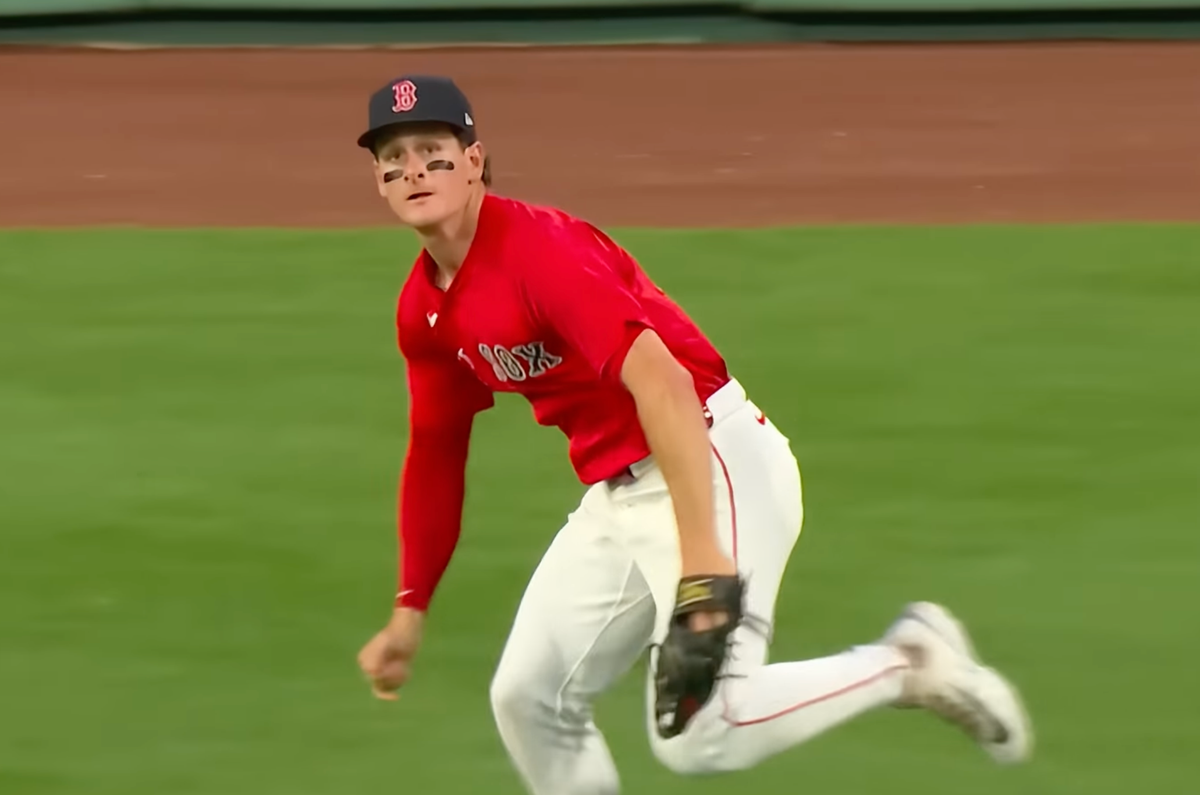
Hey, hope everyone has been enjoying early World Baseball Classic action. We’ll get to some fun stuff from that in the bits and bobs.
First, though, we’re kicking into full preview mode this week at Bandwagon HQ. Today I’ve got Part 1 of what I’m calling Bandwagon Preboarding.
Am I using that name to avoid the wrath of Effectively Wild co-host (and much appreciated reader) Ben Lindbergh over the term breakout player? Maybe. Am I trying to draw a distinction between the effort I’m undertaking and the more front-office-employee-style, more difficult art of scouting for true diamonds in the rough? Also yes.
This series is aimed at identifying players who could level up to more prominent positions in the sport in 2026. This is a newsletter called The Bandwagon; naturally, it’s more fun to hop on the good ones as early as possible.
Today’s picks are the Award Candidate Express, for players who could become candidates for MVP or Cy Young honors. (In Part 2, hitting your inboxes tomorrow, I’ll have something closer to the traditional breakout players list seeking guys who could reach All-Star levels of production for the first time.)
Award candidates. What do I mean? I don’t mean I’m picking these guys to actually dethrone Aaron Judge or Shohei Ohtani or Tarik Skubal, though maybe! I mean they have never received a vote for MVP or Cy Young, and this year I can envision a world where they receive many votes.
The standard sounds expansive, but it knocks out more guys than you might think. Last year, 57 different players got votes in MVP and/or Cy Young balloting. Cal Raleigh had twice received MVP votes before last year’s 60-homer challenger run at Aaron Judge; he wouldn’t have been eligible last March. I find it plausible that Cubs outfielder Seiya Suzuki, for instance, could put together the best season of his career just by achieving a modicum of consistency. But he’s ineligible. He got a downballot MVP vote last year.
The list is not intended to be spicy or overly novel. Getting too hipster with this goal is a great way to be wrong. Sifting for top-60 players — one of the two best players on any given team, essentially — means looking for big, honking clumps of gold.
There are two main camps of player I considered here: Young stars who I anticipate ascending quickly to the superstar realm, or later-blooming players displaying qualities that could lead to superstardom. Last year’s best examples of the latter group would be Geraldo Perdomo or Nick Pivetta.
Let’s get into the list, after a quick reminder that The Bandwagon runs on your support.
The part where I ask for your support
While The Bandwagon is totally free to read, it’s far from free to create. If you enjoy the work here, please consider pledging your support.
- Become a Fan for just $4 a month or $40 a year.
- Become a Diehard supporter for $8 a month or $75 a year.
- Offer a contribution in the amount of your choosing.
All Aboard the Award Candidate Express
Roman Anthony, Red Sox outfielder
Why? Anthony looks like someone. I can’t place who. Pretty sure it’s either an NFL quarterback or an actor who has played the president in a movie or a grizzled veteran star of 1990s baseball.

Or maybe that impression just seeps through his commanding presence. Even plucked from the top of the prospect heap, Anthony arrived in Boston with an uncommon level of control over his at-bats and the game. The 21-year-old had the ninth-best on-base percentage in baseball from the date he debuted (June 9) and the highest hard-hit rate.
His underlying metrics have been screaming superstar all the way up the minor-league ladder, and he laid the foundation in Year 1 by immediately demonstrating an expert-level understanding of the strike zone. The track record suggests he’ll make more contact and actualize a bit more power, and any boost from his 140 wRC+ as a rookie (meaning he was 40% better than the average MLB hitter) puts him in MVP vote territory.
Recommended If You Like: Early Cody Bellinger, arriving on time, meeting expectations
Chase Burns, Reds pitcher
Why? MLB hitters swing at about 48% of the pitches that come their way, but certain pitchers inspire them to take more hacks. Among qualified starters in 2025, Tarik Skubal induced the most swings, followed by Bryan Woo, followed by Jacob deGrom and Garrett Crochet.
These are pitchers who pound the zone because their stuff is too good to hit anywhere. And then they can dip out of the zone … because hitters are on tilt … because their stuff is too good to hit anywhere. Burns, in an admittedly small rookie sample (43 1/3 innings), ranked right in the middle of that group.
His fastball demands a sizzle sound effect. His slider should include both sizzle and the Looney Tunes slide whistle that indicates something or someone is about to drop a great distance.
via Baseball Savant
Give the recent No. 2 overall pick a little time to cook. This is a recipe that tends to work.
RIYL: Expressive leg kicks, over-the-top arm angles, young Verlander
Francisco Alvarez, Mets catcher
Why? Call him The Little Dumper. Alvarez is three full seasons into his major-league career, and the vibes are great, but the production keeps running into unwanted detours from inconsistency or injury. (So he’s on the Mets, you’re saying? Yes, I guess that was baked in.)
Still just 24, the power-packed Alvarez won over pitchers quickly. The immense pop that fueled his prospect status has not shown up as readily in the big leagues. But after a demotion last year, he returned with a vengeance, batting .276 and walloping eight homers in 40 games after the All-Star break. After his return to Queens on July 21, he ranked among the top 15 hitters in the sport in average exit velocity, and fifth in hard-hit rate.
He still needs to prove he can maintain a steady, productive approach across a whole summer, but the thunder in his bat, at a premium position, foretells a huge season when he puts it together.
RIYL: Colorful catcher gear, buddy comedies
Chad Patrick, Brewers pitcher
Why? “Chad Patrick” sounds like a hastily assembled Witness Protection Program identity, and his rise was similarly nondescript. He debuted a couple months shy of his 27th birthday, in a torpedo bat panic game the Brewers lost to the Yankees 20-9. Then he slowly, surely planted the seed and tended to the idea that he’s a big-league starter.
By the postseason, when he struck out 11 in 9 innings and made everyone except Shohei Ohtani look lost, Patrick had grown into something more intriguing.
An elemental 2020s development story, Patrick pitched and thrived predominantly with three fastballs (cutter, sinker, four-seam, in that order) until he worked in a slurve late in the season. Patrick’s results on fastballs were pristine — a wOBA virtually tied with aces like Zack Wheeler and Freddy Peralta — even when he was throwing those fastballs an absurd 86% of the time. Adding the slurve has the potential to transform him into a true monster who can front a rotation, even with a name that sounds like a front.
RIYL: Finding Corbin Burnes on eBay, Brewers voodoo, indie Zack Wheeler
Addison Barger, Blue Jays outfielder
Why? You may have heard that this 26-year-old slugger was sleeping on a teammate’s couch in between World Series heroics. Seemingly an ebullient and carefree daydreamer — sample quote: “He’s a head case, but he’s funny.” — Barger is also trending toward being a nightmare for pitchers.
As the world found out in October, he’s got major bat speed. The only regulars who bested Barger in both fast-swing rate and squared-up rate last season were Vladimir Guerrero Jr. and Aaron Judge.
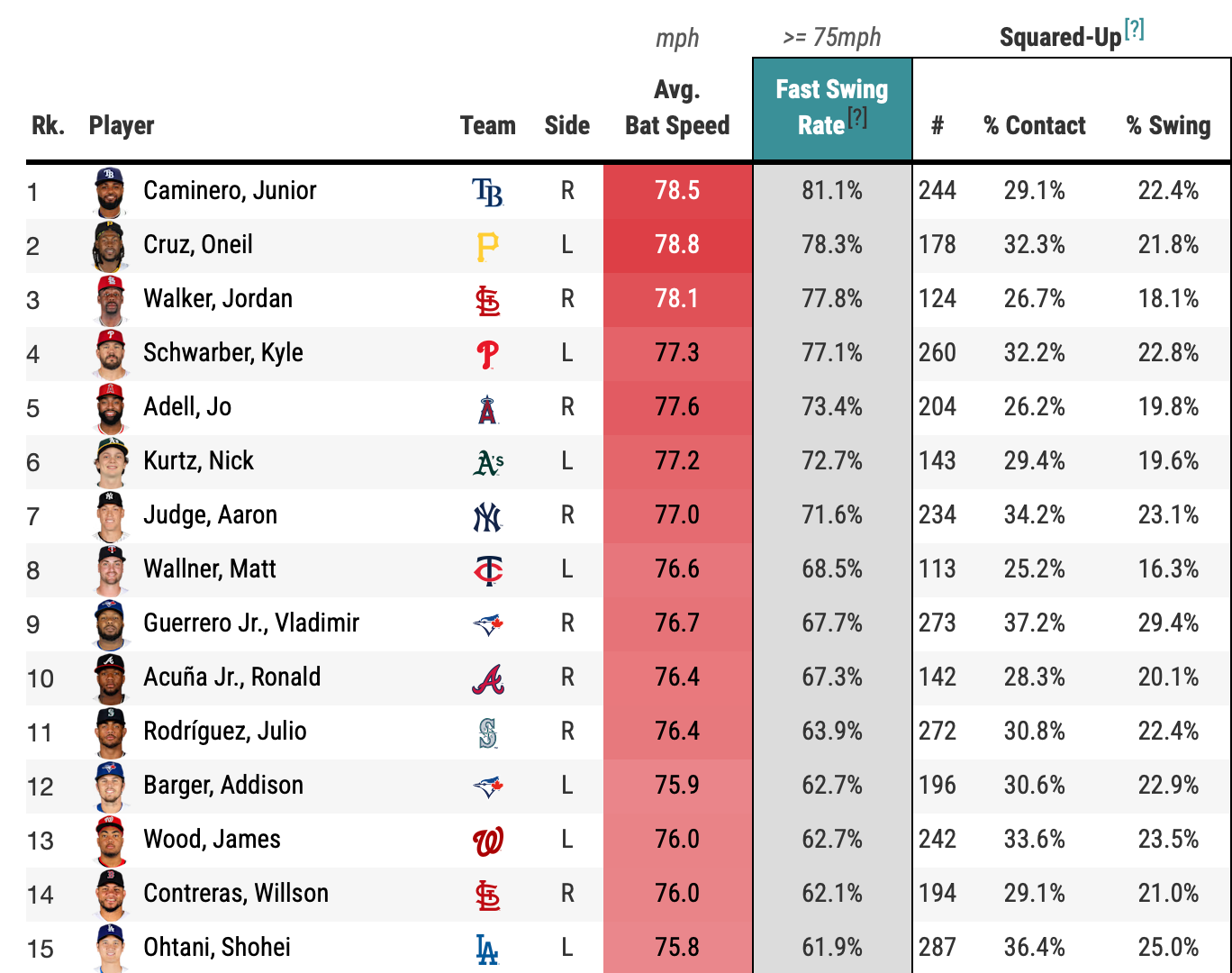
Barger came up as an infielder, and may still see some time there to accommodate Toronto’s many good lineup options, but he looks like a more natural fit in right field, where his howitzer of an arm can play up and counteract some subpar range. That’s sort of the highlight cherry on top, though. This is all about the bat, a thing that could go boom most nights.
RIYL: Couch surfing, Bam Bam from the Flintstones, Kyle Schwarber
Bryson Stott, Phillies infielder
Why? I have a type. I believe in hitters who control the count, get on base and make a ton of contact with strikes. At a minimum, these types of hitters have a high floor when paired with solid up-the-middle defense and baserunning, which Stott has provided throughout his four years in the big leagues. But it also makes for a great launching pad, as Geraldo Perdomo most recently proved last year.
Stott has crept up toward a 10% walk rate the past two seasons while maintaining a lower-than-average strikeout rate. He makes contact with more than 90% of his swings in the zone. And his exit velocities suggest he has enough raw muscle to step up his power output at some point, with some more progress.
A midseason 2025 tweak that moved his hands down broke a summer swoon and allowed him to get out in front of the pitch more naturally. Still, he only pulled the ball in the air a middling 14% of the time while surging to a .310/.377/.503 line over the season’s final two months. There’s room to boost that even more if he can prove his mettle against southpaws.
RIYL: Wall-scraping homers, bandanas, keystones
The Bullpen
⚾⚾⚾⚾⚾⚾⚾⚾⚾⚾⚾
The WBC, via Shohei Ohtani, has absorbed a Lakers courtside level of celebrity magnetism.
Timothee Chalamet and Bad Bunny are at the Tokyo Dome watching the World Baseball Classic pic.twitter.com/hcXs8RbshD
— Jomboy Media (@JomboyMedia) March 6, 2026
If Timothée Chalamet and Bad Bunny are making the trek to Tokyo, the final rounds in America are going to need a red carpet.
⚾⚾⚾⚾⚾⚾⚾⚾⚾⚾⚾
Hannah is at the WBC covering the important stuff for CNN.
Geopolitics aside, what hot dog are you getting
— Hannah Keyser (@hannahrkeyser.bsky.social) 2026-03-06T19:28:35.271Z
I'm sorry to report I got an live look-in at her review, and the dogs do not meet the moment.
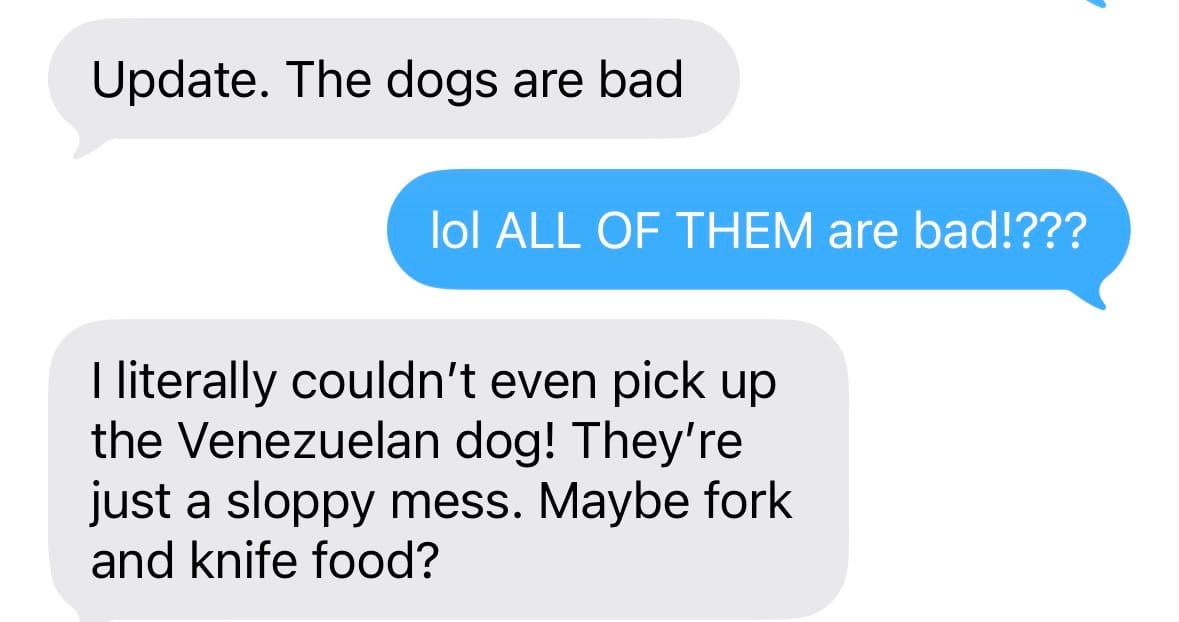
Keep an eye on her Bluesky for more updates.
⚾⚾⚾⚾⚾⚾⚾⚾⚾⚾⚾
Ozzie Albies hit the first walk-off homer in WBC history, giving the Netherlands a sudden escape from a Nicaraguan upset bid. It feels a little surprising it was the first walk-off homer in the tournament.
But not as surprising as the fact of the walk-off was to the play-by-play announcer calling the game.
OZZIE ALBIES!
— World Baseball Classic (@WBCBaseball) March 7, 2026
A #WORLDBASEBALLCLASSIC WALK-OFF HOMER FOR TEAM NETHERLANDS 🇳🇱 pic.twitter.com/T2HRyL233M
⚾⚾⚾⚾⚾⚾⚾⚾⚾⚾⚾
My least favorite part of the WBC? Oh thanks for asking. It’s seeing the children of Manny Ramirez and José Contreras starring for Team Brazil.
I’m not ready to remember the major-league debuts of multiple generations of a family. Please don’t make me. Lucas Ramirez, the closer of the duo, spent last season in A ball for the Angels organization, so we’re probably not overly close to that, but he did also homer off Logan Webb. Prepare as you see fit.
⚾⚾⚾⚾⚾⚾⚾⚾⚾⚾⚾
On the MLB implications front, it’s wild how unstoppable Masataka Yoshida looks for Team Japan ahead of a season in which he might not have a clear role for the Red Sox.
Yoshida is batting .500 with two huge homers in the WBC, batting cleanup in Japan’s loaded lineup. I wonder if his underwhelming time in MLB thus far will take a turn this year, either via change-of-scenery trade or breakout.
⚾⚾⚾⚾⚾⚾⚾⚾⚾⚾⚾
The other day, I was distractedly multi-screening the WBC when my wife caught a weird slide-related moment in the Great Britain vs. Mexico game. British runner Ian Lewis Jr. slid toward second, bounded up and rounded the base for third while appearing to skip the part where you’re supposed to touch the bag.
Ian Lewis scraped second base with his finger on his way to third base 👀#WorldBaseballClassic pic.twitter.com/mEVkpnl6Xx
— Milb Central (@milb_central) March 6, 2026
But as that replay showed, Lewis managed to graaaaze the base with his fingertip. Crisis averted, but that’s probably an overly evasive slide.
⚾⚾⚾⚾⚾⚾⚾⚾⚾⚾⚾
Finally, the Brewers are working on implementing some dugout-dictated strategy around the automated ball-strike challenge system. They debuted color-coded cards that coaches would use to signal to their players whether the situation is important enough to use a challenge on.
It’s not about whether the challenge would be correct, but about whether it’s a valuable enough moment to take the risk.
Nonetheless, MLB moved to quash that method, saying it went against the spirit of the system. Perhaps it won’t be blaring green or red cue cards, but I’d guess some version of this context yay-or-nay indicator will probably wind up in almost every team’s toolkit.