Second to none
Explain the Brewers like this: World Series champions.

One Wisconsin man, waiting for a flight to Milwaukee, stood and gazed at the sign two gates away: Tampa. Another, splayed on the airport carpet, trying to wrangle his restless kids with an iPad showing the Packers game, said he had just come from there, had tried to rearrange his family’s schedule to stay for two, three more days. Because the Brewers, by then up 2-0 in the World Series, were on their way.
This was in Nashville, Sunday afternoon. My wife and I were sitting at the gate in between, headed back to New York. All weekend, we had marveled at the preponderance of Brewers fans traipsing around town in jerseys, T-shirts, hats, talking about ticket prices and family members who ponied up, who skipped planned vacations to watch the franchise’s first World Series championship.
In a city 564 miles from Milwaukee, everyone with any connection to Wisconsin was making sure to show it. And 725 miles from Tropicana Field, almost halfway there, they were thinking about Tampa, glancing toward it, itching to be there for their heroes’ increasingly imminent, some might say inevitable, coronation.
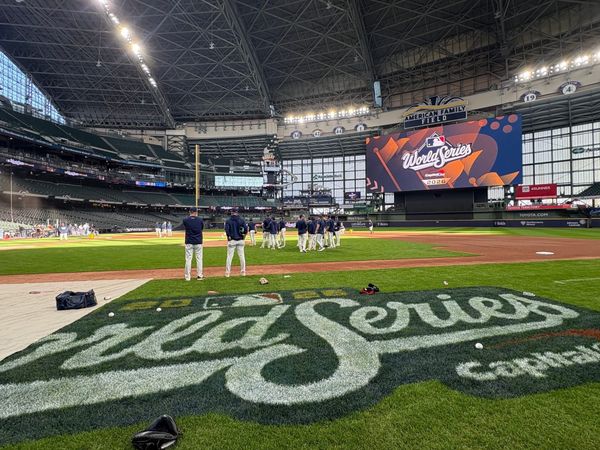
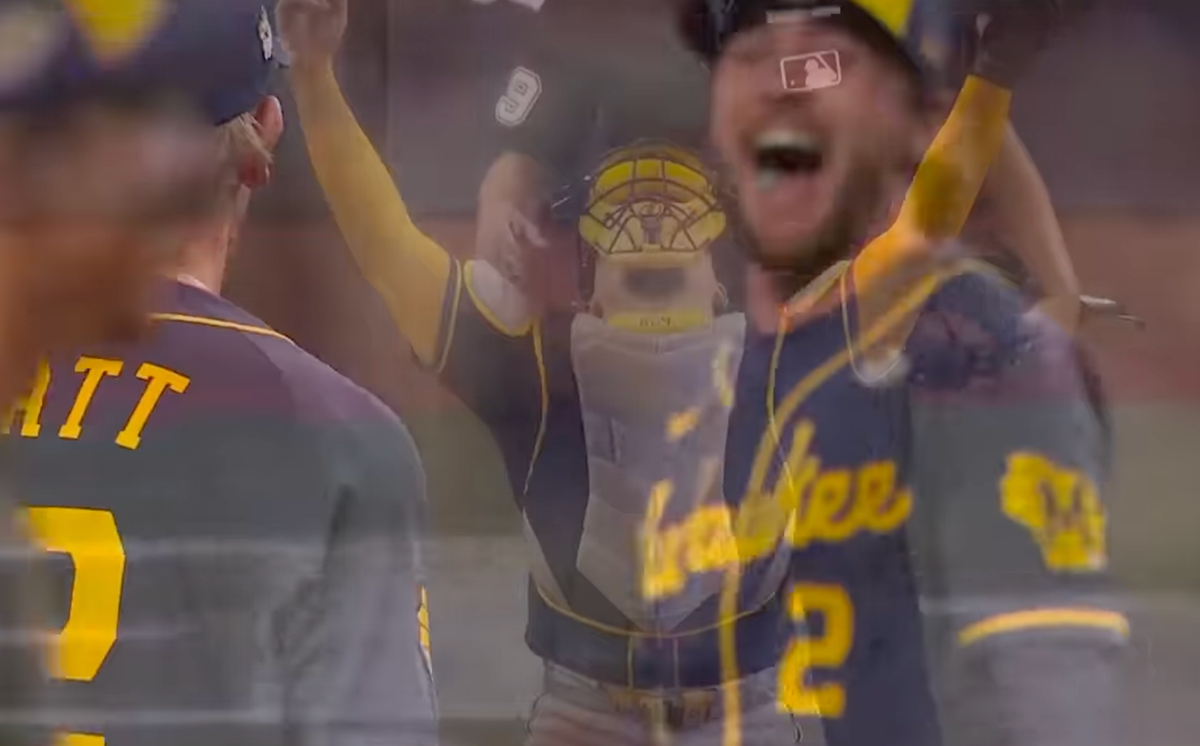
When the moment arrived Wednesday night — the Brewers taking the game and the series over the Rays, 4-1 — thousands of fans in blue and yellow injected the road ballpark with the rapture of home. Thousands more were at American Family Field to jubilate together. The enthusiasm, the reach, of major-league baseball’s smallest city felt huge.
The Brewers’ title was not sudden, not a surprise. It rode atop a swell of success that has been building since 2016, under David Stearns’ front office and then roaring on through Matt Arnold’s promotion from within. Eight postseason appearances, six division crowns, three NLCS appearances. An MVP, a Cy Young and another in the offing. Pride was there, with plenty of reason for it. But it was closely held, a targeted fire hose rather than a crashing wave, until this week.
The impulse, mine and yours and the masses’, is to explain a newly observed phenomenon, to track that wave back to its origin. Their Triple-A affiliate is in Nashville, could that be … no the tie only dates to 2020. Were the Packers in town facing the Titans? Nope.
Is this America’s team for dethroning the Dodgers? Are the 2026 Brewers the protagonists of a soaring sequel to Moneyball? Are they a blueprint being copied as they are celebrated?
Is this how any team would feel on the cusp of its first championship? Is this what it looks like when the search for an explanation widens beyond logic, beyond words, and opens up into something that can only be described as an experience?
⚾️⚾️⚾️
The day it was agreed to back in December 2022, a three-way trade between the Braves, A’s and Brewers was called the Sean Murphy deal. The offshoot of the trade that redirected catcher William Contreras to the Brewers for speedster Esteury Ruiz was a noteworthy but secondary concern.
History has perspective that headlines don’t. Last night, as Contreras hit, challenged and implored his way to World Series MVP honors, the Brewers forced the baseball world to look at them from a new angle. Because of money or media concentration or the happenstance of postseason results, the club with the most wins over the past three seasons has not been held in the regard that record would imply.
“They were often viewed as a cute success story, the little market that could,” Andy McCullough wrote in his report on the Brewers’ triumph, “rather than a real contender.”
Their championship and vengeful sweep of the Dodgers barrels the sport out of a particular type of tunnel vision. For years and years, as the postseason field expanded, “it was easy to see the playoffs as a crapshoot,” Matthew Trueblood wrote recently.
“Then, Shohei Ohtani signed with the Dodgers and won it all twice in a row, and it was like the God particle had been discovered all over again,” Trueblood said. “That messy egalitarianism that seemed to have settled over the sport burned off like low-lying fog on an unseasonably warm autumn morning, and we all saw (or imagined, at least) the ugly truth: Only power matters; only money wins.”
There was a time, not three years ago, when the Dodgers’ long run of excellence was still unvested. They were the best team in baseball, but that was valued on paper rather than in gold.
Overnight, the Brewers have called for a new assessment. The season they just completed — 103 wins, with an 11-2 playoff mission completed against the best competition available — was second to none. In degree of dominance and difficulty, it compares favorably to every champ since the 2018 Red Sox. They are two regular season wins clear of the Dodgers in the very years of the supposed Ohtani dynasty, they have a World Series pennant headed to the rafters, a young team and booming farm system in tow.
Is this Brewers team an underdog story with a happy ending or an adamant arrival of something else entirely?
⚾️⚾️⚾️
How, exactly, did you grow up? How did you fall in love? How did you get to where you are today? Do you really know? Was there a discrete, usable process involved? Or do you, in the grand tradition of the major religions, recount a singular story with the conviction of universal truth?
The Brewers’ motto was everywhere in October: Win our way. But it’s a mantra, not an invitation. Milwaukee’s way lends itself to uncertainty. Under Stearns and Arnold, they have sustained winning teams on a middling ownership-imposed budgets by trading away a number of established stars (Corbin Burnes, Josh Hader, Devin Williams, Freddy Peralta) in favor of starter packs full of young, promising, unknown commodities. They fill out rosters by sifting for high-potential waiver claims and unheralded trade chips, not winning free agent bidding wars.
In 2026, they wound up with three of the 30 most valuable players in baseball, and those players were 24 (Jacob Misiorowski), 26 (Brice Turang) and 22 (Jackson Chourio). Turang’s breakout last year was the only 4-WAR season among the group entering the spring. Two more 3-WAR hitters (Jake Bauers and Garrett Mitchell) had never even amassed 500 plate appearances in a single major-league season. The starting shortstop who batted .354 in the postseason (Cooper Pratt) had not yet glimpsed Triple-A.
They gave rookie pitchers 80 starts, more than any other team in the sport. The oldest and least acclaimed of those arms, Robert Gasser, finished with the most starts and registered the best starting pitching performance of the World Series.
Uncertainty, in such regular doses, is hard to distinguish from skepticism when viewed through a quantified lens.
Over this decade-long ascent, the Brewers have persistently outfoxed wise and grounded projection systems. First, they did it under the professorial watch of Stearns and Craig Counsell. When Counsell took a larger contract for the rival Cubs, Arnold promoted Pat Murphy, grizzled motivator of men, the most football coach of baseball managers. He delights in the undershot projections, feeding them to his team like fuel to a fire.
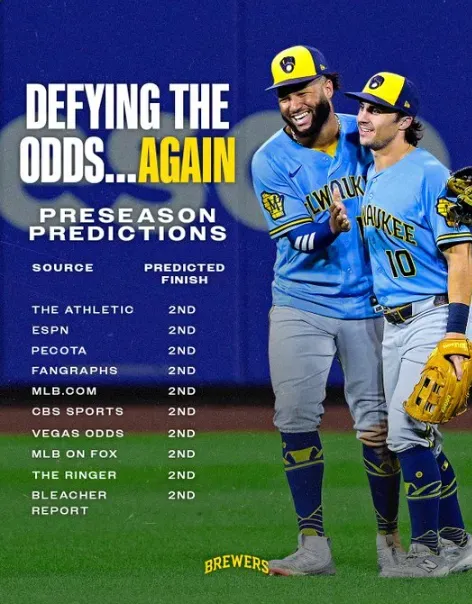
So many of them had felt like they were second-best, the second choice. And the ones who hadn’t? Well, Murphy made sure they would, as part of the collective unit that was less proven than the Dodgers, less appealing than the Cubs, less respected than they had earned.
Projecting the Brewers to do all the things they did would have been malpractice. Not projecting all those things turned out to be wrong. Would you believe it if you didn’t see it?
⚾️⚾️⚾️
Belief is necessary. It’s the quotidian forward force, the gas in the combustion engine that carries you to work and the grocery store and back home again. Seeing, with thousands of others who waited and believed alongside you on the same warm nights, sitting in the same traffic, that’s transcendent. It’s the wind in your hair at sunset, driving 75 on a wide open highway. It's the thing you get up and start each day to reach.
Throngs of Brewers fans took over Tropicana Field to see something bigger and less nebulous than overachievement. Like the outfield fences, the walls of collective understanding are arbitrarily drawn. Winning the World Series isn’t necessarily harder than winning 103 games or winning the division every year, but getting over that wall means something different. It’s a license for collective joy.
It gets Christian Yelich jerseys packed in suitcases and Chourio jerseys purchased a size bigger than the kids need right now. It gets plane tickets booked and tattoos designed. It moves broadcasters and Cy Young winners to tears.
No explanation is needed. ⚾️
Thanks for reading in 2026. Pledge your support for 2027 and beyond.
The Bullpen
⚾⚾⚾⚾⚾⚾⚾⚾⚾⚾⚾
Jacob Misiorowski has found a perfect match. The woman who gave the broadcast a fantastic GIF-able facial expression …
👑
— CJ Fogler (@cjzero.bsky.social) 2026-10-29T03:03:05.313Z
… turned out to be the winning pitcher’s fiancée.
⚾⚾⚾⚾⚾⚾⚾⚾⚾⚾⚾
In addition to being the most football coach of baseball managers, Pat Murphy is the obvious choice for a hypothetical Reporters’ Favorite award.
He talks openly and often, revealing personal stories instead of just rote phrases. Just this month, he held forth on his love of Bruce Springsteen and why men shouldn’t need to wear ties.
He even threw in an intentional mispronunciation of social media quip, which has a 100% chance of being quoted. “I’m not on social media, Twizzler or Instacart, whatever,” the AP has Murphy saying.
I’m not accusing anyone of bias. I’m just noting the reality that Murphy is both constitutionally and topically perfect for the baseball media.
⚾⚾⚾⚾⚾⚾⚾⚾⚾⚾⚾
Chourio, Contreras and midseason reliever acquisition Antonio Senzatela pulled off the double this season, winning both the WBC with Venezuela and the World Series with the Brewers.
Contreras’ older brother Willson, who has been openly affected by the hardship in their native country, was on hand wearing his brother’s jersey and tearfully celebrating with him on the field afterward.
⚾⚾⚾⚾⚾⚾⚾⚾⚾⚾⚾
Joe Davis, the lead FOX play-by-play announcer, specializes in echos of baseball broadcasts past.
In Game 4, he paid off-the-cuff tribute to legendary Brewers announcer Bob Uecker by deploying his signature home run call for Cooper Pratt’s go-ahead blast — which, at the time, looked like a potential series winner.
When the Rays eventually came back to win in 12, he joined the linage of his predecessor, Joe Buck (who was adapting his own father’s call), when he yelled, “We’ll see you later tonight,” over the post-midnight walk-off knock.
Davis’ flair for the cleverly deployed reference sometimes overshadows his original work, which tends toward the strong but subtle. But this is another area where time will crystallize the potency of the work. Last year, he punctuated the Dodgers’ epic Game 7 win with one I could see sticking for the ages: “To beat the champ, you gotta knock ‘em out.”
This year’s call:
“Unshakeable, unstoppable, and champions at last: The Milwaukee Brewers.”
The part where I ask for your support
This is a project by and for the passionate. It’s undertaken on mornings, nights and weekends. On trains and planes and holidays. Around the responsibilities of a full-time job.
I recognize the building subscription creep, the proliferation of good writers operating independently and charging independently in an unforgiving industry. I don’t expect The Bandwagon to be your only destination for baseball writing, but I hope it makes your emotional investment more enriching.
If you enjoy the work here, please consider making a monthly or yearly pledge. For less than $0.70 an issue, or in an amount of your choosing, you can help sustain the project and raise its ambitions.