Fans don’t fly in formation
Pete Alonso, Cameron Winter and the limits of fan empathy
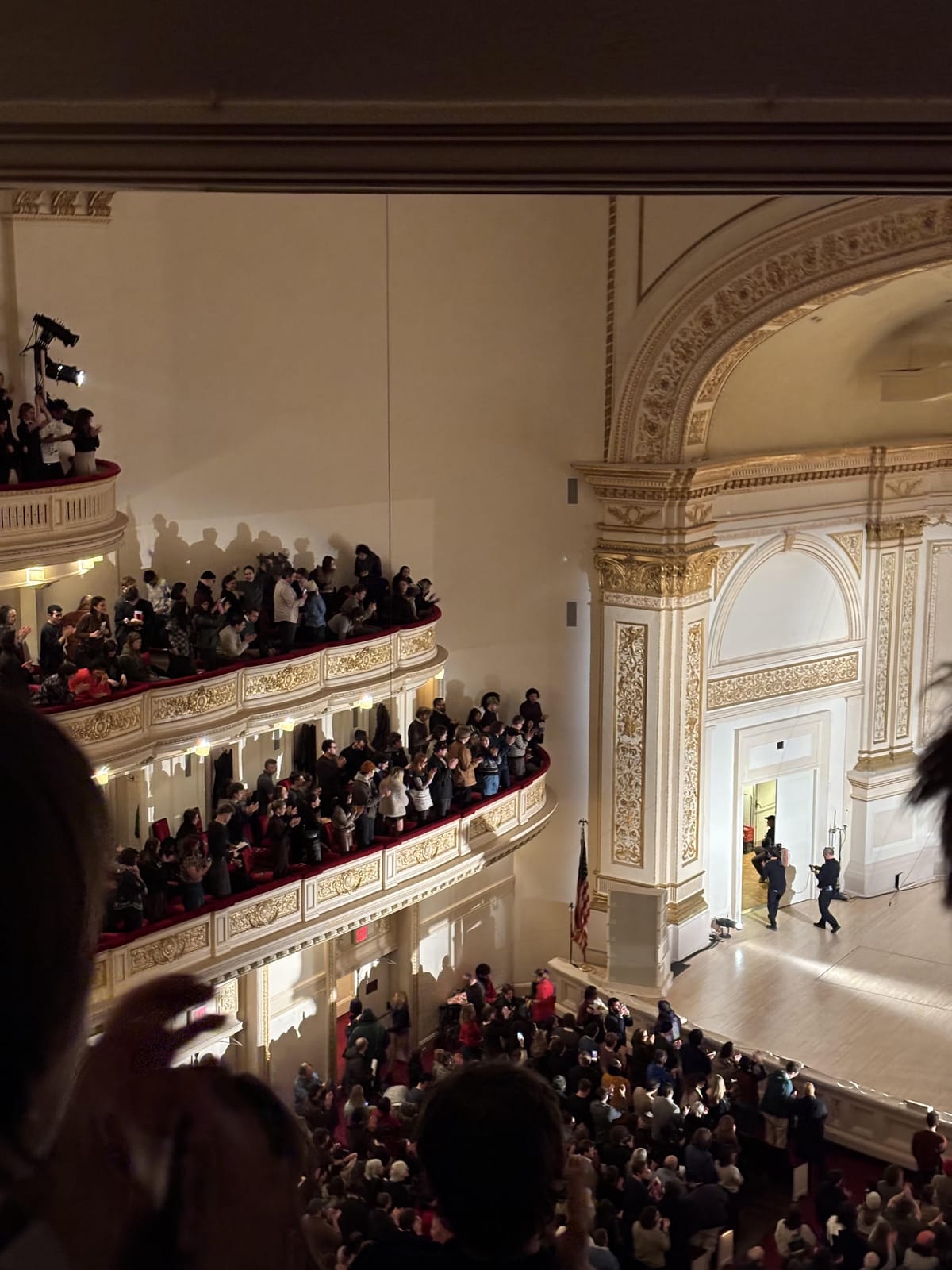
Pete Alonso just didn’t mean much to me when he was belting 53 homers back in 2019. So, the Mets letting him fly the coop for Baltimore didn’t hit me in the gut.
That’s testing the limits of my powers of acceptance and empathy in the fandom department right now.
I’ve mostly adopted my wife’s lifelong team. I love the black hats that remind me of Edgardo Alfonzo and Mike Piazza and the Subway Series. My tolerance for normal baseball broadcasts is completely shot because of the high conversational bar Gary, Keith and Ron set every night. Citi Field is a top-tier park for regular game-watching. I enjoy the mentality of the lavishly resourced yet doomed striver; it reminds me of the Red Sox teams my formative fan brain loved in the early 2000s. But so does Steve Cohen’s championship-chasing poaching of David Stearns, the local-whiz-kid-made-good Theo Epstein figure who might be able to summon the excellence that has eluded a beloved but recently ring-barren franchise.
My openness to a new version of the Mets is clashing with the more experienced Mets fans in my life. They have invested more time and emotional energy in the failures and the wins. Their connection to whatever happens next, I think, feels cheapened for having less to do with the ride the’ve been on for years.
I can say that, and understand it, but I also struggle to refrain from offering the counterpoint: Alonso was part of a core that didn’t muster a particularly consistent or effective charge at winning a World Series, and he (probably) would have represented more of a hindrance to it going forward. Spoiler, and a hot tip for some of you: Relaying that logic does not seem to be helping! I’m open to, and even excited for, the New Mets of Soto and a parade of young pitchers and whatever other Milwaukee-with-money ideas Stearns tries.
That doesn’t resonate nearly as much for Mets fans who are now down a main character in their long-running story. Or, maybe more accurately, that long-running story is just less distinctly theirs now.
Part of the reason “bandwagon” fan has a negative connotation for some, the kind this project in all its forms has lined up against, is the notion that one should have to put in time or pain or effort in relative obscurity to fully revel in the joy of a winning moment — whether it’s a sports team or a popular musician or another cultural phenomenon.
My best fan experience of 2025 was getting into the music of Cameron Winter, then Geese (the band he fronts). It’s hard to separate how much I enjoy the music from how much I enjoy exposing new people to it. I have evangelized for Winter, especially his solo album that came out last December, to anyone I thought might be halfway as intoxicated as I was by the effortful, urgent yet somehow time-blind songs emanating from a musically dexterous 20-something from Brooklyn.
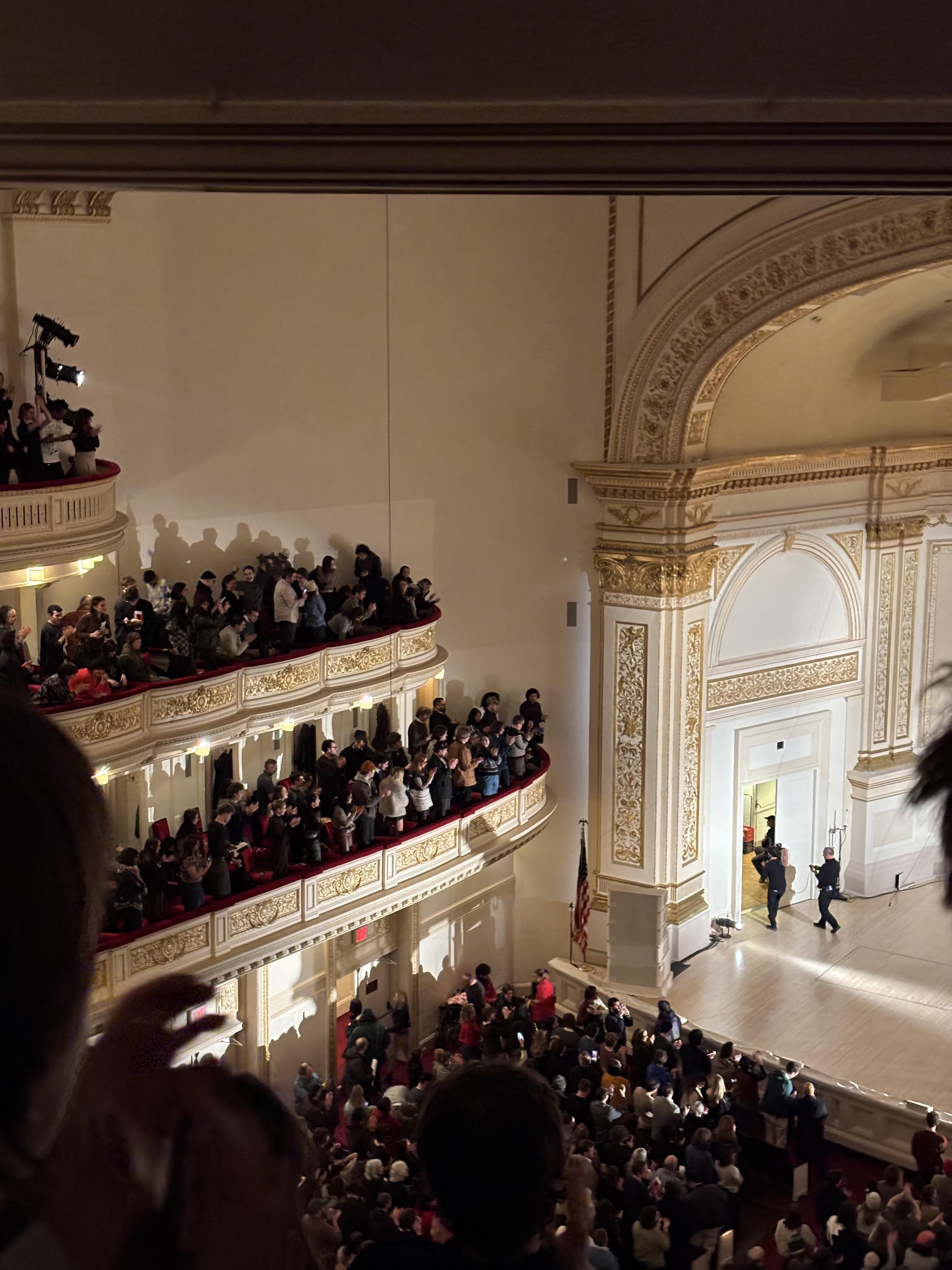
I previously recounted how, back in March, I waited around outside an East Village theater to snag last-minute tickets to see Winter play his solo material in a tiny pub space. Last week, he played a sold out show at Carnegie Hall, which I also attended with a friend who has joined me in this ecstatic fandom. If you’re on a certain rapidly expanding corner of the internet, you know that my efforts have been replicated by many, many others. The chorus of praise — in the aftermath of Geese’s acclaimed album and tour, and now Winter’s wider-scale solo shows — has grown deafening enough that it’s starting to feel like a nuisance to some folks who might have otherwise been open to finding a cool new artist.
T.M. Brown, a freelance writer whose work I enjoy, took stock of the ripples of the Carnegie Hall show and cast a dubious eye toward the significance that many (including myself) felt in the moment: “What I find so interesting about the hype machine behind Cameron Winter and Geese is that it seems as though people are going into these gigs understanding that they are witnessing an important moment ahead of time,” he writes.
Later, he zooms out to diagnose the whole situation like this: “We are desperate to participate and bear witness not a moment but to the moment in order to feel as though you’re at the center of the conversation and not relegated to some outer margin that no one engages with. To not participate in online discussion is to be obliterated from consciousness.”
Brown is deftly describing a very real phenomenon of algorithmic culture, even if I would push back on his ultimate takeaway. Every instance of someone else experiencing an exciting or meaningful thing can so easily morph into an annoyance or affront. Among two people who enjoy the same set of songs, one may perceive the public hailing of the Carnegie Hall show as rubbing it in, while the other rolls their eyes at what they detect as a late-comer’s envy.
Even having huddled into the same room of the same building of the same city to see the same thing, we are prone to skepticism of people who took a different route to get there.
I know I marveled at the size and utterly rapt attention of the crowd. Maybe I briefly wondered how many were with me in the tiny pub space back in March. But mostly I felt present for a collective something, which is the biggest thrill I know how to chase in music, in baseball, in life generally.
I didn’t want to take out my phone. I didn’t want to see the drink options. I wanted to remember it all for, yes, some future where it has accumulated significance to even more interested people, to more fans. And also just for myself, for no other reason than it felt more worthy than most options.
Walking out afterward, I was among a club of people who many others wish they could join, or will one day with they could join. I know it’s impossible, and I know they will have their own personal story of discovering Cameron Winter or the Mets or something else special. It’s natural to compare your story, to vie for superiority, to question or reshape the world that isn’t yours. I’m going to try harder to skip that part, to get straight to the collective part that lasts.
If you want to try, too, I think I’ve got a good line to start with: “Tell me how it feels.”
The Bullpen
⚾⚾⚾⚾⚾⚾⚾⚾⚾⚾⚾⚾⚾⚾⚾
Over at Opta Analyst, I’ve got a new story out this week breaking down the Tigers’ calculus as trade rumors continue to swirl around two-time Cy Young winner Tarik Skubal. Here’s a sneak peek:
It’s worth reflecting on all these variables in a different way, in light of what’s not possible.
The Tigers couldn’t have made the postseason without Skubal. They likely can’t afford to sign him in the open market (and thus probably can’t afford to sign anyone like him). A huge chunk of the other 29 teams can’t find anyone like him, so they’re willing to expend that precious, untainted capital that is unproven (and thus untainted) talent.
Given the options, it seems impossible for the Tigers to find a better use of a roster spot (and about $18 million) than Tarik Skubal. So what does the calculus really point to? Sacrificing some of that uncertain but promising future to bet big on winning with the sure thing they’re holding right now.
⚾⚾⚾⚾⚾⚾⚾⚾⚾⚾⚾⚾⚾⚾⚾
If you were tracking that little surge of reporting around the Pirates’ free agent aspirations with interest and then jaded disappointment, you now have something in common with the actor Michael Keaton. (Thanks to Andrew Mearns for surfacing this.)
The photo of Google news on a computer screen, posted to Instagram, is extreme dad energy. I hope he’s got a comfortable armchair to watch the Pirates from, at least.
But now I need to know what he makes of a refreshingly zany three-way trade with the Rays and Astros that would reportedly net them slugging second baseman Brandon Lowe, center fielder Jake Mangum and interesting pitcher Mason Montgomery for young starter Mike Burrows.
⚾⚾⚾⚾⚾⚾⚾⚾⚾⚾⚾⚾⚾⚾⚾
Tyler Zombro, a former pitcher who overcame a serious head injury suffered on a comebacker and ascended to the forefront of the independent training facility world at Tread Athletics, is now moving on up in the pro game.
After just a year working (instead of playing) in the affiliated game, the Cubs reportedly promoted him to a role overseeing much of the organization’s pitching. (Personally, not surprised, Zombro was a sharp and helpful communicator who presciently explained the in-progress evolution of major-league arsenals to me when I was reporting at Yahoo.)
It’s not new for leading minds from outside facilities like Driveline and Tread to assume control of teaching skills for MLB teams and their development groups, but it feels significant for someone to so seamlessly step from a playing career, to understanding the science and teaching it, to leading processes for a team. I can’t say for sure that Zombro is the first to take this route, but I’m very confident he won’t be the last. The amount of information active players are digesting, experimenting with and acting upon is growing quickly, and some of them are going to become experts far faster than those who can’t rear back and try an idea on their own.
⚾⚾⚾⚾⚾⚾⚾⚾⚾⚾⚾⚾⚾⚾⚾
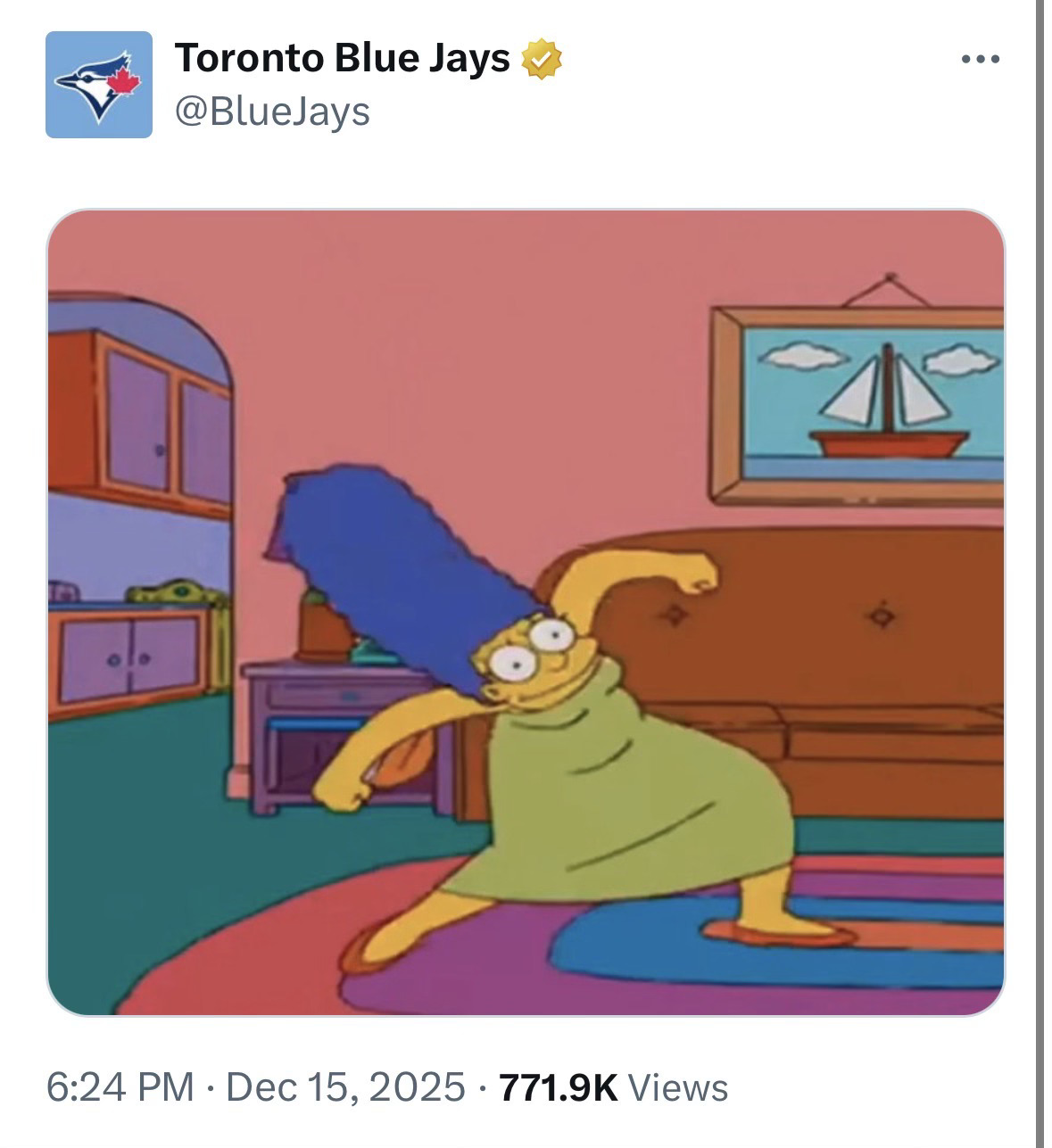
Tyler Rogers, an excellent reliever, signed with the Blue Jays as part of their ongoing pitching infusion. And it led to some excellent content. First, this A+ visualization of the gap between Rogers’ release point and that of rookie postseason hero Trey Yesavage.
Then, the Blue Jays tweeted this, probably not for the last time.
⚾⚾⚾⚾⚾⚾⚾⚾⚾⚾⚾⚾⚾⚾⚾
And, here’s an update on Phillies doing weird things with bodily substances.
Because that’s a category now, apparently.
Happy holidays, I’ll be back next week.