Half and half
Can hitters really change?

Hey, as baseball gets rolling again after the All-Star break, I wanted to use this checkpoint for the newsletter, too. What do you like? How does it fit into your life? What could make it a better or more essential part of your baseball diet?
If you have a few seconds — seriously, it won’t take long — fill out a survey to help me steer the newsletter forward.
I’m very grateful for all of you who already read and support The Bandwagon. Going forward, I want to make sure it’s primed to grow and be the best version of itself. I appreciate any feedback you can provide, and I’ll report on my takeaways soon! Now, back to the baseball.
Take a look at this table.
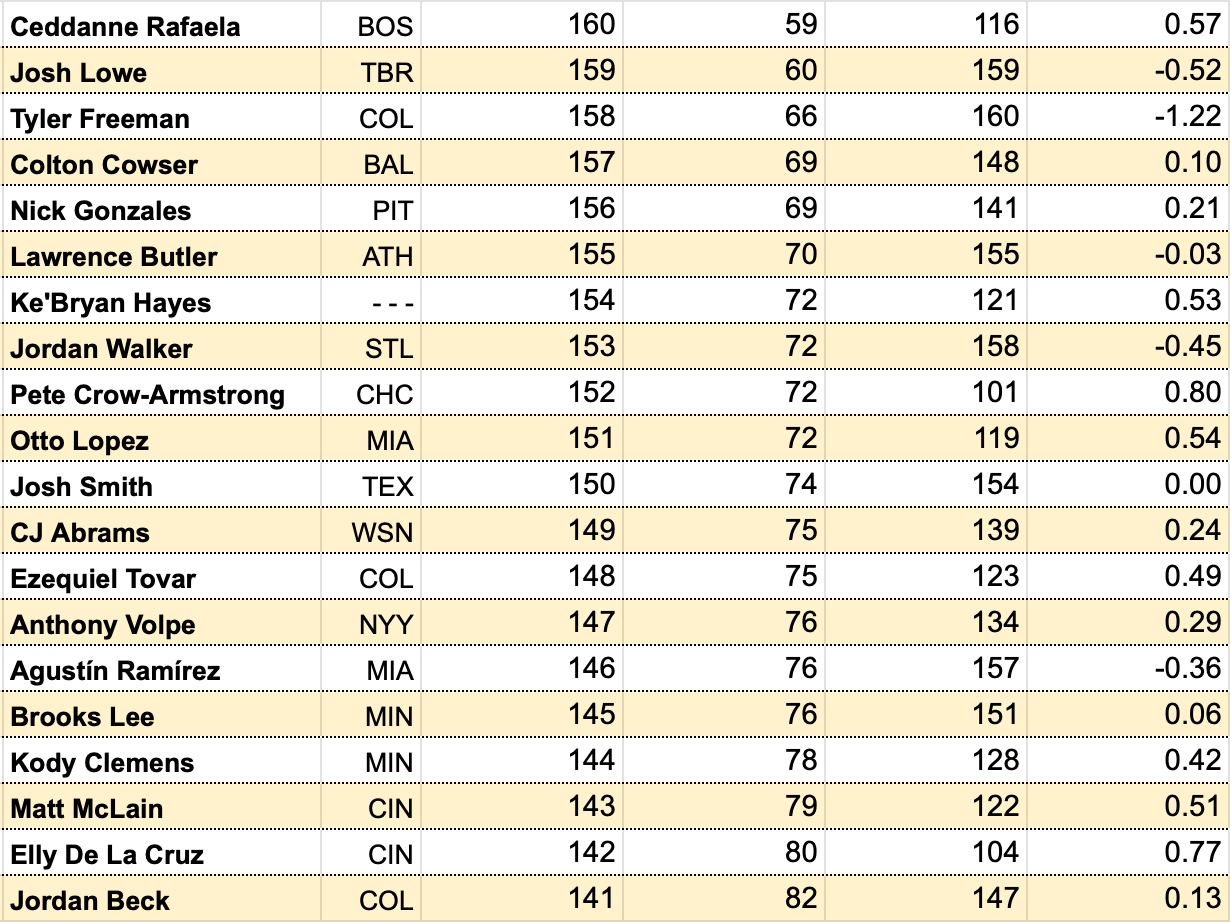
Any guesses?
That’s the hitting leaderboard from the second half of 2025, flipped upside down. It shows the worst qualified hitters after last season’s All-Star break, ranked by wRC+, the park- and era-adjusted batting stat at FanGraphs.
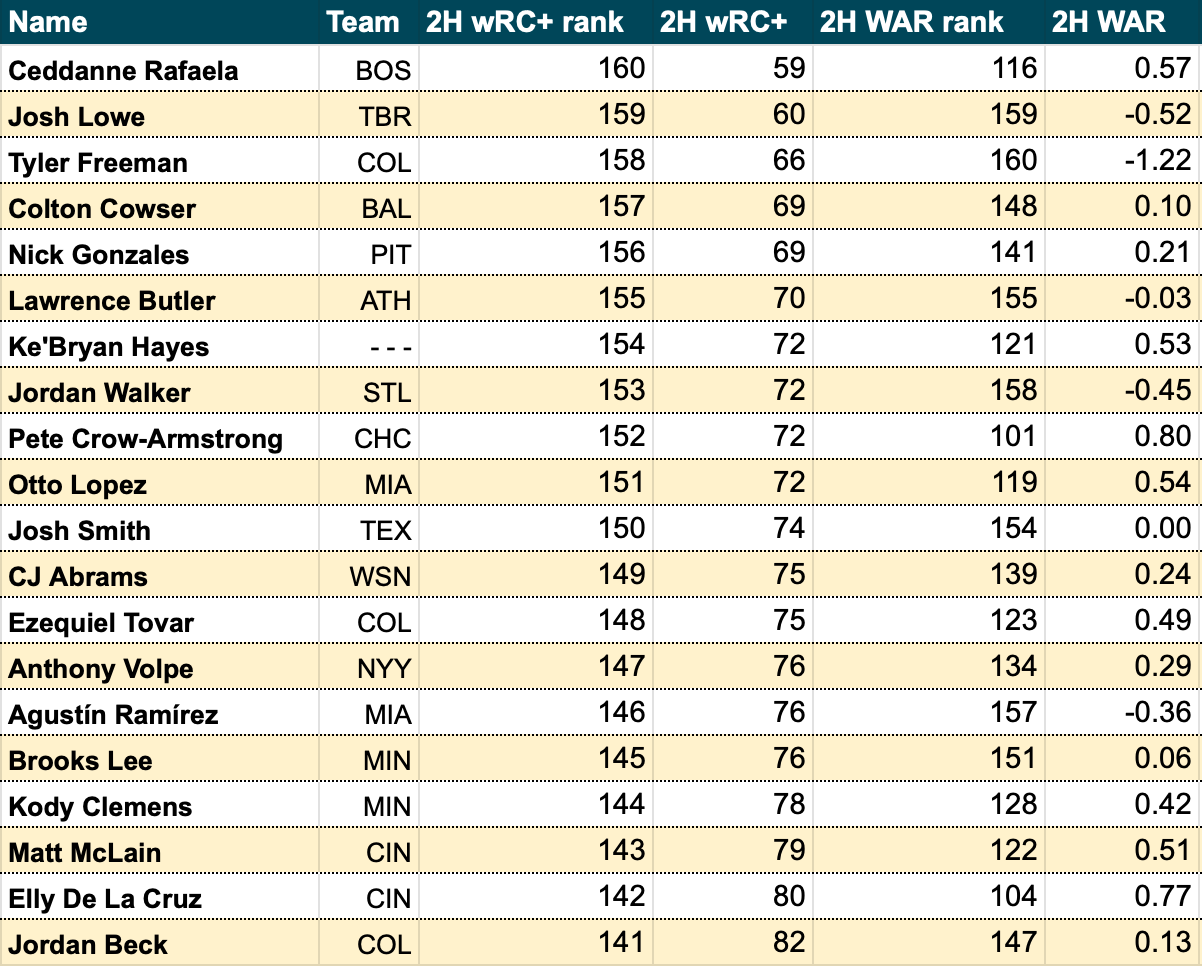
These are the 20 guys who struggled the most at the plate through sustained playing time last summer. We’re looking at grisly batting lines that would get unheralded players shipped back to Triple-A, or relegated to sparse bench duty. Performing like this for part of a second straight season will get just about anyone bumped out of the lineup, as Josh Smith, Jordan Beck and Agustin Ramirez can attest.
But then there are the names you’ve probably noticed already. Six of these 20 hitters — the least successful regulars of the previous half of baseball played! — were top 25 hitters in either wRC+ or WAR in the first half of this season.
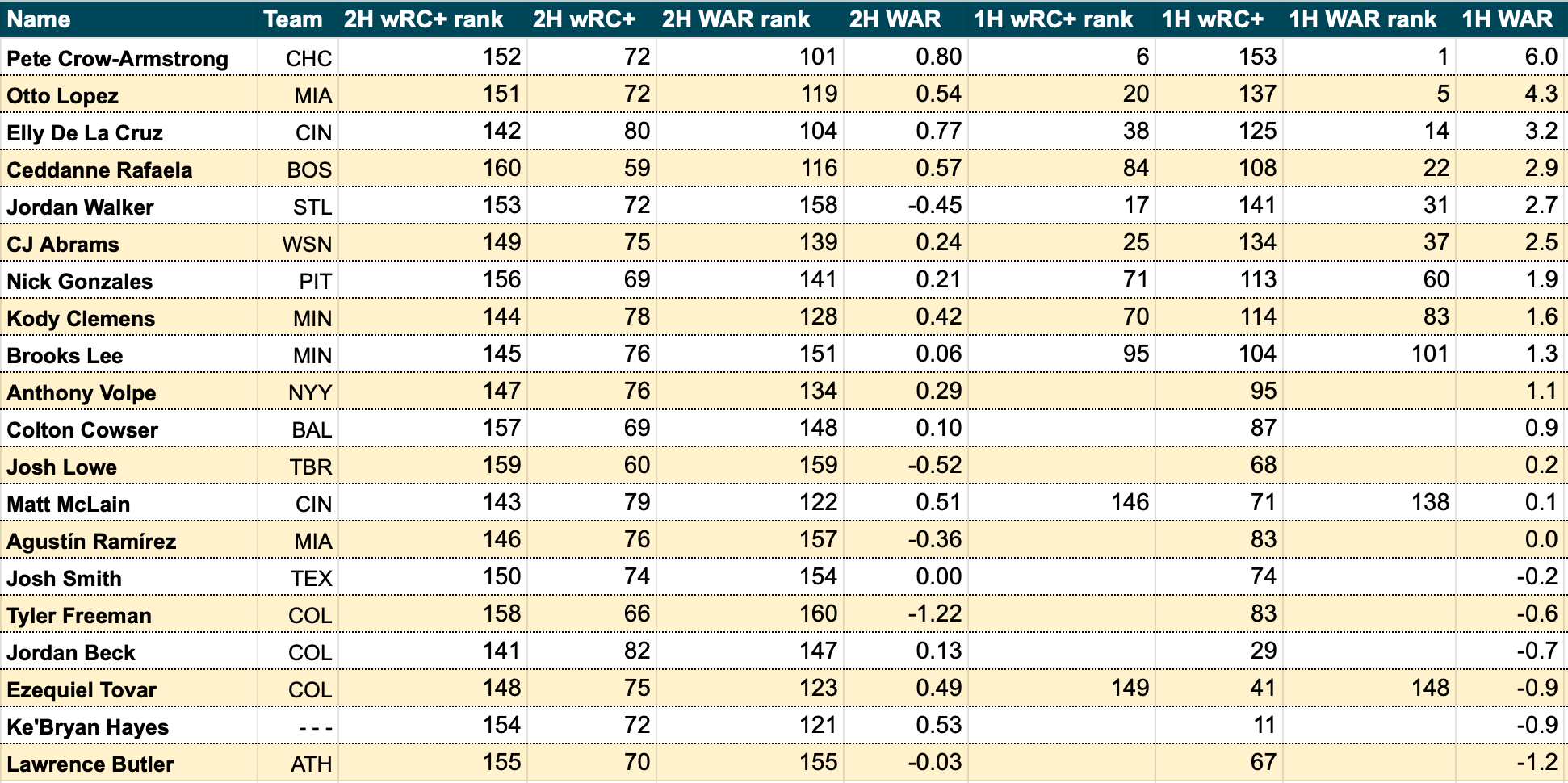
Cubs center fielder Pete Crow-Armstrong has been the most valuable position player in baseball, non-Shohei Ohtani division. Otto Lopez is rampaging toward a batting title in Miami, while playing premium shortstop defense. Ceddanne Rafaela is PCA Lite. Home Run Derby champ Jordan Walker is mashing. CJ Abrams is a key part in an electrified Nationals offense. Elly De La Cruz, more established than his compadres here, bounced back from a prolonged slump in a big way.
All of these players demonstrated ability in fits and starts before this season. All are 27 or under, could still be viewed as in their formative years. All except Lopez arrived in the major leagues with at least a degree of prospect acclaim.
They stumbled hard into the winter, but came back with a vengeance this spring. For these players, the night really was darkest just before the dawn. Are they two-faced, or truly changed?
⚾⚾⚾
You’d be forgiven in you harbor doubts. Crow-Armstrong was the fourth-most valuable position player at the All-Star break in 2025, even though his offensive contributions weren't as special. Flying even closer to the sun in 2026, Crow-Armstrong presents both the highest stakes and trickiest arc in this group.
Watching almost any 10-second glimpse of him in action, you’d conclude he’s an extraordinarily talented player. His 21 homers and 24 steals in this season’s first 96 games represent declines from last season’s first half, when he ripped off 25 homers and 27 steals in 95 games. Yet by the middle of August last year, things had changed so dramatically that Cubs manager Craig Counsell was pinch-hitting for Crow-Armstrong in some key late-game situations. By season’s end, he wound up on the list I led off with.
His huge swings in production traced back to one glaring weakness: His swings. Or, more specifically, his penchant for taking so many swings.
Last season, Crow-Armstrong swung at 52% of the pitches he saw outside the heart of the plate. Some of these pitches are strikes, but they’re pitcher’s strikes. They’re not the swings you want to take, they’re the swings you sometimes have to take. Crow-Armstrong was swinging with reckless abandon, emphasis on the reckless. Nobody else getting regular playing time swung more at these pitches. The MLB average was about 38%; Juan Soto swung at only a quarter of them. Altogether, these swings produced a .211 average and .316 slugging percentage.
Maybe more incredibly, Crow-Armstrong swung at 57.5% of non-fastballs outside the heart of the plate, which was nearly four percentage points clear of the next most enthusiastic hacker (Rafaela, actually).
The reason to buy 2026 Crow-Armstrong as the real McCoy lies in his real response to that weakness. This year, Crow-Armstrong still has an aggressive ethos, but he has mixed in a healthy dose of discipline. He’s got the overall swing rate down to 43% on pitches outside the heart of the zone, which is 41st-highest out of 189 hitters who have seen 750+ pitches.
Through some mixture of Alex Bregman influence and organizational coaching, the Cubs have helped Crow-Armstrong find a happier medium. It’s allowing him to rack up a serious number of walks and moderate his cold snaps.
“The way I framed it and the way it was presented to me really gave me some confidence,” Crow-Armstrong told The Athletic. “I’m not going up there and looking to not swing. That’s not how you walk, really. But it’s looking for one thing and sticking to that.”
In prolific analyst Matthew Trueblood’s book, the elevated walk rate is a significant new development that should mean Crow-Armstrong is “not going to go back to the guy who batted .188/.237/.295 in August and September last year.”
⚾⚾⚾
At the risk of oversimplifying something impossibly complex, what we can see about a hitter’s process comes down to when he swings and how he swings. Behind both, between his ears, there’s the unseen why — intent, powerful and inextricable from what happens but never actually observed, like atomic particles you win a Nobel Prize for discovering.