Import and export
The World Baseball Classic as a product and a dream.

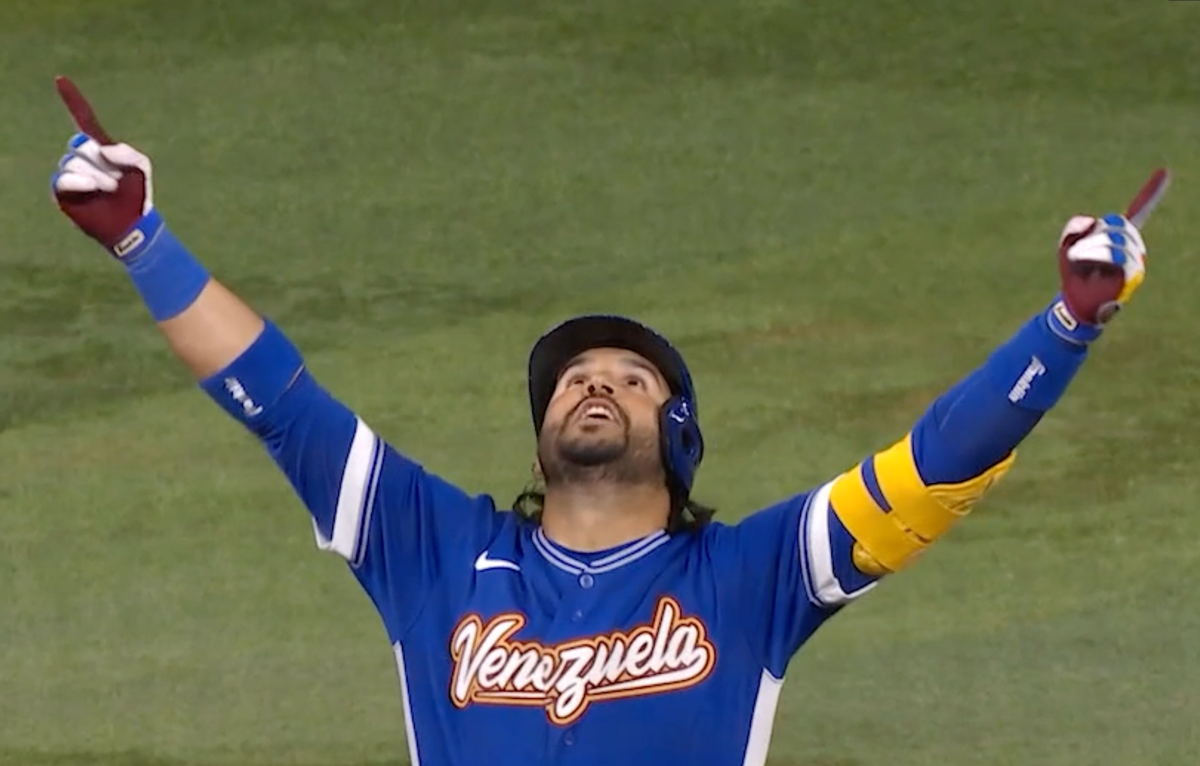
When Eugenio Suárez got to second base, looked up and screamed at the sky, you had to feel great for him, and for the Venezuelan team he had lifted back into the lead over the United States. You couldn’t tell exactly what it meant to him, but you could take some educated guesses. And above all else, you could tell it meant a lot.
The World Baseball Classic final brought pride and joy to Venezuela, and to throngs of Venezuelan fans roaring in Miami. They were a thousand miles away and also right in the thick of the reality that framed the game.
The Venezuelan players were claiming their first championship in a burgeoning showcase of national baseball pride by taking down the perpetual presumptive favorites. They were representing a country in crisis, and doing so against Americans who representing the country that caused or at least exacerbated it by using military might to capture their president.
So Venezuela’s bright, exuberant triumph over a tightly wound American team opened the door for subtext, and subtext lumbered right out onto the infield, shaking everything as it went. It descended on the result faster than Ronald Acuña Jr.’s airborne equipment. The subtext hailed a victim of American excess taking down a militaristic avatar in red, white and blue. A working class roar overwhelming the quiet hum of moneyed expectation. Color vanquishing black and white. A huge and stirring success.
Likewise, the on-field product was a huge and stirring success. The World Baseball Classic imported a compelling menagerie of baseball players and cultures, hit them with a spotlight, supercharged their appeal by simple juxtaposition to the Cobra Kai-like U.S. team, and delivered a highly entertaining spectacle in exchange for many, many American dollars.
For moment, as Venezuela celebrated, you could feel like they had won more than the baseball game that was beamed to the world from America and organized by American business powers, all as the American government pulled levers to make the place as hostile as possible toward people like Suárez who aspire to call America home, too. But that's part of the product, too.
⚾️⚾️⚾️
Tuesday afternoon, a few hours before the final, friend of the newsletter Scott and I were calling nearby bars in New York. “Are you going to be showing the WBC game with sound? … Yeah, I know, St. Patrick’s Day, I get it.”
The bar that said yes was full of people wanting to watch the baseball game, but mostly decked out in green. (The exceptions: one guy in a USA hockey jersey and another in a fantastic 90s era Orioles Starter jacket.)
St. Patrick’s Day started as a solemn religious feast day in Ireland, associated with a color like a high, muted sky that is still called St. Patrick’s blue. It was America and especially its urban cradles of Irish immigrants that broadened, commercialized, spiked and distributed the holiday as a drunken, green-dyed tribute to (someone’s idea of) Irish culture.
There are mawkish and unfortunate variations on this oft-repeated cycle of cultural repackaging, but as the Guinness and Jameson flowed, I sat there thinking about Team Italy.
A guy named Pasquantino from Richmond, Virginia, and a manager named Cervelli from Venezuela rallied a bunch of players with Italian-American ancestry to have some fun, drink espresso and play in a high-level tournament they otherwise wouldn’t have been invited to this time around. In the process of connecting however loosely with their heritage, they did a classic bit of American export alchemy.
They placed familiar points of connection in an unfamiliar context, took pride in it and let everyone see. A few heavily caffeinated nights later, they had planted seeds of interest in their game in a place where very few would be growing otherwise. A loose connection became a real, potentially impactful one. They got Italy beaned up on ball.
When Bryce Harper jolted Team USA to life with his game-tying homer, the bar played Bruce Springsteen’s misunderstood or too-catchy-to-care protest song “Born in the USA” as the waiter sprayed bubbles in the air. Soon enough, it was back to the Dropkick Murphys and the punk bagpipe sounds of “Shipping Up to Boston.”
America at its best is a place where anyone, from anywhere, can celebrate their traditions enthusiastically enough that all sorts of people choose to leave their homes on a frigid weeknight to join in the fun. Eventually, they can’t imagine not doing it.
⚾️⚾️⚾️
The WBC is still a young event. Fans have different experiences of consuming it. Some, like friend of the newsletter Scott, soak up every second of the tournament’s elevated intensity and internationally flavored ballpark atmospheres. Others, like my wife, white-knuckle through any inning where a member of their favorite MLB team is on the field, if they watch at all.
Many fans were able to revel in the Dominican Republic’s jump-out-of-the-dugout spirit, Japan’s parade of talent and Italy’s underdog spirit. Others wrote eloquently about Team USA’s disappointing tilt toward military messaging and imagery. And some deeply invested baseball fans couldn’t help but recoil at the way the United States’ wanton geopolitical encroachment in Venezuela was smoothed over for TV. Venezuela was playing with purpose.
I get the expectation that an event like this could reckon with the ills that stem from nationalist, racist hate, or prompt someone with a platform to take a difference-making stand. But I also think that’s asking a question you might not want the answer to.
We don’t need to hear what John Smoltz thinks of U.S. intervention in Venezuela, but the kid gloves feel evasive. It doesn’t move me that Paul Skenes almost went into the Air Force; I think making millions playing baseball is a better choice for him and a net societal positive. Cal Raleigh’s refusal to shake hands with people who are usually his teammates, combined with a “FRONT TOWARD ENEMY” shirt that apparently references military mines, painted a quick and dirty picture of international competition’s down side.
These big international events, from the Olympics to the World Cup to the WBC, are not sufficiently equipped to grapple with the global politics they invite by pitting countries against one another. They gesture at togetherness and unity, but what they really aim for is a uniformly unoffensive content machine. They try to inspire people to wear their colors and carry their flag for the good reasons, and to suspend their recollection of the bad ones.
It’s a tough ask. Yet the alternative to the WBC is blank space on the calendar, more days where the world screams back and forth from its respective bunkers, where Venezuela and the Dominican have their winter leagues, where Japan has NPB and where the U.S. readies for baseball season with the powerful magnet of MLB money.
In lieu of perfection or even a more amenable political reflection, my hope for the World Baseball Classic is an ever-expanding tent. It will bring its own triennial headaches. It will absolutely fail to solve whatever ails the world each cycle. But it will add a low-stakes way to see each other under the positive lights of a ballpark or a sports bar.
“It’s awesome to see the cultures come together,” Harper, who stuck around on the field to congratulate the Venezuelan victors, told reporters. “And that’s what this is all about.”
You don’t need to be Irish to celebrate St. Patrick’s Day. You don’t need to be American, or even from a traditional baseball nation, to enjoy a ballgame. To call it your game, too.
The part where I ask for your support
While The Bandwagon is totally free to read, it’s far from free to create. If you enjoy the work here, please consider pledging your support.
- Become a Fan for just $4 a month or $40 a year.
- Become a Diehard supporter for $8 a month or $75 a year.
- Offer a contribution in the amount of your choosing. Perhaps $26 for 2026.
If you were a paying supporter on Substack, thank you. Please note: Your annual or monthly selection will not be automatically renewed, so be sure to choose your support level from the choices above.
The Bullpen
⚾⚾⚾⚾⚾⚾⚾⚾⚾⚾⚾
If you have a child you’d like to raise to be a big leaguer and $12 million lying around, boy do I have the real estate listing for you.
Former Rockies and Cardinals great Matt Holliday, who you might have seen prowling Team USA’s dugout as the hitting coach, is apparently selling his home-slash-spring training complex in Oklahoma.
⚾⚾⚾⚾⚾⚾⚾⚾⚾⚾⚾
It’s the week where MLB ballparks reveal their weird food stunts for the season. So far, the highlights include:
- The Mariners are serving up fish and chips in a souvenir boat.
- The Mets are doing a “we got legal to approve this” 9-9-9 challenge with very small hot dogs and very small beers.
Elsewhere, the Cardinals previously announced a $29 all-you-can-eat deal as they try to lure the Best Fans in Baseball back to see a team that, uh, looks unlikely to clear the franchise’s usual bar. If you can’t be fat and happy, might as well be fat, amirite?