The call is coming from inside the dugout
On a potentially revolutionary strategy shift. Plus: An announcement about the newsletter
Hey everyone, I’ve got an in-depth essay on a fascinating new trend for you today that’s going to take up the whole issue. I’ll hit on some bits and bobs in an extra issue soon. But first, announcement time:
It’s good news, promise. I’m making two changes ahead of the 2026 season:
The Bandwagon is switching platforms. Next week, The Bandwagon will move to a new host site and email platform called Ghost. If you already subscribe here, you don’t need to do anything. The newsletter will appear in your email as usual; you might not even notice the change. If you want to bookmark the new site for browsing, it’s already up and running. There are some boring logistical reasons for the switch, but I’ll note that more than a couple readers have expressed a disinclination to subscribe on Substack. This newsletter strives to be totally welcoming, so that made it an easy decision.
I’m opening an avenue to support the newsletter. First, thank you all for sticking with me. I can happily report that the subscriber base has remained engaged and on an upward trend line since Hannah jumped to CNN and I moved to a weekly cadence. Next, as we head into the 2026 season, I will be asking for your support to make sure I can devote my energy to making The Bandwagon the best it can be.
While The Bandwagon will still be totally free to read, it’s far from free to create. It’s an undertaking squeezed into mornings, nights and weekends, into the spaces between life and my actual full-time job, on trains and planes and scribbled notes for later.
So consider this the beginning of The Bandwagon 2026 pledge drive. Over on the new platform, you can commit to a monthly or annual pledge or make a contribution in the amount of your choosing.
Now, back to your regularly scheduled programming.
⚾⚾⚾⚾⚾⚾⚾⚾⚾⚾⚾⚾⚾⚾⚾
Signal test
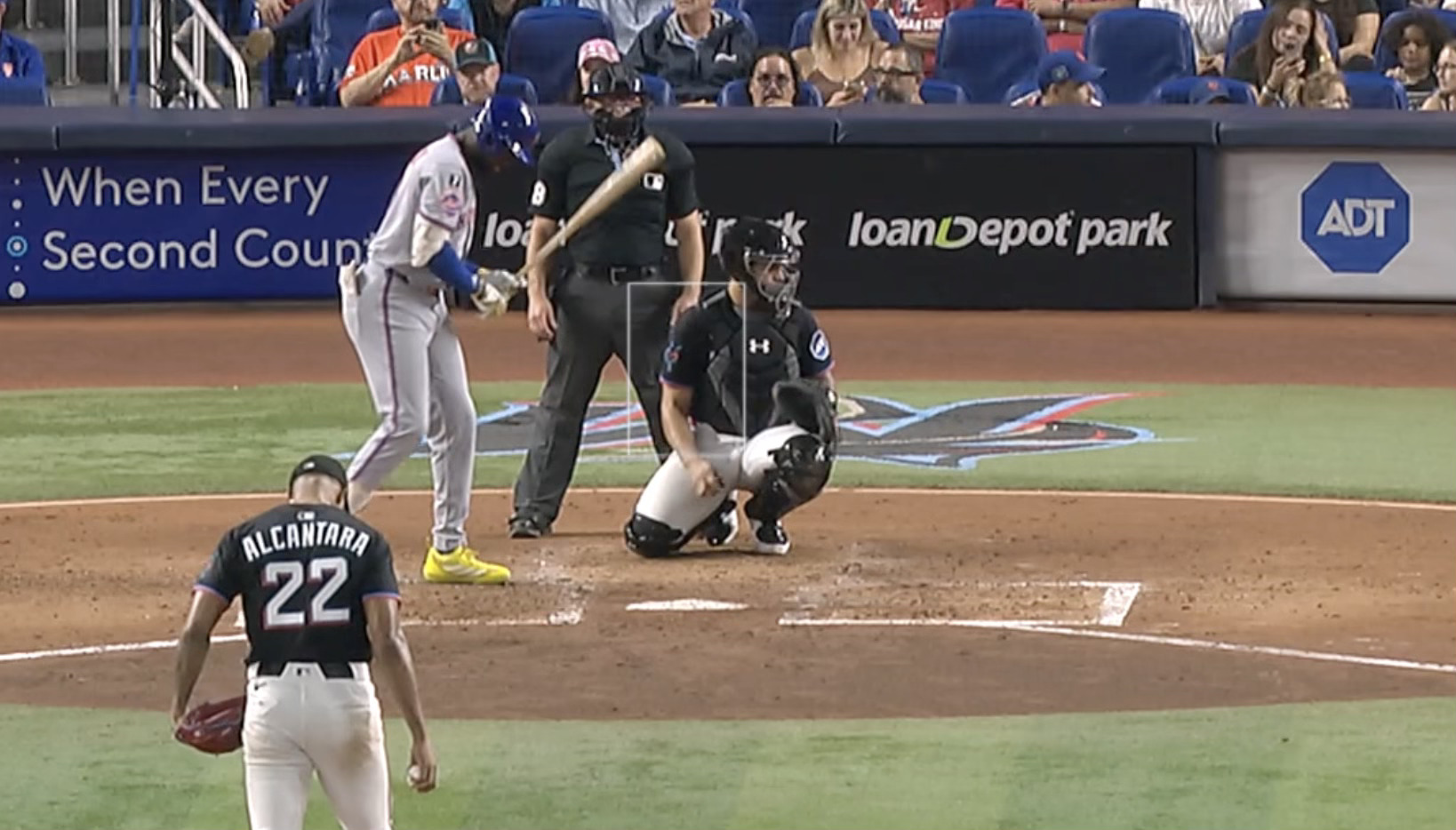
A decision sets baseball in motion, over and over, hundreds of times per game. The camera tells us where to look in the still moments. It observes patiently, a surveillance shot waiting for action. There’s the catcher and the pitcher. Hatching a plan. Which pitch? And where?
The built-in moments of scheming have taken a technological leap forward in recent years, because those cameras empowered some watchers to be too watchful. Gone are the cryptic combos of finger signals between the catcher’s legs; in the frame are little remote controls strapped to knee pads and gloves. There’s a whisper somewhere, look, the pitcher cups his hand over his ear, straining to hear. A clock counts down. Planning took to invisible frequencies, but the participants remained in view.
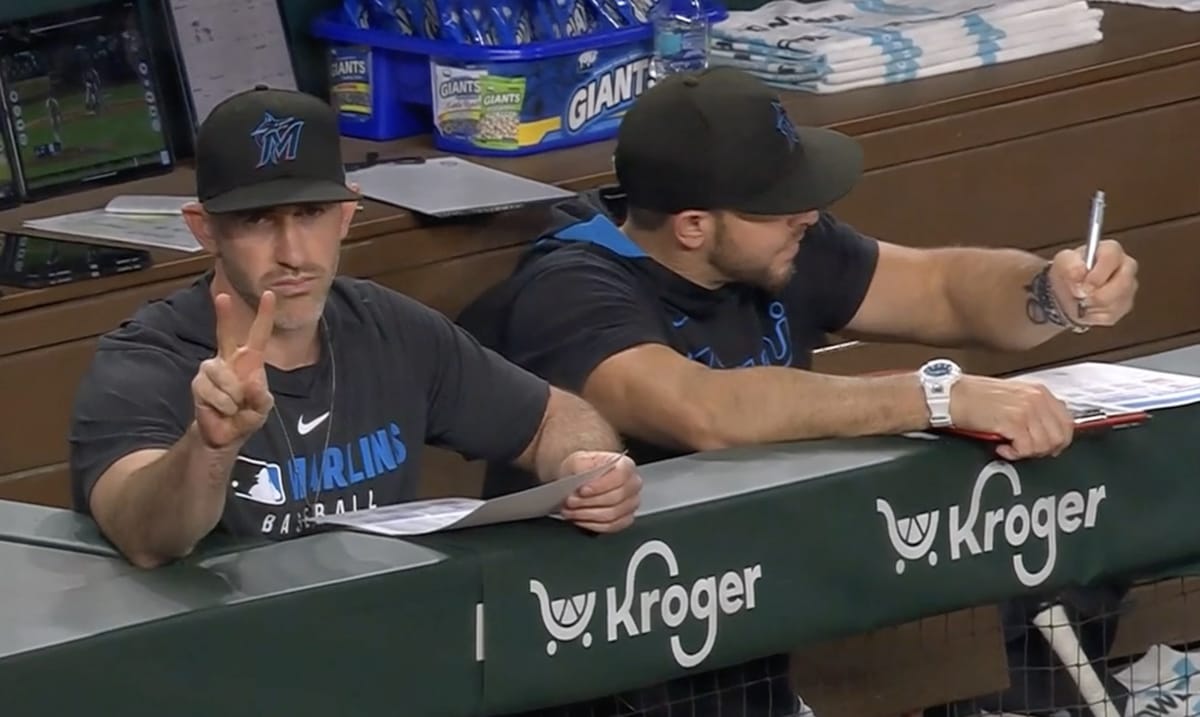
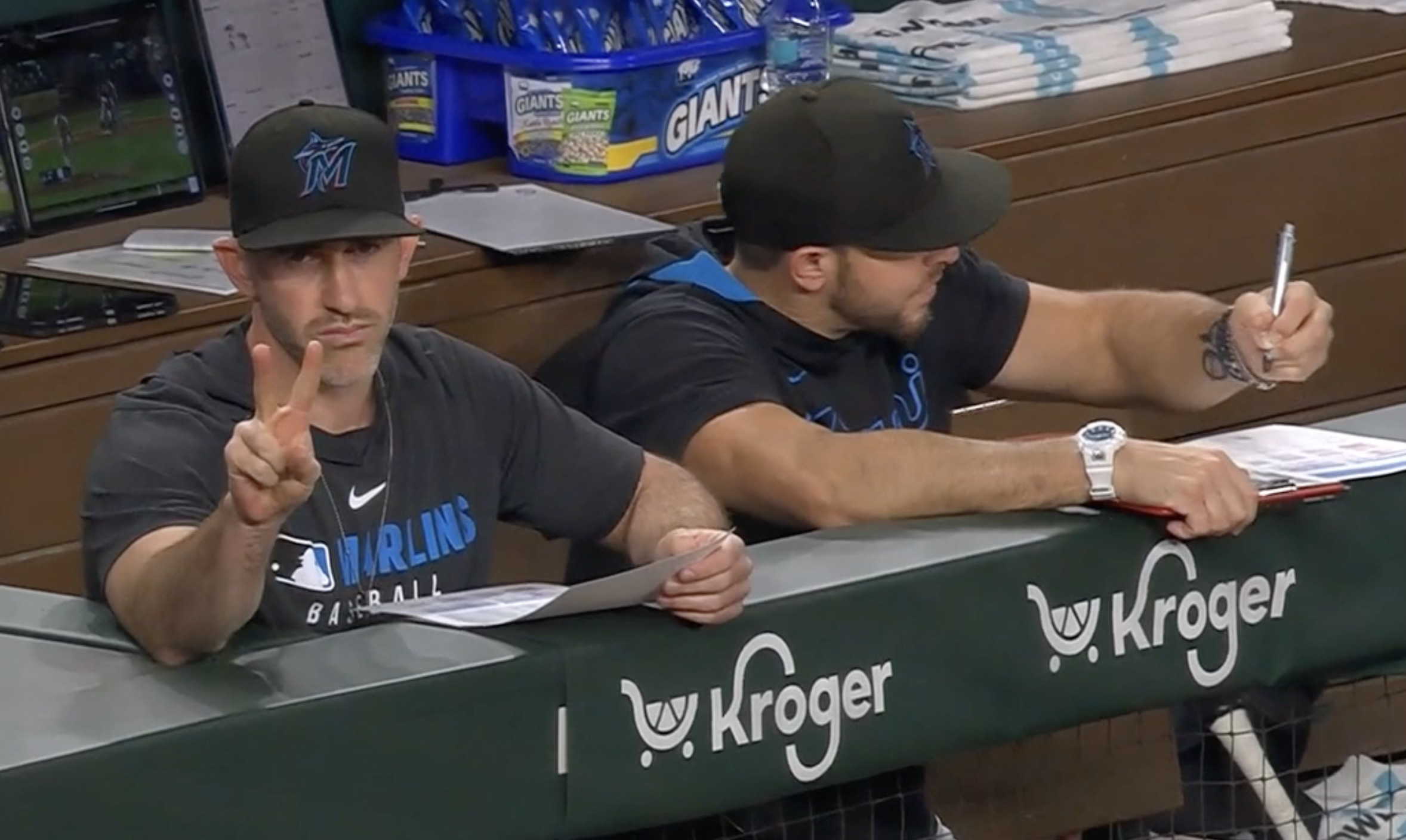
Then, last September in Miami, the call went offscreen. For the last nine games of 2025, Marlins catchers turned their heads between pitches to receive instructions. Assistant pitching coach Alon Leichman glanced at a card, then flashed upturned versions of the old catcher signals. Two fingers, then three or one or five. Another coach, on his left hip, scribbled into a notebook. On screen, we saw the relay.
Turns out, it was an experiment the Marlins had been running throughout their minor-league system under President of Baseball Operations Peter Bendix. In September, they piloted it in the majors under manager Clayton McCullough and pitching coach Daniel Moskos.
In 2026, they intend to buy in fully, with the dugout signaling in a first option for every pitch.
“It’s something that we truly believe is going to help us win more baseball games,” Bendix told MLB.com, explaining that new Marlins pitchers such as Pete Fairbanks and Chris Paddack were briefed ahead of time. “It’s going to help our pitchers get better results. We think it’s something that can be a real, meaningful advantage for us.”
As the astute pitching analyst Lance Brozdowski explained shortly after the Marlins implemented the policy, the advancing quantitative understanding of pitch quality allows teams to build decision-making models. These presumably populate those cards coaches use as a reference, and lend Bendix his conviction that the rigor of dugout-called pitches will improve upon the informed but intuitive traditional way.
If you watch football, it’s logic that evokes the modern instinct-proofing approach to fourth down decisions, combined with the look-to-the-sideline visuals of pre-snap adjustments. It’s a coordinator model without the headset, for now.
This is baseball wondering if its many smart off-field minds could wield influence over more on-field results. The Marlins won’t be the only team to reach that conclusion. They probably won’t be the only team to reach it in 2026.
The Giants plucked new manager Tony Vitello from the college ranks, where coach-dictated games are the norm. When The Athletic’s Andrew Baggarly wrote a great in-depth story on the idea this week, Vitello wasn’t as committed to calling each pitch, saying there likely wouldn’t be a hard-line rule, but said they would likely employ some dugout calls.
The Rockies, rethinking everything under new President of Baseball Operations Paul DePodesta, are reportedly going to experiment with it. They hired signal-caller Leichman away from Miami to serve as their lead pitching coach.
As for the Marlins, they promoted new assistant pitching coach Rob Marcello Jr. from their Triple-A affiliate in Jacksonville, where he called the pitches en route to a league title. Right now, the electronic PitchCom system can’t be used in the dugout, so they will all signal by hand to the catcher. But if it takes off, electronic options are already in play in the college game, and the PitchCom could probably be easily adapted.
If others around the league perceive it as a success, the dugout takeover of pitch-calling could combine with the automatic ball-strike system to begin a radical reshaping of the pivotal, ubiquitous catcher-umpire nucleus, the decisions being beamed in from above or below. It could make 2026 the year that the on-field game expands beyond the frame.
Game-calling aptitude has long been treated as crucial but mystical. A little over a decade ago, when pitch tracking technology reframed the immense value of catcher defense, proof of game-calling wizardry remained out of reach. Yet it arguably unleashed a bigger flood of anecdotal evidence than ever.
Vaunted Cardinals catcher Yadier Molina, at the peak of a career that will soon become a very interesting Hall of Fame case, inspired a series of quests to understand the art that kept hitters dispirited against St. Louis. In The New York Times, Tyler Kepner captured the reverence Molina earned from teammates and opponents.
“I’ve often heard guys say about Yadi, ‘Man, I feel like he’s a psychic,’” Brewers catcher Jonathan Lucroy said in the story. “He knows what you’re thinking, and he does the exact opposite.”
Behind this mastery of the cat-and-mouse game was loads of preparation, purportedly up to six hours a day. In this way — and in the updated patter of prep meetings informed by front office reports and data — pitch decisions have always been shaped by forces and faces that don’t meet the camera’s gaze. Still, there was an alluring simplicity to it — more spy craft, less scientific formula. Around the same time Molina was praised for his mind-reading capabilities, Red Sox legend David Ortiz was renowned for his proclivity to accurately guess the next pitch. He even complained about pace-of-play rules that he felt cut down on this time to step out of the box and think.
“I come out, I’m thinking, ‘What is this guy going to try to do to me next?’” Ortiz said to ESPN.
It made each at-bat sound like a game of Rock, Paper, Scissors. A series of split-second decisions, your own action inextricably intertwined with what you believed the opponent was about to do. It was a blend of speculative psychology, deception and pattern recognition. Then there was the actual pitch, of course.
As we’ve untangled more of the factors that make pitches more or less effective, a lot of the mythic qualities have dissipated — or crystallized in the amber of old stories about Molina or Greg Maddux.
An incomplete list of the factors influencing pitch selection now would include:
- Quality of stuff, predominantly. Clubs are measuring, and in turn constantly improving, their pitchers’ options to miss more bats. The most important thing is to throw nasty pitches in or very near the strike zone, and that guides the top line of coaching around the sport.
- Tunneling, or how a pitcher can pair selections to make pitches look the same for as long as possible in flight. Think high fastball, curveball that starts high and breaks down, hitter swings at the curve as if it’s another high fastball.
- Familiarity. A given pitch will get worse, from a pitcher’s perspective, the more hitters see it. That’s behind the times-through-the-order penalty, and the annual proliferation of new pitches.
- Situational patterns. Used to be, nobody swung at the first pitch of the game. You can see the Rock, Paper, Scissors play here. If the hitter defaults to rock (take) almost every time on the first go, you should default to paper (fastball down the middle).
- Pitcher status. Has the pitcher yanked his slider into the other batter’s box four times in a row? You might not want to call for that in a full count with the bases loaded. There’s also the increasingly pressing question of whether he is tipping any of his pitches, and if so, how?
- Hitter status. One of the apparent strengths of Molina and other esteemed catchers is picking up cues from swings. If the batter is late on a fastball, use that information.
The Rock, Paper, Scissors rationale put a lot of emphasis on the last two factors there, where uncertainty still reigns. Was the hitter late because he can’t catch up to the fastball? Or was he late because he was sitting on a breaking ball? Once you make that choice on a mental flowchart, how do you know whether that status will remain true on the next pitch?
You probably don’t.
Armed with a wealth of data, 2020s players and teams discuss tendencies and plan around the more measurable factors near the top of the list. They optimize strategies down to details as minute as the plane of a fastball against the preferred plane of a swing. Even before the Marlins’ experiment, it was clear the arc of modern pitching bends toward reading data off the TrackMan, not trying to get a read on things you can’t track, man.
If game calling used to evoke Rock, Paper, Scissors, it might be more like driving on a busy road now.
It asks for rapid multi-tasking and situational awareness. At a base level, you’ve got to know where you’re going. You’ve got to have an idea of the speed limit and the traffic pattern.
At your best, you’re running a mental odometer in reverse, counting down until your next turn, so you can glide across the necessary lanes instead of playing mirror frogger. You’re monitoring that minivan drifting into your lane, and tracking that 2008 Mitsubishi Eclipse with a spoiler and no muffler buzzing in and out of traffic behind you. Ideally, you’re remembering that your blinker sticks when you go left, turn that thing off.
My wife and I were in San Francisco this weekend visiting friends when we saw a Jetsons-esque empty bubble of a vehicle parking itself to wait for passengers.
“What’s that?” we, the puzzled New Yorkers, asked.
“Oh, that’s a Zoox,” our hosts replied, as if that clarified anything. Eventually, we came to understand it’s one of many self-driving vehicle start-ups competing to become the taxi of the future. In California, these vehicles are everywhere, with Waymo catching on as a popular way to get around.

Marlins brass has clearly done a good job communicating and selling the game-calling plan to their team. They say, reasonably, that this is meant to take a little bit of a load off catchers, who have a lot to worry about every day. Pitchers and catchers have overwhelmingly expressed comfort with it, aided by the longer-running minor-league implementation. And it’s not a matter of top-down marching orders.
“The catcher can still override the call,” Bendix said on MLB Network. “They’re still reading swings. They’re still having conversations in between innings. None of this is meant to take away the ability to add information you see in the game.”
What we, the fans, see in the game might be a more dramatic shift than how the catcher makes a call.
A guy in a hoodie making signals to (possibly) optimize his team’s play is arguably a phenomenon fans understand and love, if they watch football. They might even know their names if they are the type of fan that likes to praise or critique an offensive coordinator. But something about it in tandem with the mathematical models could understandably inch toward dystopian, a little shut the f*** up, I’m calculating win probability.
Most front office-aided elements of baseball up to this juncture inherently separate prep and play. The analysts and coaches work to impart knowledge and habits upon the players, then the action on the field plays out with little more than reminders at hand. The little outfield positioning cards in back pockets are probably very effective, but at their core they still evoke MapQuest printouts more than self-driving cars.
Are the dugout calls more like a little assist from Google Maps or an autonomous car with a dozen whirring cameras and an indecipherable stream of artificial intelligence at the wheel? Is the sequence of pitches designed to break bad habits and lean into strategic game plans crafted alongside the pitcher and catcher? Or is brain-scrambling randomness the ideal?
That might be a distinction without a difference. If the Marlins and others thrive with the assistance of a game-calling brain focusing on the process from the dugout, it’s certainly not a difference we’ll be able to see.