The stories we’ll tell ourselves about the 2026 MLB season
Six theories of how to become a bandwagon team

I make a small decision every year, about this time, that has a big effect on how I experience the baseball season.
On the MLB app, you can set your favorite team and any number of teams you “follow.” Whichever clubs get that special little nod will appear first in your scoreboard. I haven’t been a traditional one-team fan in almost a decade now, so before each Opening Day, I choose four or five teams that are striking a chord in my brain that spring.
By dint of knowing myself well or, more bleakly, the subliminal power of handing over tiny bits of attention real estate during the summer’s many, many check-ins, I find I really do invest more energy in those teams. They’ll be the main characters; everyone else will be extras.
We choose our own adventures for the seven months of baseball ahead. If this newsletter is about anything, it’s about expanding your horizons for that journey. You can try more than one path, more than one protagonist, and follow the ones that grab you.
So today, before Opening Day begins (it takes three days now, because of television), I’ve got some suggestions for the stories that capture people every year, and the teams that might live them in 2026.
It's Opening Day! Pledge your support to keep The Bandwagon going in 2026
The story of a lifetime
Your Protagonists: Seattle Mariners
A year ago yesterday, The Bandwagon launched with an issue that included Hannah breaking down how Jerry Dipoto, the Mariners president of baseball operations, had gone wrong in not just making his 54% comments, but dismissively bristling at the fan backlash. The gap between his cold, patient process and fans’ burning desire for the catharsis of a championship team was too much for the story to abide.
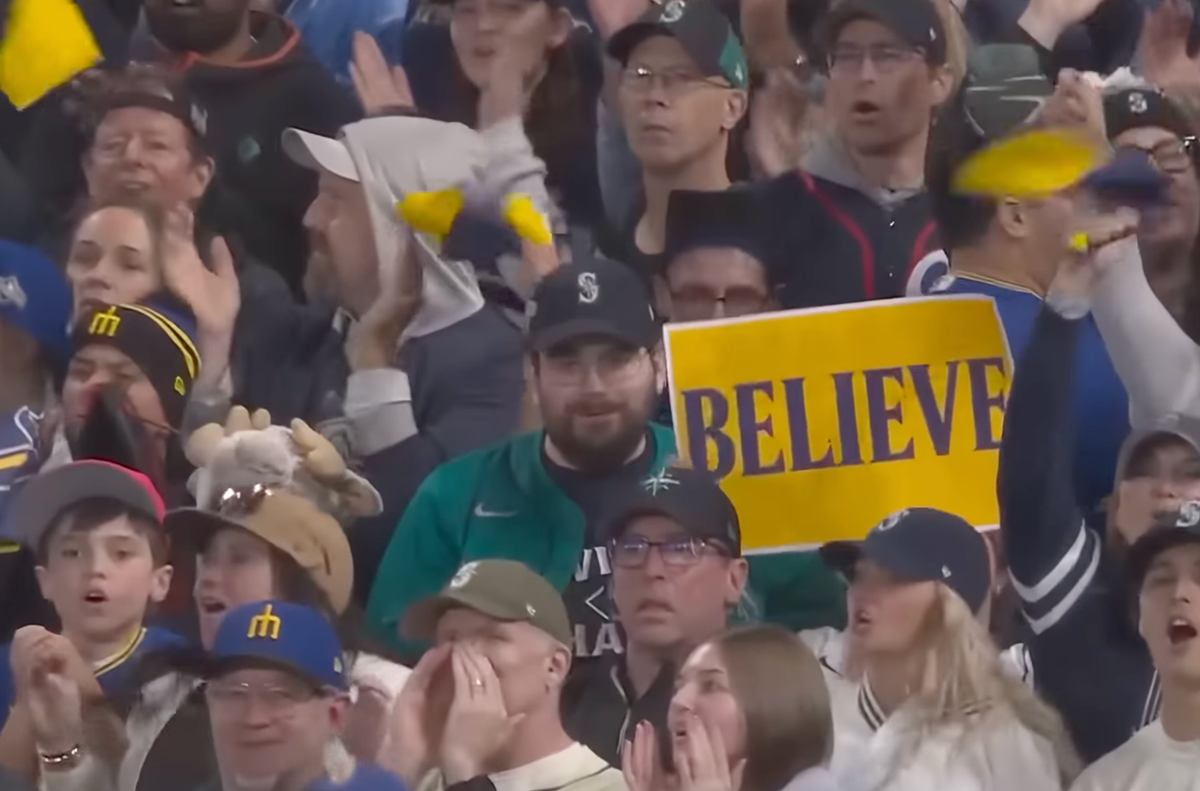
What a difference a year can make. Thinking about this year’s options, I realized that the Seattle Mariners are everywhere. Coming off Cal Raleigh’s 60-homer year and an ALCS run, they are simultaneously the most emotionally loaded team that could chase a title and the trendiest non-Dodgers pick to actually win the World Series.
Without actually changing much of their tact — their lone major free agent signing was retaining Josh Naylor, their big addition was the very good but not flashy Brendan Donovan — the Mariners have captured the public imagination because their players are compelling and their story seems to be building toward a climax.
Here, I could non-scientifically assert that this Mariners team has the most unifying pre-season hype build-up since the 2016 Chicago Cubs who broke the franchise’s 108-year World Series drought. I think that’s true, but I want to spend my unprovable assertion on something else: Theo Epstein’s gift was not breaking curses. It was marshaling the energy of the curse-breaking narratives to build good baseball teams.
Put another way: There’s a difference between maximizing situations where you can summon the force of organizational will and creating good baseball teams without the perception of history’s wind in your sails. And Epstein himself recognized this on some level. In a Wright Thompson profile during his Cubs years, the clash of business vs. baseball is referenced as a reason for the executive’s departure from Boston, where broke his first curse and won one more championship before bowing out in a maelstrom of high expectations.
He read reports about how winning alone wouldn't stop NESN's flagging ratings; the focus group data said his office needed to chase and sign the big-name free agents, whether the team needed them or not. Epstein felt the culture "jumping the shark.”
The story wasn’t good anymore. I’ve written about this in relation to Dave Dombrowski, but part of being a truly great baseball executive, especially in the 2020s, is creating or sustaining the willingness to view the next season as The Season, not just another 162 games of revenue opportunity.
If you want to see a team living unabashedly in its season of a lifetime, 2026 is about the Mariners.
The Season 2 story
Your Protagonists: Toronto Blue Jays
Or maybe it’s about the Blue Jays.
Inches from dethroning the Dodgers on multiple occasions, the Blue Jays have 2015 Royals energy. They play a low-strikeout, high-energy brand of baseball that enjoys near-universal approval. They have established their arc in a highly memorable Fall Classic. They seem to like each other.
And now they are coming back to finish what they started with Vladimir Guerrero Jr. as the committed leading man and the team mostly intact.
The one last job story
Your Protagonists: Philadelphia Phillies
The most interesting team of recent history without a title, the Bryce Harper era Phillies are approaching the ledge. Even with Cristopher Sanchez elevating himself into ace territory, the preponderance of key Phillies players are actuarially likely on the downslope of their careers.
Add in Harper’s simmering beef with Dombrowski (more on that tomorrow) and the clubhouse’s flirtation with ill-advised alternative medicine, and this is the team for anyone who enjoys the Real Housewives franchises more than they’d like to admit, goading strangers into yelling at them or fighting with the nature of time itself.
The Bryce Harper story
Your Protagonists: Pittsburgh Pirates
Yeah I know, the last one sounded like the Bryce Harper story. This is the Washington Nationals Bryce Harper story.
It’s very satisfying when one or two heroes join forces to actually elevate an otherwise moribund operation. The Pirates are the textbook definition of moribund operation. Paul Skenes is here, Konnor Griffin could arrive soon. If the Harper and Stephen Strasburg-led ascent from the basement to contention captured your interest a dozen years ago, the Pirates might be for you.
The Wet Hot American Summer story
Your Protagonists: Kansas City Royals
I hadn’t seen this classic 2001 movie about summer camp until my wife made me watch it in 2020 or so.
So, my impression of it was “holy crap, did everyone in this movie get extraordinarily famous moments after it was released?” Bradley Cooper and Amy Poehler appear in this very early in their careers. Others like Paul Rudd and the guy from Law and Order: SVU are present before their fame really coalesced. It has the effect of an accidental dream team. You’re watching a group that couldn’t have been assembled if everyone was aware of their future station in life.
I’m sold on the Royals as the most retroactively star-studded team of 2026. Everyone already recognizes the greatness of Bobby Witt Jr. But the World Baseball Classic accelerated the lore-building around Maikel Garcia and Team Italy maestro Vinnie Pasquantino, the stars who give the Royals a real chance to make noise in the AL.
I’ll throw my emotional chips down on more. On Jac Caglianone figuring out the majors to become a new exit velo prince. On Cole Ragans putting together a huge, healthy season that makes him more than a forgotten third banana in the AL’s left-handed ace grouping of Tarik Skubal and Garrett Crochet. On catchers Carter Jensen and Salvador Perez establishing some sort of veteran-rookie buddy copy dynamic. On the Royals as real contenders in a very hot American summer.
The Mine That Bird story
Your Protagonists: Miami Marlins
Mine That Bird is a horse. In the 2009 Kentucky Derby, the 50-1 longshot fell so far behind the pack that the announcer pronounced one horse “last of them all” about a third of the way through the race before realizing, no, there was another one back there. Then, Mine That Bird won.
An “impossible result” like that is vanishingly rare, but it’s among the most fun hopes you an harbor.
I cannot in good faith recommend you trust the Colorado Rockies or Los Angeles Angels — baseball’s true trail horses — with any of your emotional well-being, but I’m keeping an interested eye on the Marlins. With the coaches calling the pitches as signifier, they have a little of the grating energy of the smart-kid-in-the-room Rays, but they also have a lot of young players I’m pretty excited to watch. That includes pitcher Eury Perez and center fielder Jakob Marsee and new outfielder Owen Caissie and future pitcher call-ups Robby Snelling and Thomas White.
If there is to be a truly unforeseen team a-running through the pack in 2026, my money would be on the Marlins.
If you enjoy the coverage at The Bandwagon, pledge your support to help the project keep rolling in 2026
The Bullpen
⚾⚾⚾⚾⚾⚾⚾⚾⚾⚾⚾
Chad Jennings and Zack Meisel wrote a great story about the early knock-on effects and conversations around the Automated Ball-Strike challenge system, the big new thing making its regular season debut this week. One of the things I’m trying to do — serenity now style — is block out hand-wringing and watch for the amusing moments created by introducing new elements into the game. Reading this story inspired a few ideas for things that ABS might cause to happen, and I’d love to add more to my list (leave ‘em in the comments if you’ve got em).
An announcer gets very agitated because the K zone doesn’t match up with ABS
In that story, Jennings and Meisel write the evocative phrase, “there’s no such thing as the strike zone.”
Because the ABS system is customized to each player’s dimensions, there isn’t a single space, even hypothetically, that can be pointed to or outlined as The Zone. This will break people’s brains. Specifically, Jennings and Meisel raise it in relation to the K zones that appear as little translucent lines on TV broadcasts. While MLB asked broadcasters to avoid using those graphics to designate pitches as balls or strikes, the lines will still be in use.
Sometimes, their misalignment with the ABS source of truth will be laid bare. I predict at least one (probably crusty) commentator will experience a crisis of confidence in their understanding of reality live. I further predict I’ll enjoy it in a darkly funny way.
A player gets benched for a dumb or impulsive challenge
Tired, annoying: Pulled from the game for not caring enough to hustle.
Wired, comedic: Pulled from the game for caring so much you make a bonehead challenge.
Bonus points: If a manager rage-pulls a pitcher before his reliever is actually ready.
A catcher tries to frame badly to dupe a batter into challenging
This hypothetical is specifically addressed in the story, and it seems as though most catchers view the framing deke as a bridge too far, for now. They have enough to think about as it is.
The incentive here is clear enough. If a catcher receives the ball in such a way that the hitter is convinced it’s a ball, they could burn one of the opposing team’s challenges. The problem here is it’s a tough needle to thread. You have to get the umpire to make the right call, while duping the batter. If you dupe them both, you’ve put yourself in a position to risk a challenge, however sure you are of the pitch’s strike status.
I’m not convinced we’ll see anyone try this in 2026, but it will be very interesting if we do.
⚾⚾⚾⚾⚾⚾⚾⚾⚾⚾⚾
One unexpected ABS thing already happened. An umpire preparing to hear a ruling on his call had a hot mic moment, asking the robots / computers / gods to vindicate him.
⚾⚾⚾⚾⚾⚾⚾⚾⚾⚾⚾
Top prospects made rosters!
Tigers shortstop Kevin McGonigle, Cardinals second baseman JJ Wetherholt and Mets right fielder Carson Bengeheadline the list of prestige prospects who will make their debuts in Opening Day lineups.
There’s also a fascinating promotion a little further down the lists. The Phillies are making one of the higher stakes prospect introductions in the league. Justin Crawford, son of Carl, will start in center field for a team with pennant aspirations. He’s a former first-round pick who has batted over .300 at every minor-league level, so this looks good on the surface, but I’ll let FanGraphs’ Michael Baumann explain the rub: “Crawford isn’t just a groundball hitter; his 59.4% groundball rate in 2025 was the lowest of his career. It also would’ve been the highest by any qualified hitter in the majors since 2023.”
This could go sideways, could go blissfully Fine, or it could go Christian Yelich arrow to the moon. On a Phillies team where so many players are known, Crawford is a fast-moving question mark.
⚾⚾⚾⚾⚾⚾⚾⚾⚾⚾⚾
I wrote up predictions for Opta Analyst’s season preview, one story focusing on awards and the other on division winners and bold predictions.
I figure since I have it done already, I’ll share my forecast for the season — which is always part rational, part wishful, and fully wrong in due time.
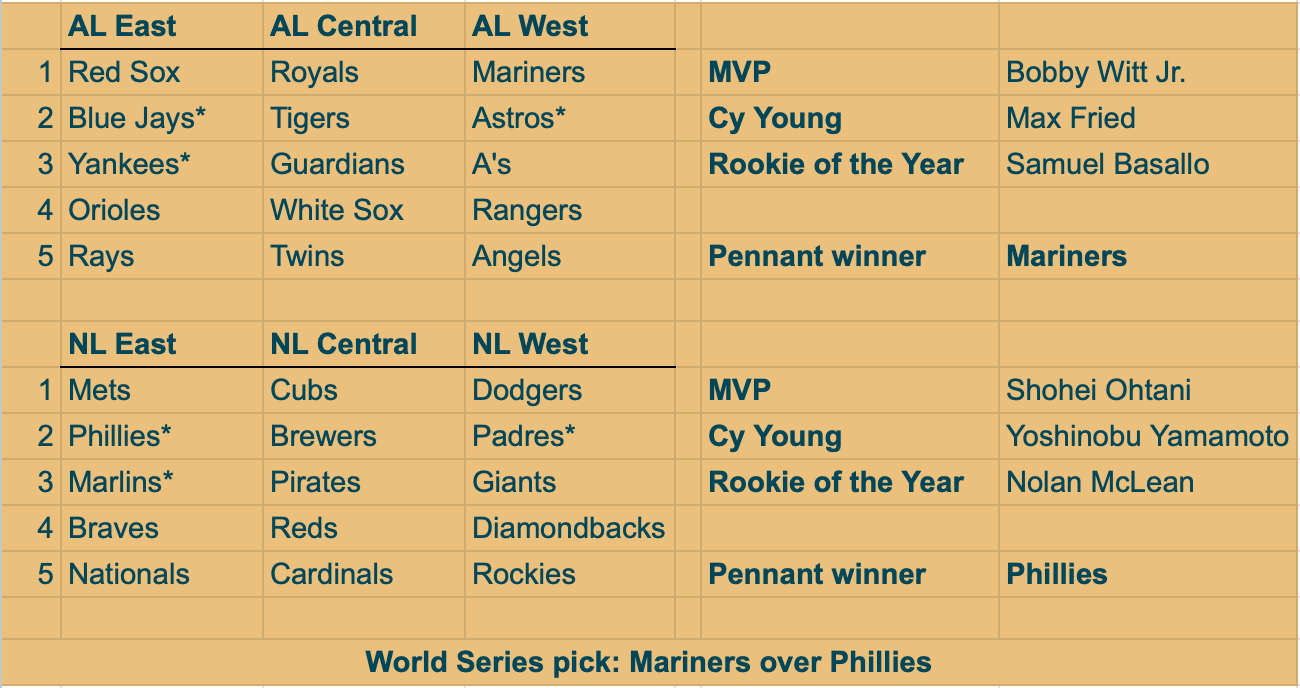
It’s a story I’m telling myself, and I lose control of the plot starting tonight.
I’ll be back tomorrow with a special edition providing a reason to root for all 30 teams.
If you made it this far, consider supporting The Bandwagon as it enters its second season, with either a recurring pledge or a one-time contribution.