The Three-Fastball Solution
Is this Pitch Design 3.0? Plus, Coaches4Hire.

About five years ago, a burger spot opened on my old street in New York’s East Village. But there was a distinction, a modifier. Not burgers, smashburgers. The hamburger, as a culinary dish, had always contained multitudes: various shapes, methods of preparations, bun customs, topping combos. Turning the thinner, crispy-edged burgers seared on a griddle — usually with the not-too-much triad of cheese, caramelized onions and secret sauce — into their own genre was both marketing and taste instruction. Yeah, that’s a burger, but what’s it like?
Fastballs are kind of like burgers. The great ones never get old, the bad ones make you sick, and the rest (the meaty middle?) tend to blur together.
When I wrote about Cam Schlittler last week, the Yankees phenom now sporting a 2.43 ERA through 21 career starts, it occurred to me that he might spark a smashburger moment for the humble heater.
Schlittler throws a fastball on 88.5% of his pitches, which is an especially high percentage for a starting pitcher in an era where fastball usage is waning leaguewide. It’s down to 54.4% so far this season, declining as sure as velocity is rising. Among notable recent starters, Schlittler’s sort of sustained fastball diet is associated with Lance Lynn, late-stage Bartolo Colon and very few others.
As you might have gathered, it’s not all the same fastball. While the pitch design revolution has understandably trained a spotlight, or at least a high-speed camera, on more narrowly defined secondary pitches like the sweeper or splitter or kick-change, pitchers have also been picking up new fastballs, lots of them. Schlittler and Red Sox ace Garrett Crochet have showed how premium velocity with small directional variations can create nightmares for hitters.
They are just the flashiest arms among a surge of starters consistently throwing three different fastball variations: Four-seam, sinker, cutter. After years of watching new bendy pitches, the most meaningful trend in pitching right now might be a story of subtle variety.
⚾️⚾️⚾️
It’s easiest to think about the pitch design era in two stages.
Pitch Design 1.0, which swelled up as Statcast data and improving technology empowered pitchers to manipulate the ball’s spin and movement with instant feedback, prioritized silver bullet pitches. The fire-breathing, bat-missing signature offerings that you could throw down the middle and send to PitchingNinja. Four-seam fastballs with lots of spin and lots of “rise” became the name of the game, along with hard breaking pitches to play off of them. The guys who mastered that formula pitched like closers who happened to throw 6 innings at a time. A lot of them were getting by (or dominating) with two pitches, end of list. Patron saints: Jacob deGrom and Spencer Strider.
Pitch Design 2.0 is about bigger, more intricate arsenals that tailor weapons to attack every type of hitter. The shift from a couple overpowering haymakers designed in a lab to a lot of targeted, tactical pitches (also designed in a lab) was probably inevitable by virtue of the lab existing at all. For one, technology started to catch up on the hitting side, allowing batters to practice against close replicas of the daunting pitches and get better at squaring them up. But maybe the best reason that pitchers kept testing and adopting new pitches is the simplest: Because they could. Patron saints: Paul Skenes and Zack Wheeler.
I don’t know if what we’re seeing now counts as Pitch Design 3.0, but there’s something happening with the diversification of the fastball. As Royals manager Matt Quatraro said in a story assessing Schlittler’s eyebrow-raising approach, “Everyone’s got them all — two-seam, four-seam, cutter. And with him, with the elite velo, it really, really compounds that.”
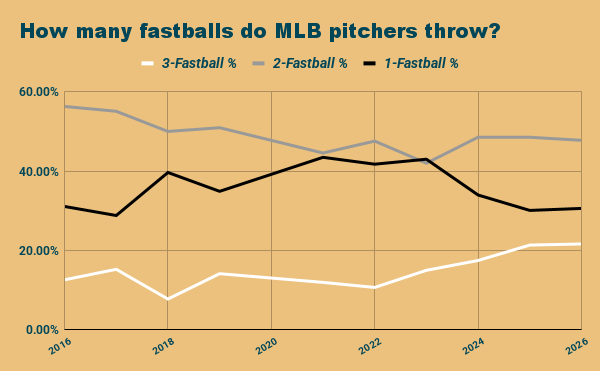
And while it’s not everyone, I suspected it was a growing number. Using Statcast’s pitch classification data, I went looking for changes in how MLB starters are deploying fastballs. I wanted to see how many of them were really using multiple fastballs — which I’m defining as a 10% usage rate or higher.

A two-fastball mix has long been the norm, except for the brief moment when it wasn’t. Now the three-fastball mix is on the come up. A total of 29 starters meeting our pitch minimum are throwing three fastballs in 2026. I made a big sortable table of their usage patterns and some basic stats on how they succeed (or don’t) that you can poke around in.

Even for those without three fastballs, the tide has definitely shifted away from a single fastball as a primary pitch. As of 2021, 58.7% of starters were still throwing one of their fastballs as 40% or more of their arsenal. This year so far, it's 30.6%.
It’s too vast a topic to make pronouncements about the efficacy of the strategy. Like everything else in pitching, the answer is going to vary on an individual level. For some, though, three fastballs is clearly a solution.
Several pitchers without the buzz (or velocity) of Schlittler and Crochet are thriving with fastball habits nearly as extreme, and they might light a path other pitchers will follow. Among them: 2025 Brewers breakout Chad Patrick and under-the-radar Rays ace Drew Rasmussen.
Rasmussen has suffered through several time-sucking injuries, diminishing his profile nationally, but he just doesn’t give up runs when he’s on the mound. Among pitchers with a (low) minimum of 400 innings since 2022, Rasmussen’s ERA is fourth in MLB behind only Tarik Skubal, Blake Snell and Max Fried. The way he talks about the logic of his heavy fastball approach (82% this year and 90% last year) is strikingly simple.
“Hitting’s hard to begin with. Velocity is probably the single hardest element to deal with. If I can throw you three shapes at a relatively similar velo, but they’re all doing different things, it’s just a guessing game at that point,” Rasmussen told Adam Berry at MLB.com. “If you have a 33% chance of guessing right, I can live with that. Especially because you could even guess right and do everything right -- and it might still be an out.”
Three-fastball pitchers tap into tunneling effects as the four-seamer goes “straight” (actually a bit to the arm side), the sinker bends further to the arm side to jam or freeze hitters, and the cutter veers down and to the glove side to get whiffs or weak contact.
Rasmussen told Berry that he developed his sinker because he needed something that moved in on right-handed batters, and really, on Bo Bichette. The then-division rival was giving him problems and he had, at that point, experienced the common issue of not being able to develop a good changeup.
You’ll hear versions of that from a lot of pitchers who wield multiple fastballs. They had a problem, and found a fastball solution.
Maybe they had one and developed another to solve a platoon problem. There is a whole swath of starters quietly or obviously utilizing totally different pitch mixes for different hitter handedness.
Maybe they had two and found the third just became more achievable with a more granular understanding of how grips and seams alter the ball’s movement in the air. Some particularly dexterous pitchers are using three variants but still running fastball usage rates around 50%. Think Max Fried, or the Guardians rookie changeup wizard Parker Messick.
Maybe they added another because it was one more thing they could throw for a strike while avoiding predictability. The motions required to throw the various fastballs are more surefire leaps than mastering certain breaking pitches or a changeup, and it stands to reason that command comes easier with a fastball.
Whatever the reason, I predict more pitchers find problems and try to solve them with new fastballs. So don’t lump all those fastballs together. You might be missing something big in a difference that seems small. ⚾️
The Bullpen
⚾⚾⚾⚾⚾⚾⚾⚾⚾⚾⚾
The Red Sox fired manager Alex Cora and half his coaching staff, and the Phillies fired manager Rob Thomson. Boston’s dugout purge, handed down by Chief Baseball Officer Craig Breslow not even a year after the similarly sudden Rafael Devers trade, did not go over well with the players.

The fact that they shipped the dismissed cadre of staffers out of Baltimore on a bus from Coaches4Hire took on new meaning when it later became clear top Phillies executive Dave Dombrowski almost immediately tried to hire Cora to replace Thomson.
Meanwhile, the Mets are 10-21 after a 3-6 record on a home stand against the Twins, Rockies and Nationals that felt like Carlos Mendoza’s last stand, but as of this writing he remains in charge.
I don’t know what to make of managers getting the boot in April, especially uniformly successful ones like Thomson. His Phillies tenure ended with a .568 winning percentage (a 92-win pace) and a 100% record of reaching the postseason — even in his partial first season, when he engineered or at least empowered exactly the type of turnaround that I guess the Phillies are trying to recreate by in turn firing him now.
I would have ranked the three big-expectation, big-problem April teams this way in terms of being justified in making a managerial change, from most to least: 1. Mets, 2. Red Sox, 3. Phillies.
With the actions they have taken, I think the fan satisfaction and optimism levels are highest with the Phillies. I don’t know who’s lower among the Red Sox and Mets but in both cases it’s bad. That seems to be what the manager is for, in the eyes of many executives. It’s an action one can take to signal change or urgency or control of a pretty uncontrollable situation.
Under the cover of those much-discussed teams, other postseason contenders like the Blue Jays, Astros and Royals are below .500, and the Mariners are right on that mark.

The standings could go the whole year in a state of weirdness, but I’d venture to say at least one of the panicking deep-pocketed clubs makes the playoffs.
⚾⚾⚾⚾⚾⚾⚾⚾⚾⚾⚾
Speaking of Red Sox personnel mistakes, play-by-play guy Don Orsillo remains a treasure.
Is Don Orsillo's "HOLY SHEETS!" call the best call in baseball right now?
— Foul Territory (@FoulTerritoryTV) April 28, 2026
(Via: @MLB) pic.twitter.com/zQoCKZROd6
⚾⚾⚾⚾⚾⚾⚾⚾⚾⚾⚾
I think we might have a new term for the baseball lexicon. In a Zack Meisel story about the strategies behind ABS challenges, Reds pitcher Andrew Abbott said this about the moments when a contested pitch barely touches the zone on the graphic, and thus becomes or remains a strike: “It’s the most beautiful thing ever when it’s a clipper.”
A clipper!
Not a weird new pitch grip, but at least one man’s term for the strikes with the slimmest of margins. I like it. Maybe we can get Clippy on broadcasts to provide explainers about the zone or leverage or something.
⚾⚾⚾⚾⚾⚾⚾⚾⚾⚾⚾
Lastly, I have an idea that must be elevated to the highest levels of the San Francisco Giants organization for consideration. There’s a gigantic sea lion named Chonkers who has taken up residence in San Francisco.
Since he is giant, and a fun, fleeting symbol of the city, it only makes sense that the Giants would create a fun, fleeting City Connect uniform in his honor and become the Chonkers for a few games.

They can start by adapting the uniforms of the San Francisco Seals, a storied Triple-A team that played in the city prior to the major leagues migrating west.
Let’s make it happen.
⚾⚾⚾⚾⚾⚾⚾⚾⚾⚾⚾
Made it this far? You must be a fan. If you enjoy the work here, please consider pledging your support to help maintain The Bandwagon as a viable project.
- Become a Fan for just $4 a month or $40 a year.
- Become a Diehard supporter for $8 a month or $75 a year.
- Make a contribution in the amount of your choosing. Maybe $26 to power the newsletter through 2026.
- Forward this newsletter to a friend. The more fans, the merrier.