The Zone of Uncertainty
Where are MLB's players and umpires confident in the ABS system's zone? And where is there room for growth?

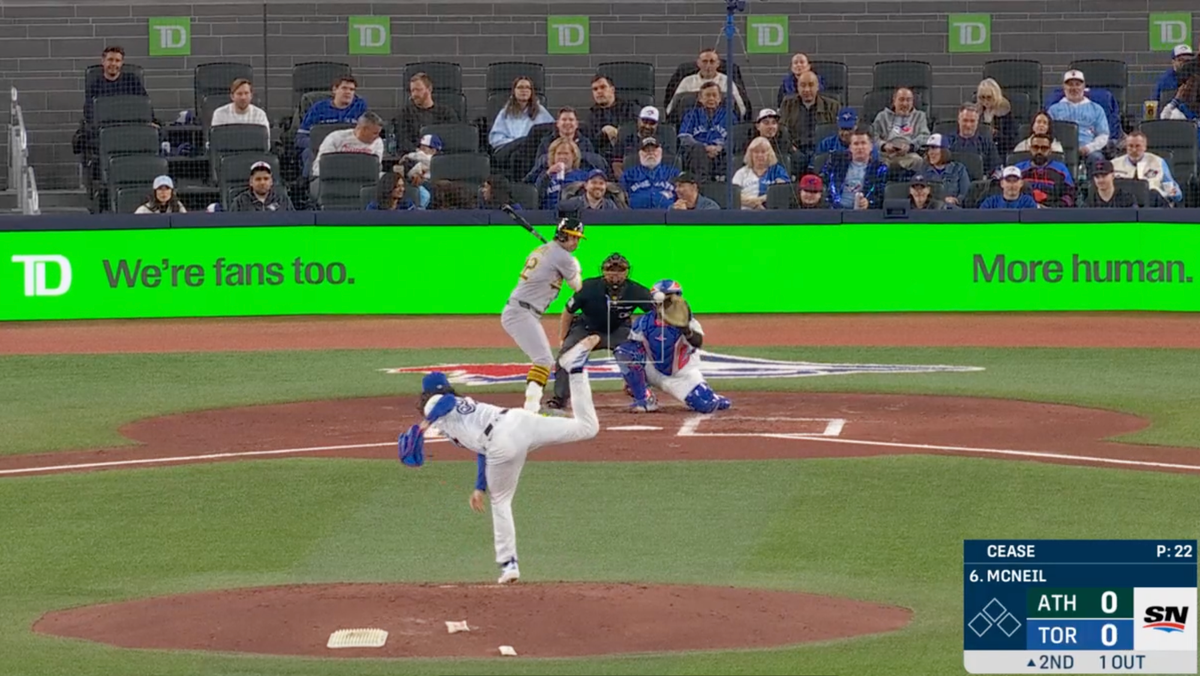
If you gave every ballplayer and umpire and coach truth serum, then asked them how well they know the strike zone, how many do you think would rate themselves better than average? My estimate: Something close to “all of them.”
Which of course can’t be true. Without a concrete reason to challenge their own self-assessment, people tend to place themselves highly on mental leaderboards. In a recent YouGov survey of thousands of Americans, only 4% of respondents said they considered themselves to be of below average self-awareness. So 46% of them would be particularly floored if someone rolled out a head tap system for proving social faux pas.
Given some experience to the contrary, or understanding the prospect of a test, we become harsher judges of our own abilities. Only 15% of respondents said they were above average at running — perhaps mentally skirting the follow-up: Oh great, so what has your average mile time been recently?
MLB’s automatic ball-strike system is a challenge measured in challenges. It is transforming a broad trait like intelligence (56% above, 6% below, per YouGov) into something more specific like mathematical ability (32% above, 26% below). And its best analogy might be the first day of school, leveling up from trigonometry to calculus with a pop quiz. The basic ideas might be familiar, some will be better prepared than others, but everyone is feeling out new territory.
There are many, many avenues of inquiry that will be worth studying around ABS, though most are best left for a later date.
But today I thought we could take a look at the learning curve in its early stages. Where are baseball’s players and umpires being confronted with what they aren’t actually sure of? Where is the concrete (if invisible) reality of the newly defined zone clear to them, and where is it still a shot in the dark?
⚾️⚾️⚾️
The zone has been on a diet for years.
FanGraphs’ Davy Andrews showed last year, with a series of illuminating charts, how the more precise technology of Statcast and increased scrutiny of umpires had already combined to tighten up the strike zone over the past decade. The effect was a taller, skinnier zone and a thinner strip of toss-up territory.
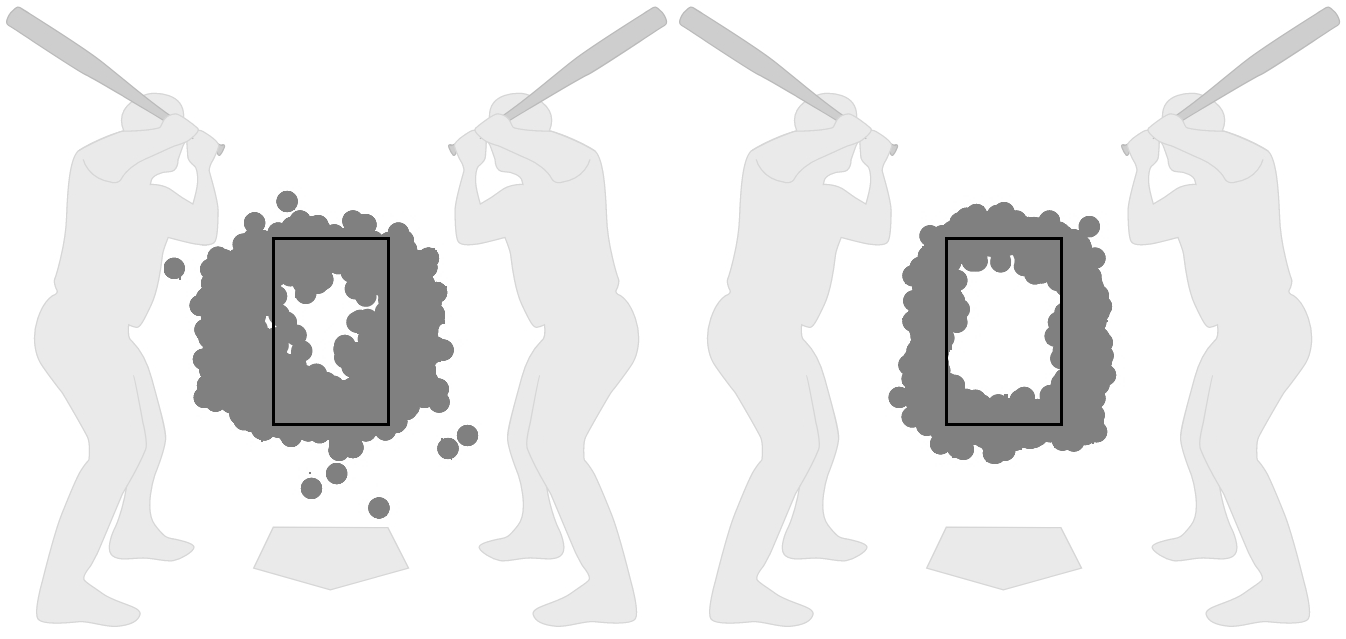
The ABS system is a more strictly enforced version of the zone that was already reshaped through attention and exercise. Like Ozempic, or a corset.
The two-per-team limit on unsuccessful challenges introduces scarcity and strategic considerations, leaving the vast majority of calls unchecked in the moment, even as the ABS system hums along printing binary judgments in the background. Layer that catalog of the umpire’s trained decisions and the players’ most confident guesses on top of the answer key and you begin to shade in the parts of the zone where everyone involved might need to confront uncertainty.
Using Statcast data, which in 2026 charts pitches by the ABS zone, I compared this season to recent history using a three-year sample of 2023-25. With the zone broken down into nine segments and the space outsize the zone broken into four, I checked on the percent of taken pitches in each section that were called strikes (a number that includes the resulting calls from overturned challenges).
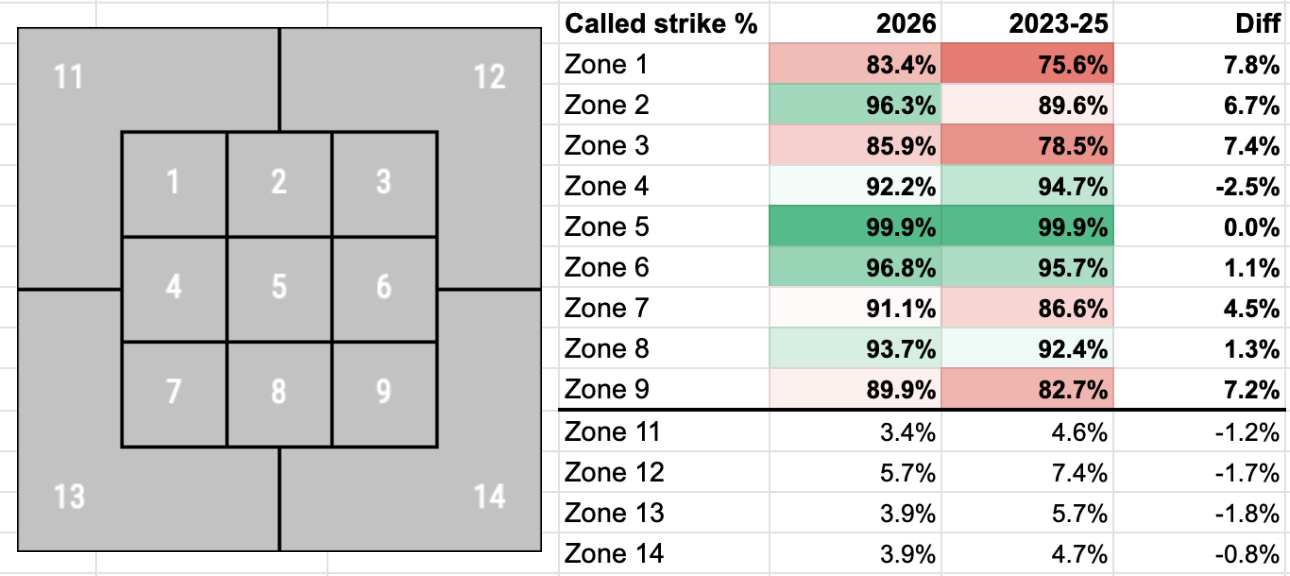
In short: The top corners of the zone are the toughest to gauge.
Zone 1, which is up and in to right-handed hitters (or up and away to lefties), is where you’ll find the highest percentage of technical strikes not called that way and the newly added strikes compared to previous seasons. Zone 3, its mirror image at the top of the zone on the other side of the plate, is second on both fronts.
Factor in handedness and you see that the up and away pitch is the strike most often missed, which makes sense. They are the pitches furthest away from the most nebulous reference point. Only 81.1% of Zone 1 pitches to left-handed batters are called strikes, compared to 86.8% for righties.
A smaller but directionally similar gap exists for Zone 3. Zone 9, which is the heavily trafficked area down and away to right-handed batters, is the only other zone where less than 90% of would-be strikes are being called that way.
This is a strike, per the ABS system, but not a pitch that everyone has internalized as such. The very first ABS challenge in major league history, by the Yankees’ Jose Caballero, was a Zone 1 pitch accurately but perhaps jarringly called a strike. (Glad Netflix deigned to catch the pitch on camera.)
Those numbers mainly concern the umpires, who are familiar with their task even as it now comes with more, uh, opportunity for accountability. Their behavior, consciously or not, is evolving further toward matching the prescribed zone. In all but one region, they are beating their 2023-25 marks by the system’s binary standards of correctness.
So how are the players fairing? They theoretically get to be the proofreaders of the zone. They flag things that look wrong. But they also have far less experience making those snap judgments.
In the early going, the players’ confidence levels in assessing the zone don’t diverge that much with the umpires who spent years informing that understanding. That leads to plenty of those razor-thin margins, yes, but more importantly: Challenges are being spent on low pitches, where the umpires are relatively more effective.
If players were operating at a high enough level of confidence to use their challenges with an understanding of the umpires’ tendencies, they would theoretically be tapping their heads on high pitches at the corners more frequently and winning more often than in other parts of the zone. Because that’s where the umpires are most misaligned with the ABS zone that can overrule them.
I wanted to quantify this in a way we could track as confidence levels and strategies evolve. Where do calls go totally missed (by the ABS system assessment) and where do they get overturned? There will always be more wrong calls than challenged ones in a system with limited challenges. How many, and where, is the question. I’m calling this the Wrong to Win Ratio.
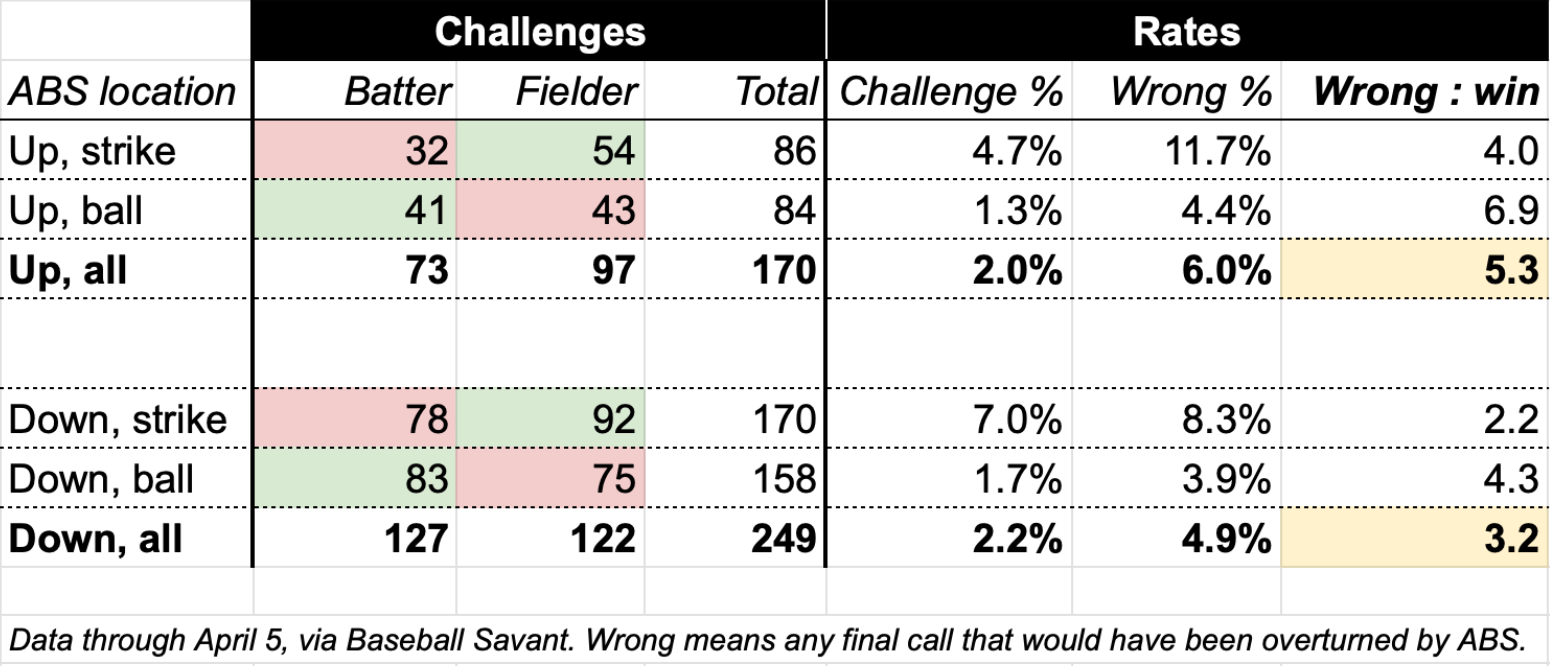
High pitches are leading to more missed calls (and more missed opportunities), with 5.3 incorrect calls for every successful challenge. Low pitches are generating only 3.2 missed calls per successful challenge. That tracks anecdotally, too.
“I think guys that are tall, even catchers, are having trouble determining what is the top,” Twins manager Derek Shelton told The Athletic. “Where does it go? The challenge for umpires is going to be ‘How high does it go now’ compared to previous places?”
If learning happens as you’d expect, the ratio should go down. Umpires should miss fewer calls relative to the system judging them — we can see that’s already happening compared to previous seasons — and players should improve at spotting and challenging those misses. Disregarding the risk aversion of game-situation strategy for a moment, teams should be chasing ways to flip the greatest number of incorrect calls in their favor.
Education will have an impact. Even with catchers the demonstrating the most aptitude for challenges, 7.6% of ABS strikes are still being called balls, while only 4.1% of ABS balls are winding up as strikes. The learning curve, in other words, should favor pitchers.
That’s an intended consequence, in a way, but it might have unintended ripple effects. As Russell Carleton wrote at Baseball Prospectus when MLB was testing the ABS system, turning toss-up pitches into surefire strikes is “going to mess with the whole ecosystem.”
Batters respond to increasing probability of a strike by swinging more often, because their other option is accepting a higher likelihood of a strike. Would they be incentivized to chase worse pitches that the evidence shows that they have a harder time making contact on?
For now, everyone is in this together — watching, absorbing, waiting until maybe becomes a reflexive yes or no.
Hope you enjoyed this early deep dive into the challenge system. I'll be back with bits and bobs in a bonus issue later this week.
Pledge your support to keep The Bandwagon going in 2026