Tommy Pham is the MVP of baseball access journalism
Plus: Venezuelan baseball impact, head-scratching deals for Japanese stars and Kyle Tucker's market
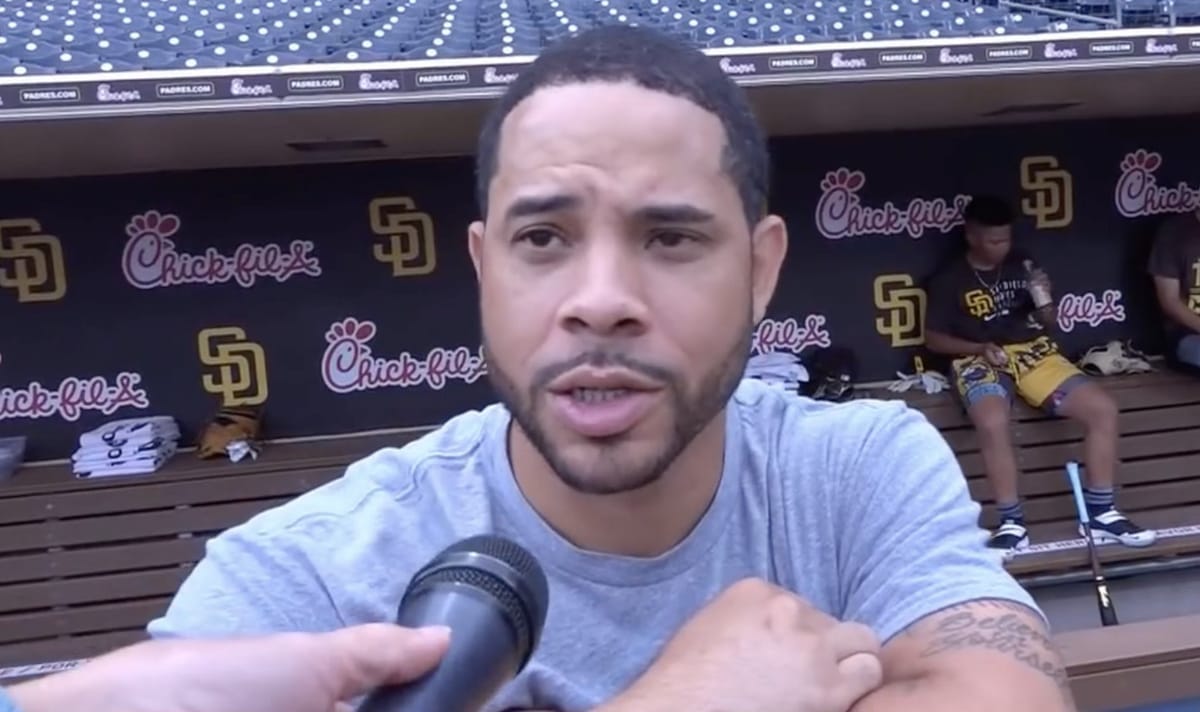
You might have seen that Tommy Pham has some ideas about stats that would make Tommy Pham look better.
The free agent outfielder, who turns 38 in March, is aiming to land a contract to play his 13th MLB season. And this week, The Athletic published a story dedicated to the ways in which Pham says player performance is “not being quantified like it should.”
His “pitch” is pithily titled — PhamGraphs, admittedly very good — but it’s nebulous and solution-free. Really, it’s just two long-known hurdles to player valuation highlighted, small problems turned into a big article for online discussion by virtue of a major leaguer acknowledging them.
Substance of those aside for a moment, Pham is portrayed in the story as a thoughtful, plugged-in participant in the business of the game, and that I can whole-heartedly agree with. He has indeed developed his own personal strategic lane. But it’s not about stats or clubhouse vibes or a winning mentality. It’s about hustle. The hustle to remain relevant — to be quoted, to be mentioned, to be written about far more than on-field value would dictate at this stage of his career. If WAR stood for Words Above Replacement, well, PhamGraphs would be the authority.
Let’s quickly touch on the statistical issues he raises: That hitters who repeatedly face excellent pitching don’t get enough of a positive adjustment, and that defensive metrics don’t account for difficulty added by the wind and the sun. He connects that first thought to his time playing for the Pirates, a bad team that nonetheless played tight, low-scoring games, and therefore (in his estimation) faced a disproportionate number of high-leverage relievers.
As the story points out, Baseball Prospectus’ main hitting metric, DRC+, does account for individual pitcher matchups, and did rate Pham as a slightly better hitter in 2025 (98, or 2% worse than league average) than the more commonly cited OPS+ (95) and wRC+ (94) numbers used by Baseball-Reference and FanGraphs.
Upshot: It’s an issue worth considering, but it’s small and unlikely to alter the assessment of a player who gets regular at-bats. In Pham’s case, we have a good idea of who he is. Of the 229 hitters who have accumulated at least 1,000 plate appearances since 2023, Pham’s overall value ranks 192nd by FanGraphs WAR and 193rd by Baseball-Reference WAR. Stretching back to 2020, Pham is one of 93 players with at least 2,500 plate appearances. He’s 86th in wRC+, 86th in good old OPS and 90th in FanGraphs WAR.
I was texting with Hannah about the story, and we decided there was a more extraordinary question at hand.
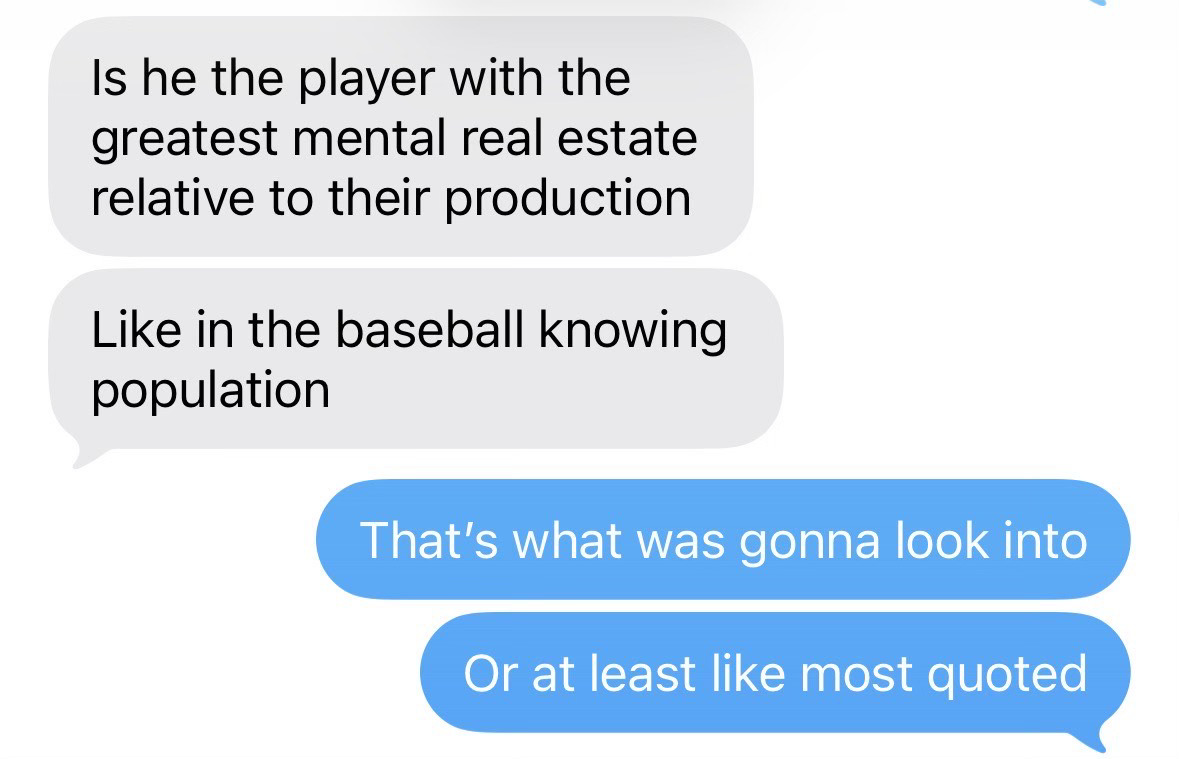
Pham has played for six teams since 2023, one of which went to the World Series, so the flood of transactions explains some coverage. But his value has turned into a consistent cause célèbre among industry insiders that dwarfs any attention paid to similarly valuable and similarly well-traveled names like Mark Canha, Jorge Soler, Randal Grichuk and Ty France.
Mulling that question, it’s hard to avoid the fact that most players who generate this much coverage relative to their production do so by playing poorly or not playing at all. (And also might be named Anthony.)
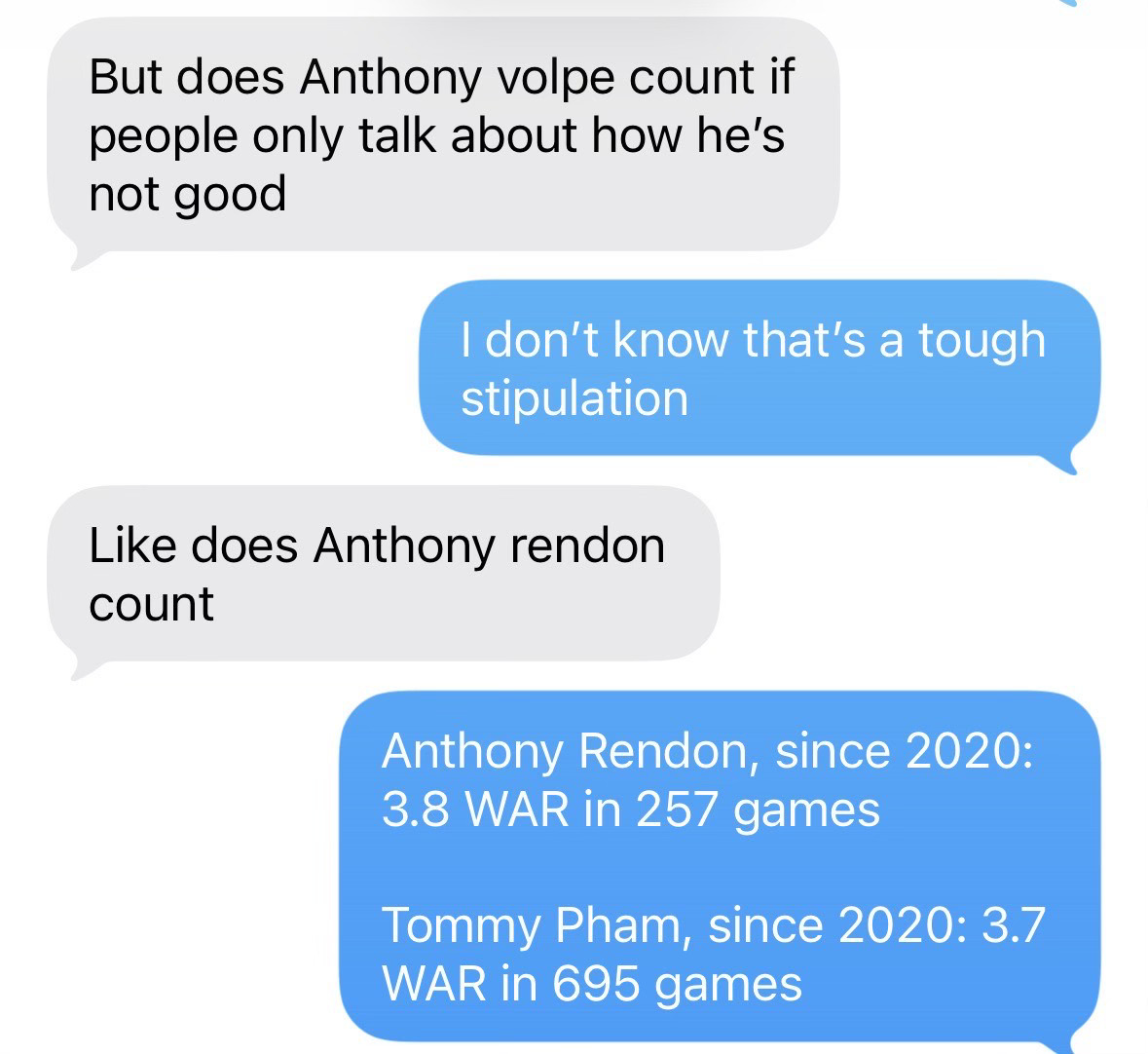
That’s not Pham’s issue. He’s a veteran role player with some strengths and some limitations, and teams treat him as such. His ubiquity in baseball news doesn’t stem from misaligned expectations or being a weak link on a prime contender. It’s something else, and it’s pretty, pretty clear what that something else is.
In this week’s PhamGraphs story, he’s introduced as “a 12-year veteran outfielder with a reputation for speaking his mind.”
Earlier this offseason, The Athletic used a section of a notebook article to quote Pham explaining that he played through plantar fasciitis in 2025, and that he wants to play until he reaches 200 homers and 200 steals.
During the 2024 World Series, he joined The Athletic’s live game coverage and made headlines for his characteristically feisty response to the incident where a Yankees fan interfered with Mookie Betts.
When he signed a minor-league deal with the White Sox in 2024, he was described as “the free-agent outfielder who helped the Arizona Diamondbacks reach the 2023 World Series last season only to be unemployed for the next five months.” Earlier that winter, his slow market was mentioned in one story before Blake Snell’s, probably thanks to the detail that he was working out every day in Las Vegas waiting for offers.
In a glowing September 2023 feature, The Athletic wrote: “In a sport overflowing with monotonous characters programmed by the rigors and repetitions of a 162-game schedule, Pham stands out because he’s unafraid of speaking his mind and carries an edge.”
In July of 2023, The Athletic wrote about Pham’s trade value, extensively quoting him on his own contract situation and the machinations of the trade market. Writer Will Sammon, who is also one of the authors of this week’s story, explains that “penetrating Pham’s gruff exterior reveals his baseball smarts.” He continues:
Pham appreciates direct communication and speaks with candor. Other players facing trade speculation may shield behind cliches and use a line like, “I can only control what I can control.” Not Pham. Even in discussing where he stands in the trade market, especially compared to last season, Pham keeps things real.
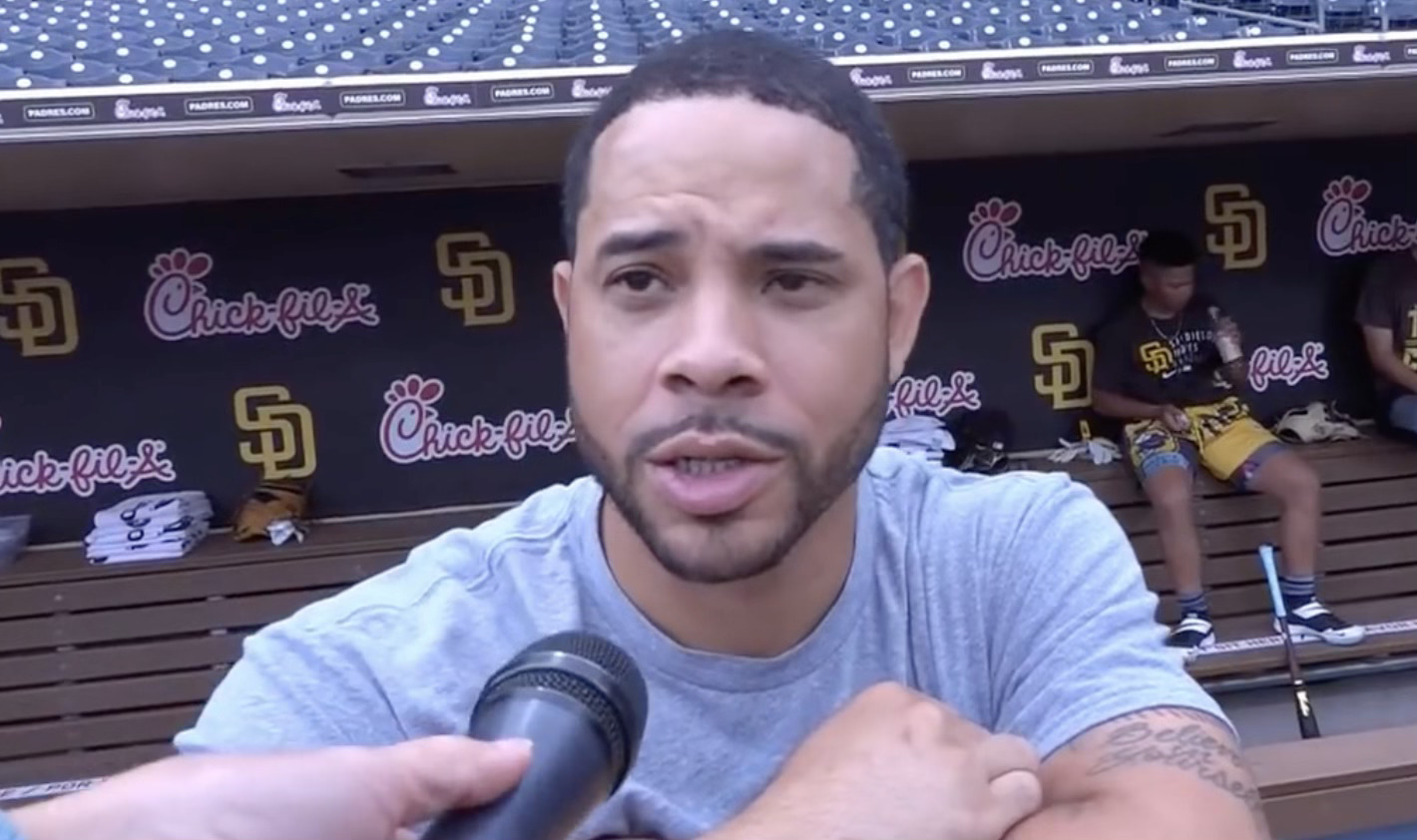
I don’t know the functional limit or market value of being a good and useful quote who always responds to reporters, but Pham might be running the best test we’ll ever see.
(It’s also fair to question whether he’s the ideal candidate for such attention. Along the way, he got into at least two spats with fans, one of which resulted in a suspension, and erroneously accused the Blue Jays’ Addison Barger of taking steroids. That seems to be the one time he didn’t want to talk to The Athletic.)
It’s clear Pham appeals to big-league clubs without stating his case through access journalism. He has a long track record of strong exit velocities and occasional scorching hot streaks. Several of those stories quote longtime baseball people explaining his positive contributions within clubhouses and on the field, and I doubt MLB front offices are influenced by his ever-present appearance in media reports. So there must be a reason, even subconsciously, that Pham so persistently and openly engages with writers.
He obviously studies the game and has some acumen for the concepts that drive player evaluation. That’s not true of everyone, but plenty of sharp players have that. Perhaps he’s interested in a career in media when he’s done playing. Maybe he feels undervalued or undersold by his representatives. Maybe he just likes the reporters he’s chopping it up with. Whatever the rationale, what Pham apparently has in spades is a willingness to speak bluntly about contract situations and clubhouses, about his own goals and obstacles and desires, topics that often elicit silence or nothing-burger responses.
For that tendency, he has value to the writers, and to the fans who want something interesting to read.
I think we’re getting a bigger dose of Tommy Pham over these past few years than reality prescribed. But in a way, I hope his tactics work in his favor in some demonstrable way, because there are a lot more players who I’d like to hear from with this level of candor and consistency.
The Bullpen
⚾⚾⚾⚾⚾⚾⚾⚾⚾⚾⚾⚾⚾⚾⚾
MLB clubs scrambled this weekend to make sure their Venezuelan players and coaches were safe following the United States raid that captured President Nicolás Maduro, per reports from ESPN and The Athletic. For now, many reported a sense of relief that the current state of affairs will allow for travel ahead of spring training.
If there’s anything to be sure of, though, it’s that we can’t expect uneventful stability.
Hundreds of baseball-related lives are going to interact with this geopolitical cauldron. Stars like Ronald Acuña Jr., Jackson Chourio and Jose Altuve hail from Venezuela. Same for Hall of Fame candidates Felix Hernandez and Bobby Abreu, and Mets manager Carlos Mendoza. Some of them are there right now, and we can only hope their stature in a culturally significant game will offer them the best chance to keep themselves and their families safe.
MLB, meanwhile, appears to be treading carefully. In that report from The Athletic, “A spokesperson for Major League Baseball declined to comment on the situation in Venezuela.” It’s likely the league wants to avoid drawing the attention or ire of the Trump administration for as long as possible — after all, it took several layers of political intervention to get a Venezuelan Little League team into the country over the summer.
But the spotlight is going to shine on baseball’s deep connection with Venezuela soon enough.
Venezuela will be competing in the World Baseball Classic in March, with a team of high-profile players who might have opinions about what’s going on. It’s possible the players are happy with the outcome of removing Maduro, but who knows where things will stand in Trump’s effort to “run” the country by March. The league once barred Willson Contreras, an outspoken Maduro critic, from wearing a Venezuelan flag sleeve during a period of mass protests.
This is only the beginning of a dangerous chapter in a very long story. I’d encourage you, if you’re interested, to absorb some of the context and history around Venezuelan baseball and the country’s influence on the majors. Baseball Prospectus ran a terrific multi-part series by Zack Moser a few years ago, and touched on the evolution of recent famous Venezuelan faces earlier this week.
⚾⚾⚾⚾⚾⚾⚾⚾⚾⚾⚾⚾⚾⚾⚾
In lighter news: Jason Benetti, current Tigers and former White Sox play-by-play voice, is the favorite for a lead national role with NBC as the network prepares to take over Sunday Night Baseball, per Front Office Sports.
I’m pretty interested to see what NBC does with baseball. The network tends to go big on its showcase Sunday night events, from Sunday Night Football to the heavily advertised return of the NBA. It could certainly be a boon for baseball if the same approach makes more national games feel like capital-E Events.
Benetti would be a fun and worthy voice to steer that effort.
⚾⚾⚾⚾⚾⚾⚾⚾⚾⚾⚾⚾⚾⚾⚾
It was a weird cycle for NPB stars jumping to MLB.
Starting pitcher Tatsuya Imai signed with the Astros for three years and $54 million, way below the expectations of industry experts. But as Eric Longenhagen explains at FanGraphs, Imai has a few characteristics that are clearly sparking some industry skepticism. This deal could allow him to prove himself and quickly opt out to test the market again while still in his 20s.
The White Sox snagged Munetaka Murakami, a record-breaking slugger who won back-to-back NPB MVP nods in 2021 and 2022, for just $34 million over two years. Despite the unquestioned power, concerns about his contact rate and defensive home seemed to win out for many clubs. So Chicago winds up with a nice upside play.
And the Blue Jays signed Kazuma Okamoto, a 29-year-old with a higher contact rate and better chance at sticking in the infield, to a four-year, $60 million deal. Apparently, per his delightful introduction presser anecdote, that was partially influenced by his young daughter choosing the Blue Jays hat out of all 30 MLB options.
⚾⚾⚾⚾⚾⚾⚾⚾⚾⚾⚾⚾⚾⚾⚾
Finally, over at Opta Analyst, I took a gander at explaining the slow-developing market for Kyle Tucker, this winter’s top available free agent, and the scarcity that might nonetheless get him to $400 million.
I don’t know exactly what I expected to find, but what emerged is a picture of an anomalous superstar surge returning to normal. Even though Tucker isn’t in the neighborhood of Aaron Judge, Shohei Ohtani or Juan Soto, the next wave of young would-be free agents is almost entirely locked into extensions. The next best hope is probably Gunnar Henderson, if the Orioles don’t sign him or trade him to someone who will before 2029.