What if baseball were the Olympics?
Skills that matter, and the MLB stars who would stand on the podium. Plus: Injury reveals and beat writers
A few terms I’ve Googled in the past week or so: A twizzle, a switch backside double cork 1260, the Super-G. This is the experience of watching the Winter Olympics. It’s a great reminder of how alien the details of a sport can sound to the uninitiated.
Any skill that we culturally decide to care about and compete at can be a thrilling sport. The distinction between the individual pursuits of the Olympics and the team sports of popular consumption falls mostly in the variety of skills involved in conducting a single game.
As pitchers and catchers report for spring training, and players start honing their skills in amusing fashion, I got to thinking about how the game’s most valuable abilities might be broken down into component individual sports and terminology.
I came up with three, and figured out how the medal stands of those skills would likely look among current MLB stars.
Powertoss
What it is: Missing bats with fastballs.
Through all the new pitches and the evolution of our understanding of stuff and sequencing, there’s one pitching superpower that virtually guarantees a modicum of success: Being able to throw a fastball in the zone and get the batter to whiff. It’s a multiplier effect that allows major league arms to throw their most easily controlled pitch fearlessly.
Mario Delgado Genzor’s great breakdown of fastball movement at Baseball Prospectus goes into much more detail about how pitchers achieve this trick, but we’re here to observe who does it best.
🥇 Gold: Joe Ryan
🥈 Silver: Bryan Woo
🥉 Bronze: Zack Wheeler
How I scored it: I used Statcast data to check the in-zone whiff rate for traditional fastballs (so only four-seamers and sinkers) among pitchers who threw at least 750 of them in the zone. The MLB average in 2025 was 10.4%, and that has been inching down. Hitters whiffed on 11.6% of in-zone fastballs in 2021.
Ryan, the Twins ace who only sits at 94 mph, leads the way by inducing whiffs on almost 17% of his in-zone fastballs. He’s a great case study in how angles and deception factor into pitching. I used him as an example in explaining VAA, vertical approach angle, a few years ago.
This is not a one-note scoring system, though. Watching the normal hill ski jump (which did not look like a normal hill to me), I was a little surprised to learn that distance is not the decisive metric. Instead, there is a points system that also accounts for style and adjusts for things like the wind — Tommy Pham would be thrilled. I deem a similar adjustment necessary in this category, one to account for the increasing difficulty of daring to throw more fastballs in the zone, which elevates Woo to silver. The Mariners starter achieves a top-10 whiff rate despite throwing way more of these fastballs for strikes than anyone else — 44% of his pitches last year were heaters into the zone.
Wheeler gets a tiebreaker nod for bronze over Paul Skenes by the same logic.
Uphill batting
What it is: Hitting behind in the count.
Modern pitching strategy is devoted to getting ahead in the count. Throw strike 1, work off that. It’s such a priority that hitters are starting to break norms to beat back the creeping progress of strike 1 on the first pitch of the game.
Still, the reality remains: Many, many plate appearances are going to be spent fighting against a pitcher who has the upper hand. They only need three strikes. A batter needs four balls or to achieve the the near miraculous feat of connecting wooden bat to a three-inch-wide ball traveling faster and more erratically than you’ve ever driven your car (hopefully).
So finding a way to win more of those situations than usual will almost inevitably produce a great hitter.
🥇 Gold: Aaron Judge
🥈 Silver: Kyle Tucker
🥉 Bronze: Yordan Alvarez
How I scored it: This one was pretty simple. I used the FanGraphs splits leaderboards to check results in plate appearances, over the past three seasons, where the hitter faced an 0-1, 1-2 or 0-2 count.
To emphasize the gravity of going behind in an at-bat: 289 hitters have faced this situation at least 500 times since 2023, and only 15 have managed above-average batting lines by wRC+. Judge, with a 141 wRC+, has been as good behind in the count as Pete Alonso was last season in all situations. He’s different.
In case the Dodgers needed another point in their favor, Tucker still manages to walk in 11.1% of these plate appearances, the most of any hitter in this span (though Juan Soto and Kyle Schwarber have managed similar rates in more playing time). Shohei Ohtani, Freddie Freeman and Mookie Betts are also among that rare group of 15 that breaks even while behind in the count.
Pulling
What it is: Hitting the ball hard, and in the air, to the pull side.
There are really multiple skills involved, but one of hitting’s most valuable resume lines is being able to consistently create fly-ball contact to the pull side. Those batted balls provide the highest percentage chance at a home run.
🥇 Gold: Cal Raleigh
🥈 Silver: José Ramírez
🥉 Bronze: Isaac Paredes
How I scored it: Again using the past three seasons for a larger sample, I looked at the percentage of plate appearances that ended with a batted ball matching this description:
- Exit velocity of 95 mph or harder
- Launch angle between 20 and 40 degrees
- Hit to the pull side
With the switch-hitting Raleigh’s spray chart as evidence, you can see that good things tend to happen on these.
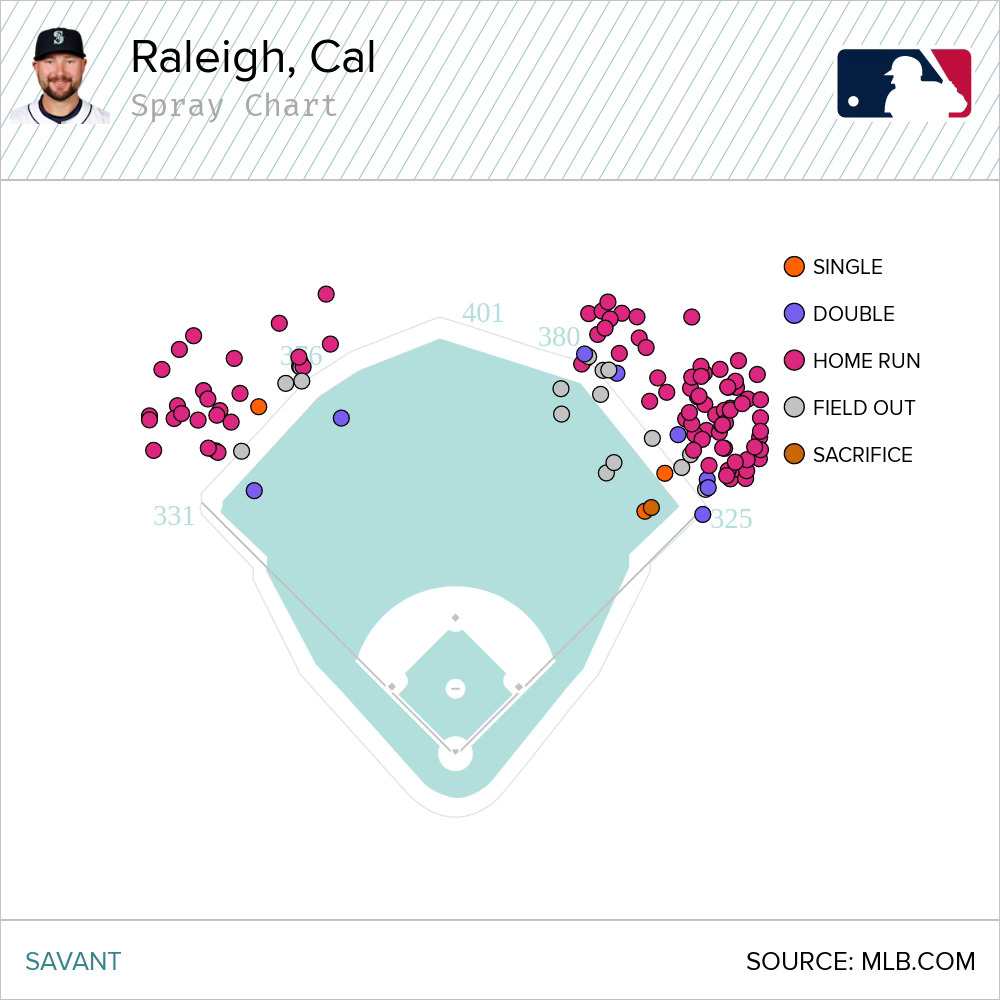
The elite hitters at this strategy manage to bring a homer-primed pull fly ball to fruition about 6% of their plate appearances, which would be about 36 times in a typical season. Raleigh and Ramírez are the clear leaders.
I’ve given Paredes a boost into the bronze spot because of how much of a difference his ability makes for his profile. The Astros third baseman (for now) is sixth by rate of pulling, but first in production over expected production (by Statcast’s estimation). He’s squeezing every ounce of value out of his own talents by being so good at this aspect of hitting.
The Bullpen
⚾⚾⚾⚾⚾⚾⚾⚾⚾⚾⚾⚾⚾⚾⚾
Unfortunately, “pitchers and catchers report” is becoming less a celebration of the impending season and more an opportunity for managers to reveal upsetting injuries — many of which happen to involve the tiny hamate bone at the base of the hand.
The hamate is an evolutionary boondoggle that is tiny, can be totally removed, and yet causes big problems for those trying to hitting baseballs.
A non-comprehensive list of guys to be sad and/or worried about, thus far:
- Diamondbacks outfielder Corbin Carroll (broken hamate bone, spring will be affected at the very least)
- Mets shortstop Francisco Lindor (stress reaction in hamate bone, could miss Opening Day)
- Braves pitcher Spencer Schwellenbach (elbow inflammation, will start season on the 60-day IL)
- Blue Jays pitcher Shane Bieber (forearm fatigue, implications unclear but not good)
- Blue Jays outfielder Anthony Santander (shoulder surgery, out most of the year)
- Orioles shortstop Jackson Holliday (broken hamate bone, same)
- Tigers pitcher Reese Olson (shoulder surgery, out for 2026)
⚾⚾⚾⚾⚾⚾⚾⚾⚾⚾⚾⚾⚾⚾⚾
The Red Sox and Brewers made a weird swap this week. With an unsettled infield following Alex Bregman’s departure, Boston acquired short, speedy Caleb Durbin — who finished third in NL Rookie of the Year voting last year, right after being acquired as part of a deal for Devin Williams — to start at either third base or second base. They also got depth infielders Andruw Monasterio and Anthony Seigler. They gave up pitchers Kyle Harrison and Shane Drohan, along with similar depth infielder David Hamilton.
There’s a whole line of questions to ask about the Red Sox.
But I want to focus on the Brewers, who are often characterized as having a schtick — including here, where I’ve written about their recent preference for short former second basemen. This winter, having logged the best record in baseball, they traded away two of the top four finishers in NL Rookie of the Year voting (Durbin and Isaac Collins) in pursuit of pitchers, mostly, in whom they presumably see potential.
The Brewers’ whole deal isn’t about short guys or rebound arms or contact hitters. It’s about ruthless opportunism and maximizing players’ potential.
It’s churning, sifting, looking for the most usable value they can pack onto a 40-man roster. I suppose, after acquiring Jett Williams in the Freddy Peralta trade, they figured Durbin might be expendable. Maybe this is step one and another move is on the way. Either way, the Brewers and top executive Matt Arnold, a Rays alum, seem to be operating in the way Tampa made famous, and doing it at a higher level (or at least in a more forgiving division).
I have always found this mode of operation to be a little grating, from a fan perspective, but the Brewers’ results — like the Rays a few years ago — are hard to argue against. Milwaukee does have points in its favor in a few long-term stars like Christian Yelich and Jackson Chourio.
I’m curious how Milwaukee fans weigh the roster turnover from an emotional perspective. Let me know. Leave a comment or email hellobandwagon@gmail.com if you have thoughts.
⚾⚾⚾⚾⚾⚾⚾⚾⚾⚾⚾⚾⚾⚾⚾
Ronald Acuña Jr. was one of the Latin American celebrities partying in the background of Bad Bunny’s epic Super Bowl halftime show.
The Braves MVP is one of many, many MLB players who have used the Puerto Rican music superstar’s songs as walk-up music.
Bad Bunny has featured in MLB events before. I remember thousands of teenage girls suddenly announcing their presence at the 2022 MLB All-Star festivities via piercing scream when Bad Bunny appeared at Dodger Stadium. If the league decides to add less-weird entertainment options around major events, he would be an obvious top target.
⚾⚾⚾⚾⚾⚾⚾⚾⚾⚾⚾⚾⚾⚾⚾
Justin Verlander is back with the Tigers on a one-year deal.
The signing makes cold, hard, calculating sense with the aforementioned Olson injury, but it also makes poetic sense with Verlander returning to Detroit as his career approaches the end (you’d think).
He will now share a rotation with Tarik Skubal and Framber Valdez, more than a decade after he fronted a bonkers 2014 Detroit rotation that included Max Scherzer and David Price. That staff wound up featuring five past or future Cy Young winners, with Rick Porcello, Robbie Ray also making starts.
⚾⚾⚾⚾⚾⚾⚾⚾⚾⚾⚾⚾⚾⚾⚾
Lastly, I wanted to take a second to talk about beat writers.
I mentioned the Washington Post layoffs last week, and shortly thereafter MLB.com also laid off Alex Stumpf, a longtime Pirates beat writer who has been one of the most valuable resources for following that team.
Beat writers do the often thankless work that makes this newsletter possible, that makes following a daily game in rich detail possible.
I thought it might be helpful to start a simple hub where Bandwagon readers can both populate beat writers who do the good work on their favorite team, and find the writers to follow for teams who might have fewer reporters on the beat or writers scrambling to set up new avenues to publish their work.
I started a Google Sheet, available for all to edit, to build out a list of active MLB beat writers. I started it with Mark Zuckerman, who has launched a newsletter to continue his work covering the Nationals. Add the beat writers you follow, and we’ll hopefully create a useful resource in trying times for baseball journalism.