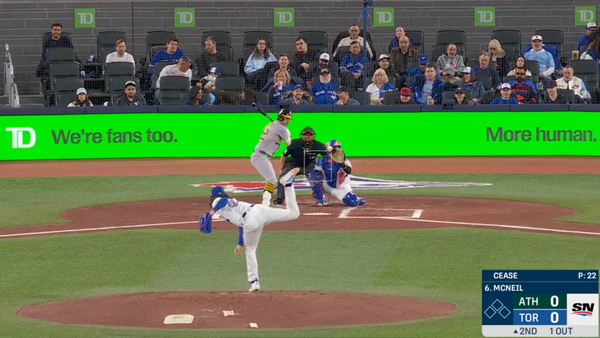
What would you call this pitch?
Let's name Tatsuya Imai's "slider" something that makes sense for fans.

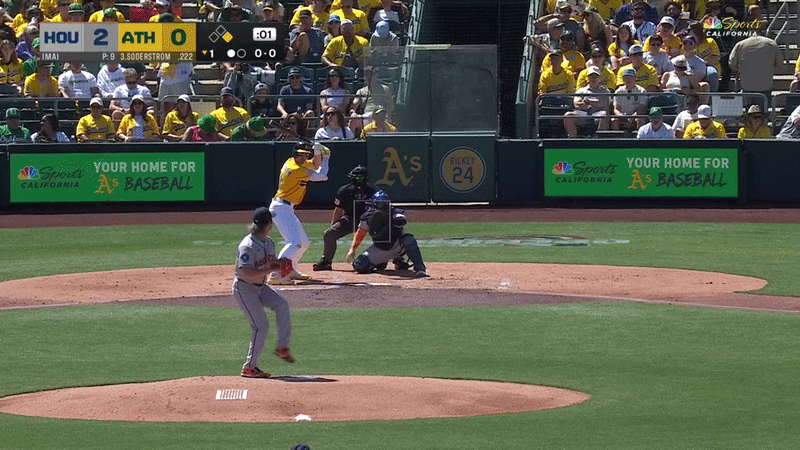
So the new Houston Astros starting pitcher Tatsuya Imai has made two starts in the big leagues. In the early going, he has leaned on two pitches, a four-seam fastball and a pitch that looks like this.
via Baseball Savant
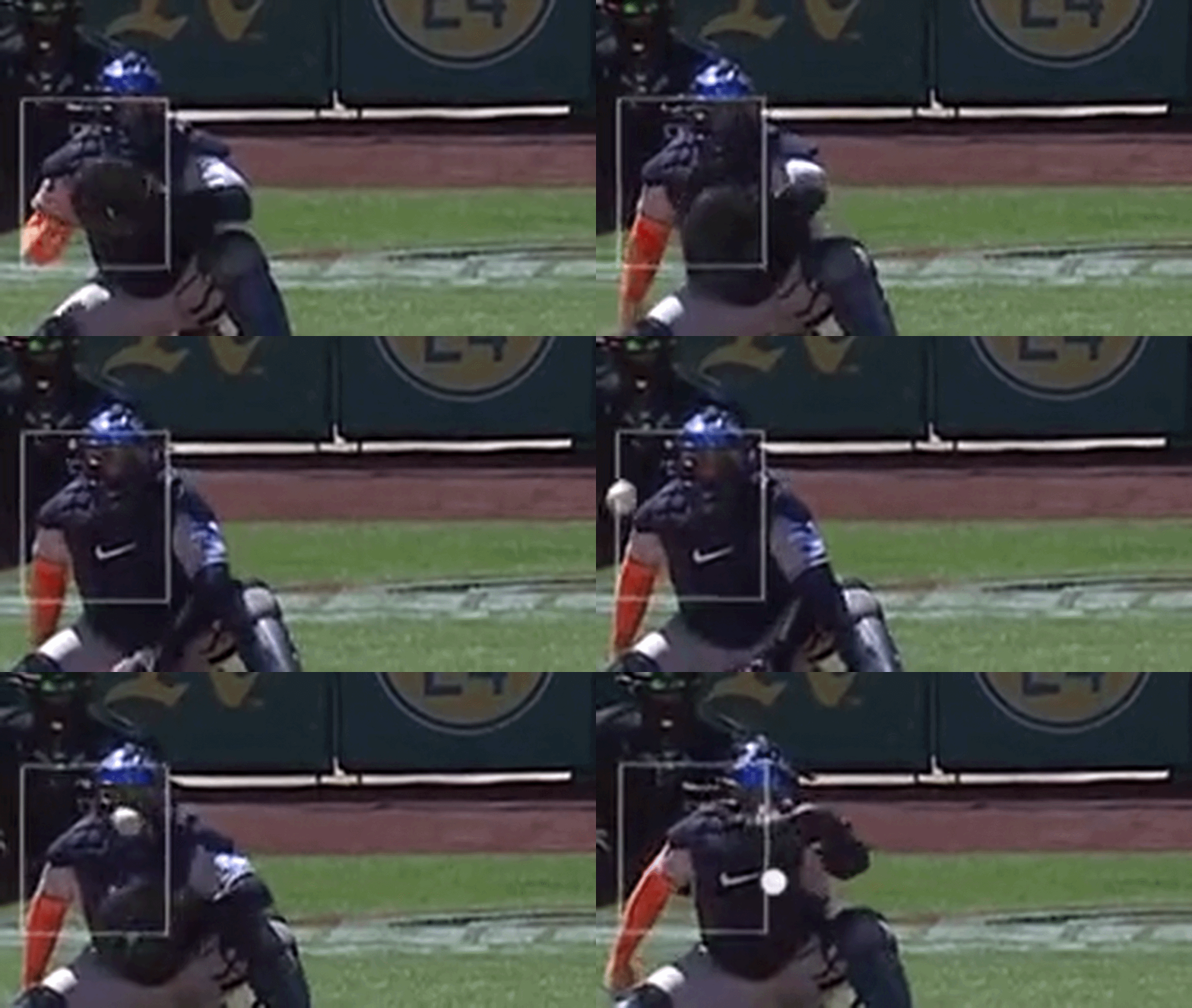
Here’s another look at it without that potentially distracting swing. It’s going 87 mph. You may notice that Imai is right-handed, and that the pitch bends toward his arm side as it flies toward the plate.
via Baseball Savant
If I were talking to a casual fan who asked what that pitch was, I’d say, “It’s really interesting, and rare. It moves like a changeup but has the spin of a breaking ball. It’s kind of like a screwball variation, but it’s thrown differently.”
If I were talking to a new fan or a kid trying to learn the game, well, I don’t know what I’d say. Because that thing is being called a slider. The common understanding of a slider is that it breaks toward a pitcher’s glove hand, so a right-handed pitcher’s slider typically dives away from a right-handed hitter. So this is generating interest for being a wrong-way slider, or a backward slider.
The baseball internet has been marveling at the pitch’s stateside debut. David Adler wrote a great deep dive on the novelty at MLB.com, PitchingNinja and Driveline are all over it, and it’s not a sudden development — MLB Network discussed it while scouting Imai over the winter.
Imai’s pitch is many things: Fascinating, visually stimulating, effective. But it’s not a slider.
Calling it one is deceptive, and not in the fun pitcher-batter duel way. In a sport captured and beamed to an audience of millions, the pitch is the drumbeat, the delineation of play, the most common thing that happens. And lumping that in with every other slider is a benign but unnecessary form of gaslighting. The name of a pitch should describe what happens in a narratively consistent manner, for the people watching, for the people who won’t already know the intent.
⚾⚾⚾
I must admit, there’s a good reason the experts and institutions that define and tag pitch types have labeled this a slider. It spins like one and it is thrown like one. A lot of pitches — more than you realize, I bet! — are named for how they are thrown, not what they do, because the first people who have to call them anything are the pitchers themselves.
Thus, the four-seam fastball and the two-seam, the split-finger fastball that became just splitter, the forkball, the knuckleball. The circle changeup’s modifier describes how the pitcher’s fingers are arranged on the ball. Even the cutter apparently got its name not from the tight glove-side movement we associate with it, but from the wrist movement — “as if cutting cheese” — used to produce the pitch. Research on the slider, perhaps the pitch with the most byzantine origin story, shows that even it was possibly named for the pitcher’s interaction with the ball. Per the Dickson Baseball Dictionary: “A modified curveball that is rolled, or slid, off the middle and/or index fingers, rather than spun hard.”
None of those words meant anything to the first fans who saw them travel from the mound to the plate, but we learned over many years to associate four-seamers with the gravity-defying “rising” action, and two-seamers became synonymous with sinker. With more detailed information and more finely tuned eyes on the ball, the catalog of pitch types has been plotted, defined and redefined. I wrote a guide to the state of arsenals in 2023 and there are already major updates to make.
When I posted wondering why Imai’s “slider” wouldn’t be more aptly dubbed a screwball, smart observers like FanGraphs’ Michael Rosen and PitchInfo founder / Baseball Prospectus research leader Harry Pavlidis responded with the very sound logic of why it doesn’t match the description. The rationale for the slider designation resides not in its distinctive flight path, but in the minute details of its grip and release. Imai is throwing it like a slider, creating the spin by supinating his arm. That’s the motion you’d do to throw a spiral with a football, releasing it off your index finger as your hand moves under the spinning ball. Pronation, on the other hand, is the less natural method most often used to throw changeups, the ball rolling of the pinky finger side as your hand moves over the ball.
Sliders are thrown with supination, screwballs with pronation; a supinated screwball doesn’t compute. Fair enough, but not satisfying. If you saw this ball travel its 60 feet, 6 inches without the pitcher in the frame, you would actually think it was a slider …
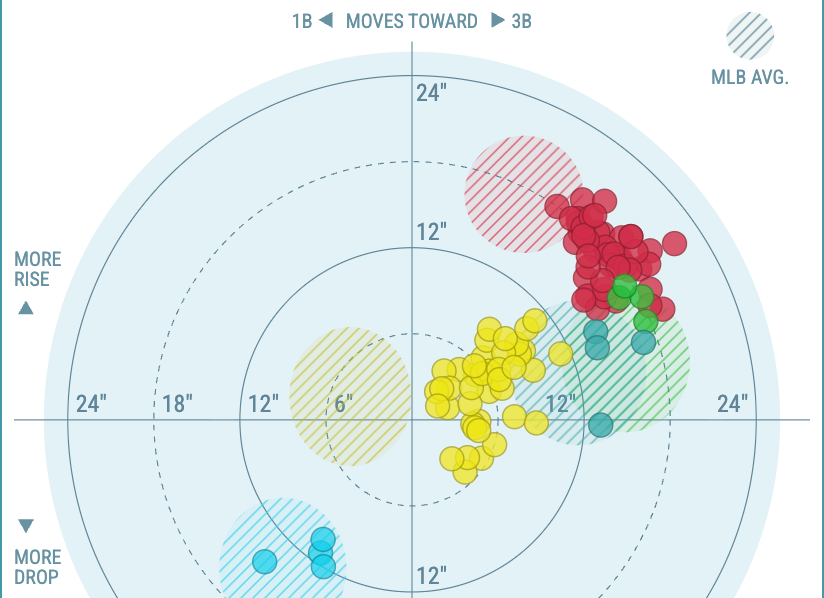
A left-handed slider. It sort of is! On a chart of how it moves relative to its starting point, and relative to the norms for each pitch type, look at the yellow dots representing the slider and the yellow dashed circle representing MLB's normal slider movement. That pitch's relationship to a normal slider is sort of like your relationship to your reflection in the mirror.
Using Statcast’s spin direction tracking, which visualizes the rotation of the baseball using a clock face, we can see Imai’s ball spins toward 2:30, and moves as if it is spinning toward 3:00. Its closest cousins are all left-handed sliders; Imai is throwing the only right-handed slider between midnight and 4:15. Upon realizing that Imai threw it, with his right hand, you’d have to conclude that either your video was accidentally flipped, or that we don’t have a good word for that.
⚾⚾⚾
Our current moment of constant experimentation and flux seems like a great time to break the inertia of naming a pitch for how it takes shape in the unseen hollow of a mitt. These pitches exist to wow us (and flummox hitters) with their airborne shapes. It only makes logical sense that the person throwing it musters the first name for a pitch, but they are the last person in the wider world who needs a description. These split-second delights are a show, a crucial element of an entertainment product for the masses.
Yet when a pitch doesn’t walk like a duck or talk like a duck, we’re still calling it a duck, because a study shows it technically shares the reproductive processes of a duck.
Why not call them like we see them?
Imai’s pitch is the most prominent, attention-grabbing example of this sort, but it isn’t the first and won’t be the last. A commitment to descriptive quality in pitch type naming could have been helpful in the occasional cases of other major leaguers throwing these strange benders that we had to call sliders. When Giants scribe Grant Brisbee encountered itinerant reliever Cory Abbott’s version, he wrote, “That most certainly does not look like a slider. That is a changeup, and Baseball Savant is broken. It’s the only explanation.”
He eventually had to fall in line, accepting its alien slider tag while appending his own description: “It’s like a cutter thrown by someone with gravity boots and hanging from a wall at a 45-degree angle.”
If you remember the craze over Daisuke Matsuzaka’s gyroball, you know that Japanese baseball culture has some descriptors that don’t line up easily with the usual American pitch types. The gyroball was essentially a pitch thrown like a slider that spun inefficiently, or without contributing directly to movement. In America we’d usually refer to that as a bullet slider. It actually travels almost perfectly straight, and a little down with the tug of gravity, yet that path can be disconcerting because it’s so unusual.
Japan might already a word for Imai’s offering, too, and I’d argue it is more necessary in this case than in Matsuzaka’s. The shuuto describes a hard pitch that bends in this backward-seeming direction. Its definition, at least in English-speaking formats, is a bit muddy and broad — perhaps including some two-seamers that aren’t what we’re getting at — but it’s a good start.
Two others to consider.
- Goofy slider: Borrowing the snowboarding world’s terminology for riding in an unexpected orientation. This would at least provide a format for future surprises of the opposite day variety. The screwball could be known as a “goofy curveball” and the submarine fastball that actually rises might be a “goofy sinker.”
- Slicer: A la the golf term for the same flight path. Courtesy Baseball Prospectus editor in chief Craig Goldstein.
By all means, watch the pitch and craft your own. The best descriptions begin in the eye of the beholder. ⚾
Bandwagon Support Drive 2026
While The Bandwagon is totally free to read, it’s far from free to create. If you enjoy the work here, please consider pledging your support.
- Become a Fan for just $4 a month or $40 a year.
- Become a Diehard supporter for $8 a month or $75 a year.
- Make a contribution in the amount of your choosing. Maybe $26 to power the newsletter through 2026.
- Forward this newsletter to a friend. The more fans, the merrier.
If you were a paying supporter on Substack, thank you. Please note: Your annual or monthly selection will not be automatically renewed, so be sure to choose your support level from the choices above.
The Bullpen
⚾⚾⚾⚾⚾⚾⚾⚾⚾⚾⚾
The Pirates and top prospect Konnor Griffin have agreed to a nine-year, $140 million deal. It’s basically a small nudge over Corbin Carroll’s deal, and the last in a rapid series of small intrigues that saw Griffin sent to the minors out of spring training but called up for the home opener.
Hopefully, it’s the start of a rich relationship between a player, a club and a city that deserves far more to root for than the franchise has provided lately.
⚾⚾⚾⚾⚾⚾⚾⚾⚾⚾⚾
Speaking of the start of relationships … Giants manager Tony Vitello is not off to a smooth start with the whole major leagues thing.
Vitello, hired away from the University of Tennessee after spending his career thus far in the college ranks, could perhaps use some professional media coaching. I like honesty. It’s the spice of life that sometimes gets smoothed over in high-stakes industries with lots of reporters milling about. But also, Vitello getting ejected in an MLB game, only to rant about a loss to Lipscomb (a small college in Nashville) and a coaching nemesis who he calls a cheater? That’s verging on oblivious to social cues.
I’m not going to throw the Giants’ sour early results at his feet just yet, but the stream of consciousness he’s allowing into the world is not inspiring confidence.
⚾⚾⚾⚾⚾⚾⚾⚾⚾⚾⚾
I imagine it might not be as funny to the kid involved, but I enjoy that Padres star Jackson Merrill takes his Rock, Paper, Scissors games seriously.
Late in the game, I saw Jackson Merrill turn around in the dugout and play a quick game of Rock, Paper, Scissors with a young kid in the stands. I asked him about it. The answer, as you can imagine, is perfect 😂 pic.twitter.com/vEbdDbuEny
— Annie Heilbrunn (@annieheilbrunn) April 2, 2026
⚾⚾⚾⚾⚾⚾⚾⚾⚾⚾⚾
If you can’t say something nice (or appropriate for television) …
"Ooh. Everybody okay down there?" - Jim Deshaies Boog Sciambi remained silent on this one after a full moon appeared at Tropicana Field.
— Awful Announcing (@awfulannouncing.bsky.social) 2026-04-08T01:43:21.321Z
Make like Cubs play-by-play announcer Boog Sciambi and don’t say anything at all.
Pledge your support to keep The Bandwagon going in 2026