Munetaka Murakami is a certain type of slugger
A lot of outcomes could be true.

I don’t know if Munetaka Murakami is awesome, in the sense of lasting productivity, but he’s definitely inspiring some awe.
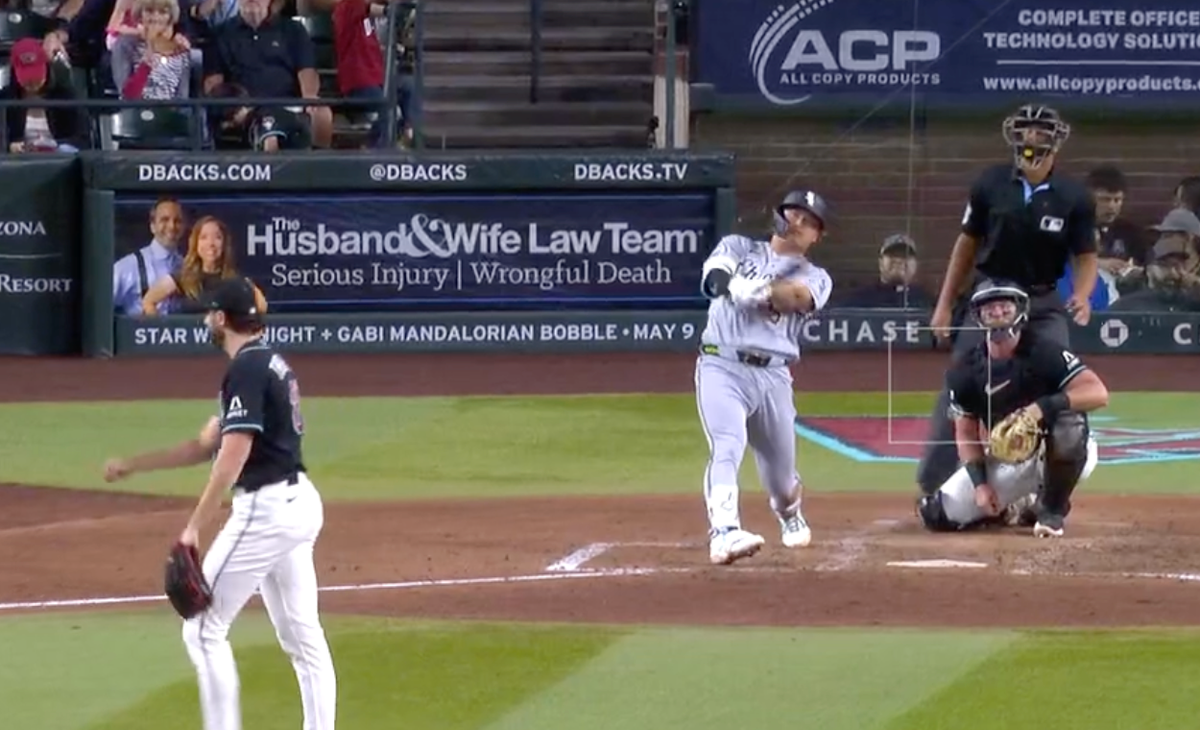
A little over a month into the Japanese slugger’s stateside debut with the Chicago White Sox, his 14 home runs rank second in MLB. Several of them have been of the “stop what you’re doing and watch this dinger” variety. Just this week, he blasted a well-located 98 mph high heater from Jose Soriano into the next zip code. But my favorite might be the one he smashed over an imposing batter’s eye in Sacramento.
via Baseball Savant
In the interlude between thunderous dingers, you might stop to notice that he’s batting a tolerable .237. That he’s drawing plenty of walks and little attention to his defense. That he has begun adjusting to major-league breaking balls. By wRC+, the park-adjusted metric gauging offensive performance, his 152 (or 52% better than MLB average) makes him a top 15 hitter in baseball thus far, in league with Bryce Harper and Max Muncy. That the White Sox are flirting with .500.
It all amounts to a real positive buzz around the South Side’s team for the first time in years. So snagging Murakami on a two-year deal after his market sagged under contact concerns might already count as a win, but trying to adjudicate the ultimate value of his contract misses the richer plot developing.
One thing seems clear and relatively permanent: Murakami is a certain Type of Guy. He’s the type of guy who might hit 50 homers in a season, or bat .190 in a season, or do both in the same season. He’s the type of guy who could produce either a screaming missile or a cloud-moving wind every time he loads and swings.
Thrilling when he hits, crushing when he misses, captivating at all times because of the existential chasm between the two. You’re already thinking of the other guys who are this Type of Guy. Hold that thought for one second.
To sketch the outline of this Type of Guy for those who perhaps haven’t been plugged into news of the White Sox, let’s break down Murakami’s 156 plate appearances. Murakami has 14 homers, as you’ll recall, which comprises about 9% of his trips to the plate. He has 17 other hits. Of those, 16 are singles. He managed his first double less than a week ago. He has walked 28 times (18%), struck out 55 times (about 34%) and hit a ball that defenders turned into an out just 46 times. A hair under 60% of his ventures to the batter’s box end without a fielder’s involvement, via one of the Three True Outcomes (strikeout, walk or homer).
If you were introduced to baseball by the 2026 season in a vacuum — like the newbie learning a board game in a remote cabin — you’d conclude that a pitcher is more likely to retire Murakami by striking him out than by recording an out against him in the field, and that this is a very notable trait. Whether it’s more superpower or Kryptonite would be less apparent.
That’s the story with this Type of Guy. It’s all or nothing, but there’s always the hope (or worry) that tomorrow will be the opposite.
We have a long way to go before we know enough about Murakami to say whether he’s going to homer enough to make the strikeouts a reasonable price to pay, but we can already see his lineage.
Take a look at the batters who have tallied at least 2,000 MLB plate appearances with 45% or more of them ending in one of the three true outcomes. This is the whole list back to 1901, though you won’t find any names that stretch your historical knowledge.
A select few make this list thanks to power and patience so prodigious that they deposited themselves in the game’s history books, or are in the process of doing so. Judge, Thome, McGwire and Stanton are a cut (or several cuts) above.
The rest had to walk a tightrope of sorts, if you can imagine any of these barrel-chested gentlemen doing such a thing. For all the simplicity of the ternary results, there are a lot of ways Murakami’s blend of skills and shortcomings could go.
Rangers fans lived the roller coaster with Joey Gallo. It wasn’t that long ago that the Cubs non-tendered Kyle Schwarber after he logged a sub-.200 batting average in 2020. Chris Davis streaked across the Baltimore sky like a meteor, then burst into flames and fizzled out. Others, like Adam Dunn and Russell Branyan, struggled to have their oddly shaped skillsets appreciated, even at their best.
A great many, including several recent alums of the Japanese league, have fallen too hard to sustain careers at the MLB level.
Murakami is starting off on a high note because so many of his walloped fly balls are leaving the yard, but that rate won’t hold. He won’t turn 38% of fly balls into homers. He won’t have 14 of 15 extra-base hits become homers — Trent Grisham last year became the first hitter since Frank Thomas in 2006 to have more than 75% of his extra-base hits in a full season be homers.
Meanwhile, Murakami’s 59.3% contact rate just can’t hold. Only Gallo, in 2017, has managed a contact rate that low across a full season in the pitch tracking era (which stretches back to 2008).
He has ways to combat the vulnerabilities. Murakami, like teammate Miguel Vargas, is posting a very low (read: very good) chase rate. So with that discipline, he can keep walking even if the home run flood slows to a drip at some point next month or next year or on his next contract.
In a matter of weeks, he has demonstrated what he can do to major-league pitches. He can put on a show. Now we wait, and hope that Murakami can walk the tightrope long enough to be another good outcome for this type of guy. ⚾️
The Bullpen
⚾⚾⚾⚾⚾⚾⚾⚾⚾⚾⚾
Tarik Skubal is on the injured list and having surgery to remove loose bodies in his elbow. The two-time reigning AL Cy Young winner, and impending crown jewel of the free agent class, is hopefully going to return in two or three months, though that seems optimistic.
This is a seismic injury for the Tigers and the AL Central race. We can only hope it’s not a seismic injury for Skubal’s longer term status.
⚾⚾⚾⚾⚾⚾⚾⚾⚾⚾⚾
Elsewhere in the Detroit rotation, someone should tell Framber Valdez to at least use a pitch he actually throws when he decides to bean an opposing hitter.
Also!
— Céspedes Family BBQ (@CespedesBBQ) May 6, 2026
The pitch Framber hit Story with was classified as a four-seam fastball, the first four-seamer Framber has thrown all season.
That feels like more than coincidence to me. https://t.co/emRiuZnzse
⚾⚾⚾⚾⚾⚾⚾⚾⚾⚾⚾
Growing up in Richmond, Virginia, the Braves were everywhere. That’s partially because the Triple-A team, the Richmond Braves, called the city home for so long. But it’s also because of TBS, and Ted Turner.
The maverick media mogul — who led a madcap life in many spheres — died Thursday at 87. He turned his father’s billboard company into an empire that saw baseball as an entertainment product and promoted itself as such. He took over as manager for one game before MLB told him he couldn’t manage a team he owned. He tried to emblazon “Channel” on the uniform of the player who wore No. 17, to promote his TV station.
Which brings us back to TBS. Before MLB.TV and the corporatized structure of regional networks, you could come home from school to watch the Cubs on WGN in the afternoon and the Braves at night on TBS. Even though I didn’t consider myself a Braves fan, their wildly successful 90s and 2000s teams were the foundation of my baseball diet, from Chipper Jones and Greg Maddux down to momentary Richmond stars Tim Spooneybarger and Wes Helms.
I understand why it changed, why it behooves the league to shave off the edges, but the foresight and competitive spirit to build the best team to make people watch your TV channel is exactly the energy a sports team owner should possess.
Not many do. And maybe none possessed it quite like Turner.
⚾⚾⚾⚾⚾⚾⚾⚾⚾⚾⚾
The legendary Yankees broadcaster John Sterling died earlier this week, also at age 87.
Overflowing with enthusiasm, he shared it with a huge audience through personalized home run calls, his bellowing “Theee Yankees win!” tagline and commitment. At one point he broadcasted 5,060 consecutive games, the voice of the era’s most dominant team. And for many, just the voice of the sport.
⚾⚾⚾⚾⚾⚾⚾⚾⚾⚾⚾
You don’t expect to go to a game, sit behind home plate and catch a pitch that was not foul ball. But that happened for a Mariners fan the other night.
Braves pitcher Bryce Elder managed to throw a pitch bounced hard in the dirt, ricocheted off the umpire’s mask and vaulted over the backstop netting.
via Baseball Savant
You can see the fans turn and watch it. That’s gotta be a rarity.
⚾⚾⚾⚾⚾⚾⚾⚾⚾⚾⚾
Baseball, the sport experiencing a cultural boost from trimming the fat to fit the speed of modern attention, can also be part of the solution for folks who want to slow down that attention carousel.
Keeping score can introduce “friction.” Allow Sportico’s Jacob Feldman to explain:
Of course, the functional purpose of tracking hits, runs and fielder’s choices is beyond outdated. Anyone can instantly look at play-by-play data for every MLB game going back to the 19th century. But the old-school act of putting pencil to paper is booming, seemingly for the same reasons baseball itself is claiming converts: In our hyper-connected digital age, people are yearning for a bit of the phone-free, slowed down, single-tasking past. An afternoon at the park, notebook in hand, offers exactly that.
⚾⚾⚾⚾⚾⚾⚾⚾⚾⚾⚾
Made it this far? You must be a fan. If you enjoy the work here, please consider pledging your support to help maintain The Bandwagon as a viable project.
- Become a Fan for just $4 a month or $40 a year.
- Become a Diehard supporter for $8 a month or $75 a year.
- Make a contribution in the amount of your choosing. Maybe $26 to power the newsletter through 2026.
- Forward this newsletter to a friend. The more fans, the merrier.